Blog
Blog  03-Aug-2026
.svg) 27,930
27,930 

The proprietary trading landscape has experienced explosive growth over the last few years, but the glaring absence of traditional financial oversight from regulatory bodies—such as the SEC, FCA, or ASIC—leaves many traders asking a critical question: What legal protection do traders actually have when participating in an unregulated market?
The short answer is that being unregulated by financial retail authorities is not the same as operating in a lawless space. Under the law, the relationship between a funded trader and a prop firm is not categorized as a brokerage-investor relationship, but rather as a commercial service contract.
This article breaks down the legal architecture of the prop trading industry, the real enforcement tools available to traders, and how emerging tech infrastructure is rewriting the rules of trader protection.
Financial Law vs. Commercial Contract Law
Most proprietary trading firms offer simulated accounts to evaluate risk management and trading execution. Because these firms do not accept client deposits for live market investment, they do not fall under the mandate of traditional financial conduct authorities.
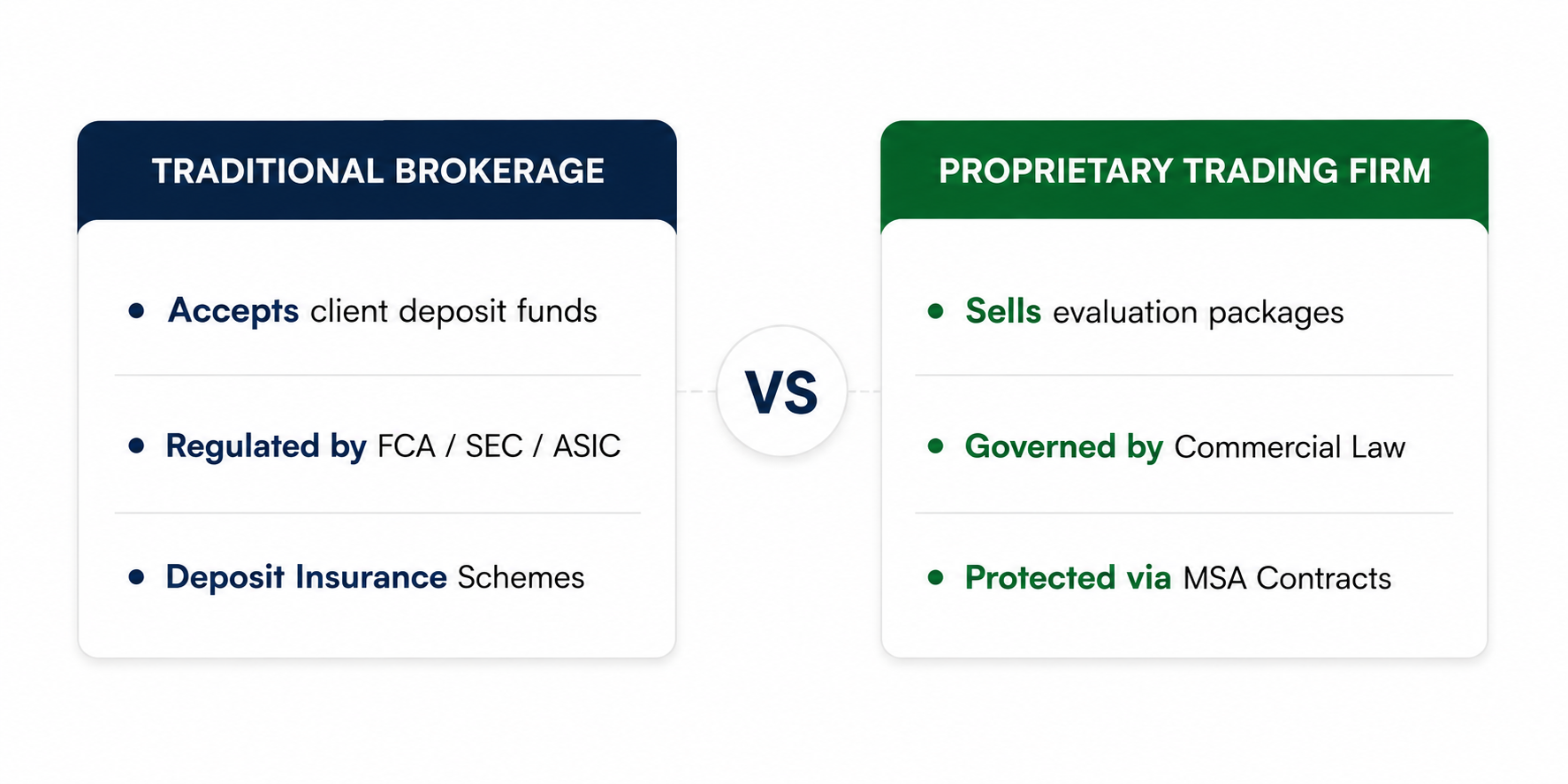
While traders do not enjoy statutory investor protection funds (such as the UK’s FSCS or the US’s SIPC), they are fully protected under Commercial Contract Law within the jurisdiction where the prop firm is incorporated.
Actual Legal Safeguards Available to Traders
When payout disputes arise or accounts are flagged, traders do not rely on financial ombudsmen. Instead, their legal standing rests on three primary pillars:
A. Mechanical Service Agreements (MSA)
When you pass a evaluation or activate a funded account, you sign a binding electronic contract—a Mechanical Service Agreement (MSA) or Trader Agreement.
-
Legal Enforcement: This document legally locks the rule parameters (drawdown limits, profit split tiers, hold-time rules) at the moment of account activation.
-
Trader Protection: Once executed, the firm cannot unilaterally change risk rules or retroactively ban trading styles (e.g., news trading or scalping). Any retroactive denial of payouts based on newly invented rules constitutes a clear Breach of Contract.
B. Immutable On-Chain Ledger Proofs
Modern prop firms are shifting away from internal, closed-door databases toward public blockchain integration for payouts.
-
Verifiable Data: Payout executions generated via smart contracts emit a permanent, tamper-proof transaction hash on public blockchains (e.g., Ethereum, Polygon).
-
Elimination of Subjective Discretion: On-chain data acts as an independent cryptographic audit trail. If your trading execution respects the automated hard risk boundaries, the smart contract triggers the release of funds, bypassing the risk of subjective “discretionary reviews” by internal compliance officers.
C. International Commercial Jurisdiction
Reputable prop firms register in recognized international business hubs (such as Dubai, Singapore, or the EU). Contractual disputes are subject to the commercial courts or international arbitration centers of those jurisdictions, giving traders legal recourse against fraudulent non-payment.
Structural Comparison: Legacy vs. Automated Architecture
The strength of a trader’s protection depends heavily on the operational model of the prop firm:
Because there is no central ombudsman to file complaints with, traders must take proactive measures to secure their legal standing:
-
Review the Signed Agreement (MSA), Not Just the Landing Page: Ensure all key terms—such as consistency ratios, news blackout rules, and payout windows—are explicitly defined in the enforceable legal agreement.
-
Prioritize Verifiable Payout Systems: Choose firms that offer verifiable on-chain ledgers or third-party audited payout reports rather than unverified platform screenshots.
-
Maintain Comprehensive Trade Logs: Export your trade receipts, execution logs, and account status confirmation emails regularly. In the event of a technical glitch or slippage dispute, these logs serve as vital evidence under contract law.
Final Verdict
The lack of traditional financial regulation in the prop firm sector does not leave traders defenseless. Your true legal protection stems from Commercial Contract Law and the industry’s adoption of immutable smart contract technology. By partnering with firms that operate under legally binding MSAs and verified on-chain mechanics, traders can effectively neutralize discretionary risk and trade with structural confidence.
Frequent Asked Questions