News & Events
  26-Apr-2026
.svg) 91,105
91,105 

Introduction
For most of the past decade, getting funded as a retail trader followed the same path: pay an evaluation fee upfront, pass a multi-phase challenge, and hope to reach a payout before running into one of the many rules designed to protect the firm. The economics worked because failure rates were high. Industry data suggests only 1 to 2 percent of traders who start a challenge ever receive a payout.
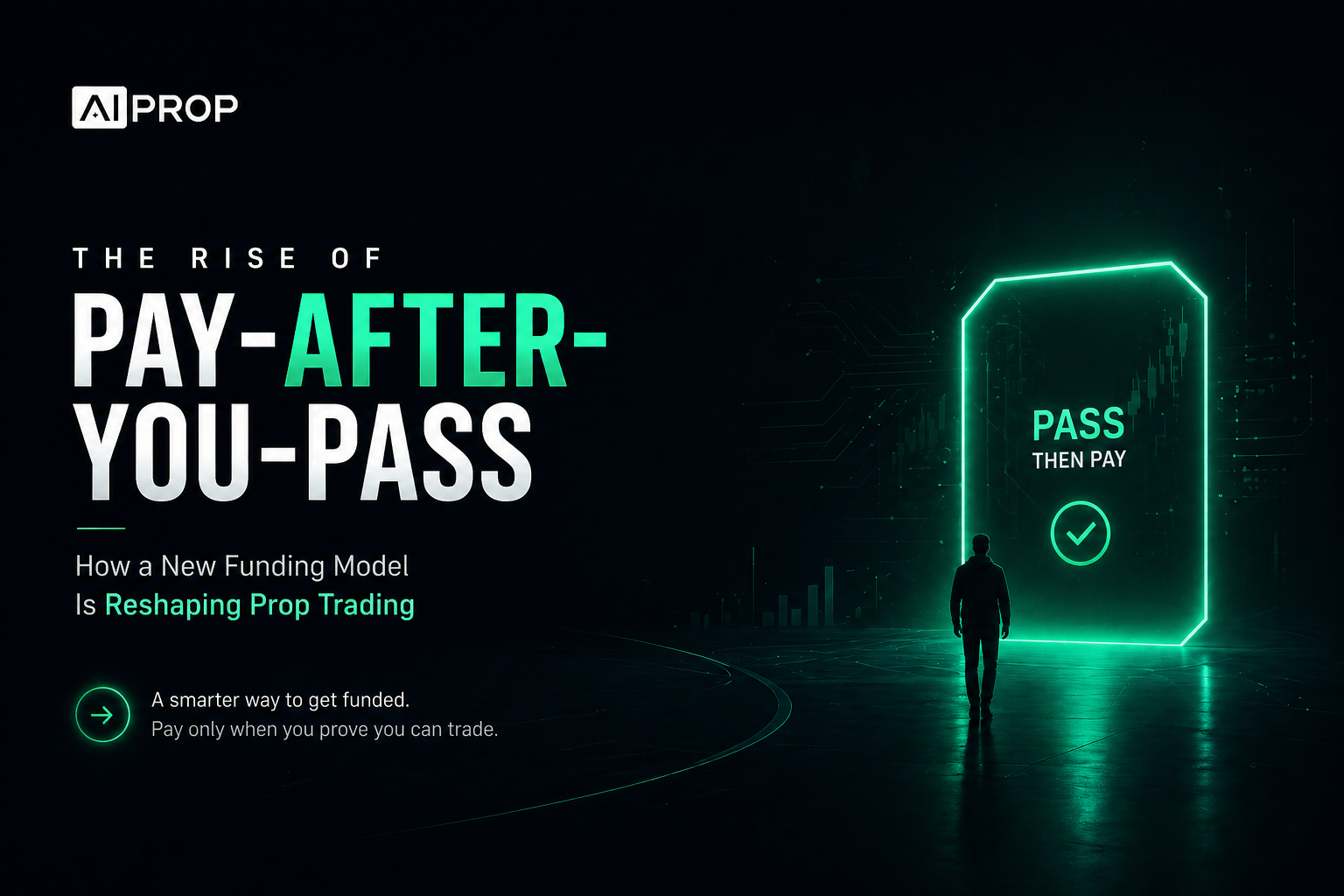
That model is now being challenged by a new commercial structure. It is called Pass-First-Pay-Later (PFPL), or Pay-after-you-pass, and at least ten firms now operate an active version of it.
What Is Pay-After-You-Pass?
Under the traditional model, a trader pays the full evaluation fee before taking the first trade. Whether they pass or fail, the firm keeps the fee.
Pay-after-you-pass flips the timing. The trader pays a small access fee to begin, typically in the $1 to $19 range, and settles the remaining evaluation fee only after passing. Failing the challenge costs nothing beyond the initial access fee.
The key point is that PFPL does not eliminate the cost of prop trading. It defers it. The total commitment a trader pays if they pass is often similar to, or slightly higher than, a traditional upfront challenge. What changes is the risk exposure before success. A trader attempting a PFPL challenge has roughly one to two percent of their capital at stake during the evaluation phase, compared with the full fee under the old model.
For traders, the implications are practical. They can attempt more challenges with the same budget. They can try a new firm without committing several hundred dollars upfront. And the firm has, at least partially, aligned its revenue with trader progression rather than trader failure.
What the Research Found
A recent benchmark study compared nine firms with active PFPL programmes across pricing, rules, infrastructure, and affiliate economics. Four patterns stood out.
Access fees are converging
Most firms have settled into a narrow entry-fee band of $1 to $9. The gap between a $1 and $9 access fee is not commercially meaningful for most traders. The category is commodifying on this dimension, which means future competition will need to happen elsewhere.
Total commitment is the real cost story
The headline access fee is not what a successful trader actually pays. The post-pass fee is where firms recover their margin. Across the benchmark set, total commitment at the $100K account tier ranges from roughly $244 for promotional offers to $1,388 at the premium end. For traders confident they will pass, the post-pass fee is the number that matters.
Capital ceilings differ widely
PFPL programmes cluster around $100K maximum funding at the entry level. One firm in the benchmark set offers PFPL accounts up to $400K, and one extends the model to $1M. For high-capital traders, the choice narrows quickly.
Infrastructure is where firms are diverging
Most PFPL firms offer comparable execution and analytics tools. The real differentiation is emerging in a newer category: behavioural tools. AI-driven coaching, automated trade journaling, and live behavioural metrics are not yet standard, and the gap between firms that publish them and firms that do not is widening.
Where AIProp Stands
Among the benchmark firms, AIProp lands in an interesting position. It is not the cheapest. Its access fee starts at $19, above the $1 to $9 floor most competitors have adopted, and its total commitment at $100K is higher than the field.
What AIProp offers in return is infrastructure depth. The firm publishes a behavioural-tool stack that includes an AI Coach, automated journaling, and live behavioural metrics on the trader dashboard. None of the other benchmark PFPL firms publish an equivalent system.
On the competitive scorecard, AIProp ranks first but by a narrow margin, just 0.65 points above Goat Funded Trader (8.50 vs 7.85). The two firms compete on different strengths. AIProp pulls ahead on infrastructure and affiliate design. Goat Funded Trader counters with category-leading affordability and solid infrastructure and affiliate economics of its own.
The rest of the benchmarked field sits in a clear second tier. Atlas Funded, AquaFunded, and FTUK Flex score between 6.60 and 6.80, competitive on affordability but trailing the two leaders across infrastructure and affiliate economics.
This is a two-horse race, not a runaway lead. The narrowness of AIProp’s position is the point. It is a credible edge won against a real competitor, not a default win over a weak field.
What This Means for Traders
PFPL is not the right model for every trader.
The model benefits traders who:
- Want to test a firm’s rules and execution before committing full fees
- Have limited capital to spread across multiple challenge attempts
- Are confident their strategy will pass the evaluation
It is less suited for traders who:
- Want the lowest possible total cost regardless of timing
- Prefer a firm with a multi-year operating history
For traders choosing within the PFPL category, the decision tree is reasonably clear. Cost-minimisers will find the cheapest options among the $1 to $9 entry-fee firms. Traders who prioritise rule flexibility, capital scale, or infrastructure should look at the higher-priced end of the market.
One practical takeaway: do not evaluate PFPL firms on access fee alone. The post-pass fee is the larger number, and it varies by roughly 5x across the benchmark set at the $100K tier.
What This Means for Affiliates
The PFPL shift also changes affiliate economics. Affiliate programmes are one of the primary acquisition channels for prop firms, and the structure of commission payouts varies more widely than many in the industry realise.
At the category-leading end, some firms pay entry commissions around 5 to 8 percent, rising to 15 to 20 percent for top-tier partners with very high referral volumes. AIProp operates a three-tier structure with a 15 percent entry commission, rising to 21 percent at high volume, plus multi-tier overrides on affiliate-recruited affiliates.
For content creators, trading educators, and partners who recruit other affiliates, the differences are material. A single tier upgrade or override rate can shift annual earnings by tens of thousands of dollars at scale. The commercial logic is that prop firms acquiring traders through sophisticated affiliate networks can afford more aggressive commission structures than firms relying on paid advertising alone.
As the PFPL category matures, affiliate design may become as strategically important as pricing or rules.
The Bigger Picture
Pay-after-you-pass is not a settled model. The category is only a few years old, and the long-run economics have not yet been tested through a prolonged market downturn.
What is clear is that the traditional model is no longer the only option. Traders who previously paid $500 upfront for a chance at a funded account can now pay $5 to start and keep their capital committed elsewhere until they pass. Firms that once built revenue around challenge failure now have to decide how much of their economics to tie to trader success.
PFPL will not replace the upfront-fee model overnight. But it has introduced genuine commercial competition to a category that had been static for a decade, and the firms building infrastructure on top of the new model are starting to separate themselves from the firms competing on entry fee alone.
For traders, that is a meaningful improvement. For the industry, it is the beginning of a more mature competitive landscape.
Read more at https://aiprop.com/research/pass-first-pay-later/