Blog
 27-Oct-2026
 4,180


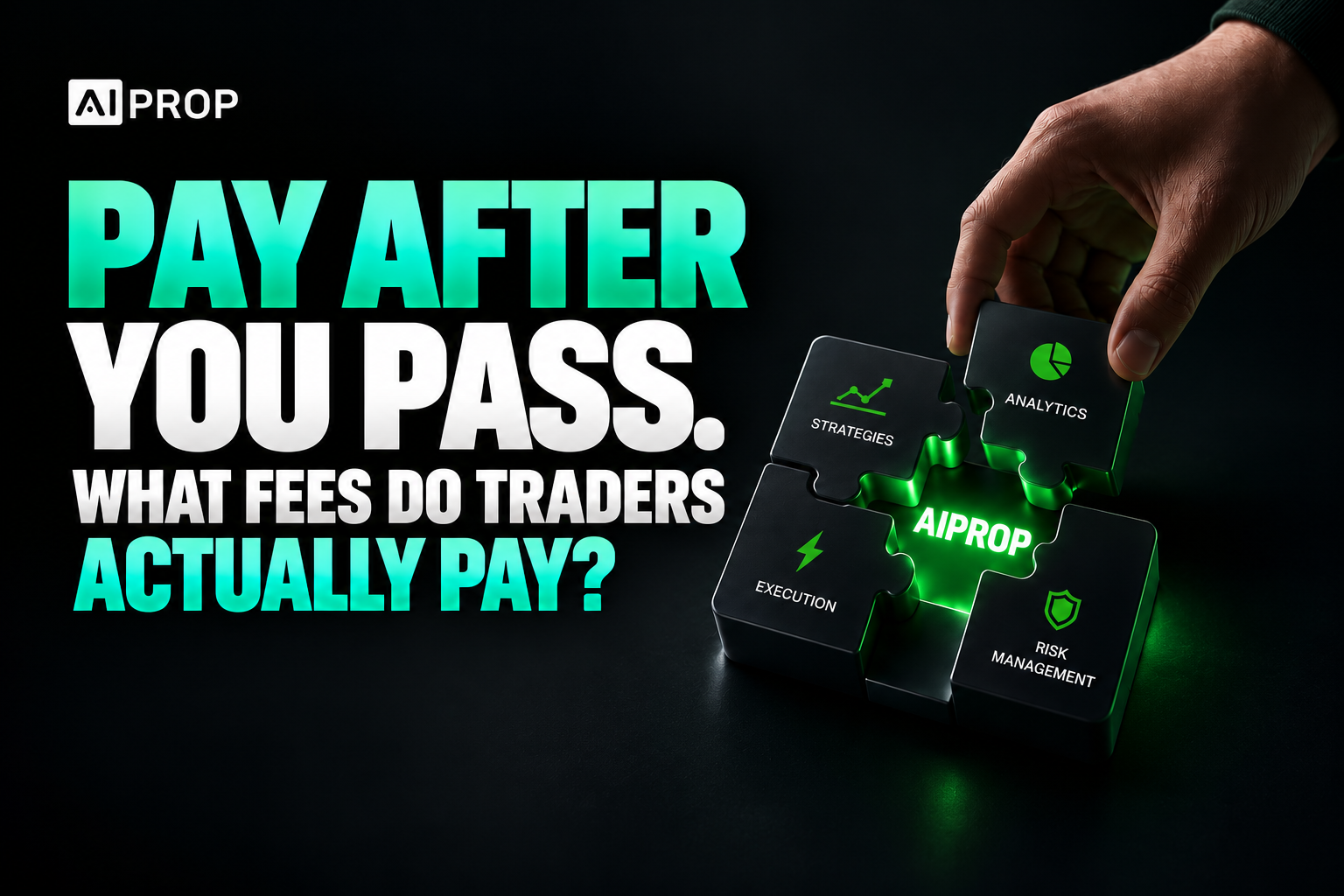
Summary: A small entry fee can make a prop firm challenge look inexpensive. But the amount needed to start may be only part of the cost of reaching the next account stage. Pay after you pass changes when traders pay. It does not automatically remove the evaluation fee or make the overall programme cheaper. Before choosing a challenge, separate the cost of entering, the payment due after passing, and any additional costs associated with further attempts or account use.
What Does Pay After You Pass Mean?
Pay after you pass, also called pass first pay later, is a deferred-fee challenge structure. In AI Prop’s published description, traders pay a smaller amount to enter an evaluation, then pay the remaining fee after successfully passing to activate the funded stage.
Think of it as two payment checkpoints: access to the assessment, followed by activation after approval. Passing and receiving a payout are separate milestones. An evaluation result should not be treated as money available to cover the next fee.
AI Prop’s website disclosure also identifies its service accounts as simulated. A displayed account balance is therefore not cash transferred into a trader’s personal bank account.
The payment journey
Two payments. Separate milestones.
PAYMENT CHECKPOINT 01
Initial access fee
Pay to enter the evaluation.
EVALUATION MILESTONE
Pass the assessment
Meet the applicable rules and review requirements.
PAYMENT CHECKPOINT 02
Post-pass payment
Pay the remaining amount to activate the next stage.
After activation: reward eligibility still depends on the applicable conditions. Passing does not guarantee a payout.
Which Fees Should Traders Check?
1. The Initial Access Fee
This is the amount paid to begin the challenge. Check the selected account size, programme name, and checkout total rather than relying on a “starting from” headline.
Also check what the purchase covers: one attempt, a fixed access period, or another arrangement. Those details determine what happens if the evaluation ends unsuccessfully.
2. The Post-Pass or Activation Fee
This is the payment required after a successful assessment to move into the next account stage. AI Prop describes the remaining evaluation payment on its pricing page. Its earlier explanation of the model also discusses activation fees and the cash-flow pressure they can create.
Before entering, establish:
- The exact remaining amount.
- When payment becomes due.
- Whether the initial fee is credited against the quoted total.
- Whether payment can be deducted from a future reward or must be paid separately.
Do not assume that a fee payable after passing is also payable after receiving a payout. Ask for written clarification if the payment sequence is unclear.
3. Additional Attempts and Resets
A low access price can become a larger expense if you purchase several attempts. Check whether an unsuccessful challenge requires a fresh purchase, whether resets are available, and what either option costs. Do not assume that free retries are included.
Your personal cost calculation should include earlier unsuccessful attempts, even if the firm’s advertised price describes only one attempt.
4. Trading Costs and Optional Extras
Separate payments made to join the programme from costs reflected in trading performance. AI Prop’s general 1-Step help page says commissions and swap fees are included in its calculations, and lists optional checkout upgrades. That page concerns the general 1-Step programme; it does not establish the same charges or options for PFPL.
For the specific PFPL plan, check:
- Applicable spreads, commissions, and overnight financing.
- Any platform or subscription charges.
- The price and purpose of optional upgrades.
- Whether your payment provider adds currency-conversion or transaction charges.
These are verification questions, not a claim that AI Prop charges every item.
How Do You Calculate the Total Cost?
Use two separate calculations:
Programme payments = access fees for all purchased attempts + post-pass payment + other applicable programme charges.
Net reward received = approved reward after the contractual split − applicable payout or payment-provider charges.
Trading costs may already be reflected in the performance figure used to calculate a reward. Avoid subtracting the same expense twice.
This distinction helps answer two different questions: how much you pay to participate, and how much money you actually receive if you qualify for a payout.
Follow the money
What you pay vs. what you receive
MONEY OUT
MONEY IN, IF ELIGIBLE
What Does AI Prop Currently Disclose?
At the time of review, AI Prop’s public pricing page displayed a $109 initial fee for a $100K account and described a further evaluation payment after passing. The retrieved page did not provide a complete, independently checkable PFPL total for every account size. Confirm the selected plan and final checkout before purchase.
For historical context, AI Prop Research Hub’s April 2026 report recorded a $79 access fee and a $1,388 total commitment at the $100K tier. Those are dated research figures, not a current checkout quotation. The report also stated that recurring maintenance fees were not disclosed at its cut-off. Absence of a disclosed fee in an older report is not confirmation that no such charge applies today.
AI Prop’s published refund policy states that purchased services are non-refundable. Do not budget on recovering a fee after failing or deciding not to continue.
Is Pay After You Pass Cheaper Than Paying Upfront?
Compare the full route to activation, not just the first payment. A deferred structure can reduce the amount committed before demonstrating your ability. However, it can still involve a larger overall payment for someone who passes.
Compare equivalent account sizes, total fees, trading rules, included tools, and payout conditions. A lower purchase price alone does not establish that two programmes offer equivalent terms. Plan for the activation payment before starting. That gives you room to evaluate the next step without making a rushed decision simply because you have already passed.
Compare payment timing
A smaller first payment is only part of the picture
Upfront structure
BEFORE EVALUATION
Pay after you pass
BEFORE EVALUATION
AFTER PASSING
Compare the complete route: total fees, repeat attempts, trading rules, included tools, and reward conditions.
Frequently Asked Questions
Is pay after you pass free?
Not necessarily. AI Prop describes an initial access payment followed by a remaining evaluation payment after passing.
Do I receive money as soon as I pass?
Passing an assessment is not a payout. Activation, review, and the relevant reward conditions are separate steps.
Do I pay the remaining fee if I fail?
AI Prop’s April 2026 PFPL research describes the remaining payment as conditional on passing. Check the current plan terms, including the cost of another attempt.
Are challenge fees refundable?
AI Prop’s published policy states that service purchases are non-refundable. Review that policy before ordering.
Can the post-pass fee come out of my first payout?
Do not assume this. Obtain confirmation of the payment method and timing for your selected programme before entering.
Review the Full Fee Structure Before Choosing
To assess a pay-after-you-pass challenge, identify what you pay now, what becomes payable after passing, and what an unsuccessful attempt would cost. Review AI Prop’s pricing alongside its terms and conditions and refund policy. If the selected plan does not show the complete payment sequence clearly, request clarification before purchasing.
For informational purposes only. Fees, programme availability, and conditions may change. Participation does not guarantee a payout.