Blog
 29-Oct-2026
 4,370



What Percentage of Your Account Is $100 a Day?
Before talking about strategy, look at the simple division. The smaller the account, the more unrealistic the daily return you need to achieve.
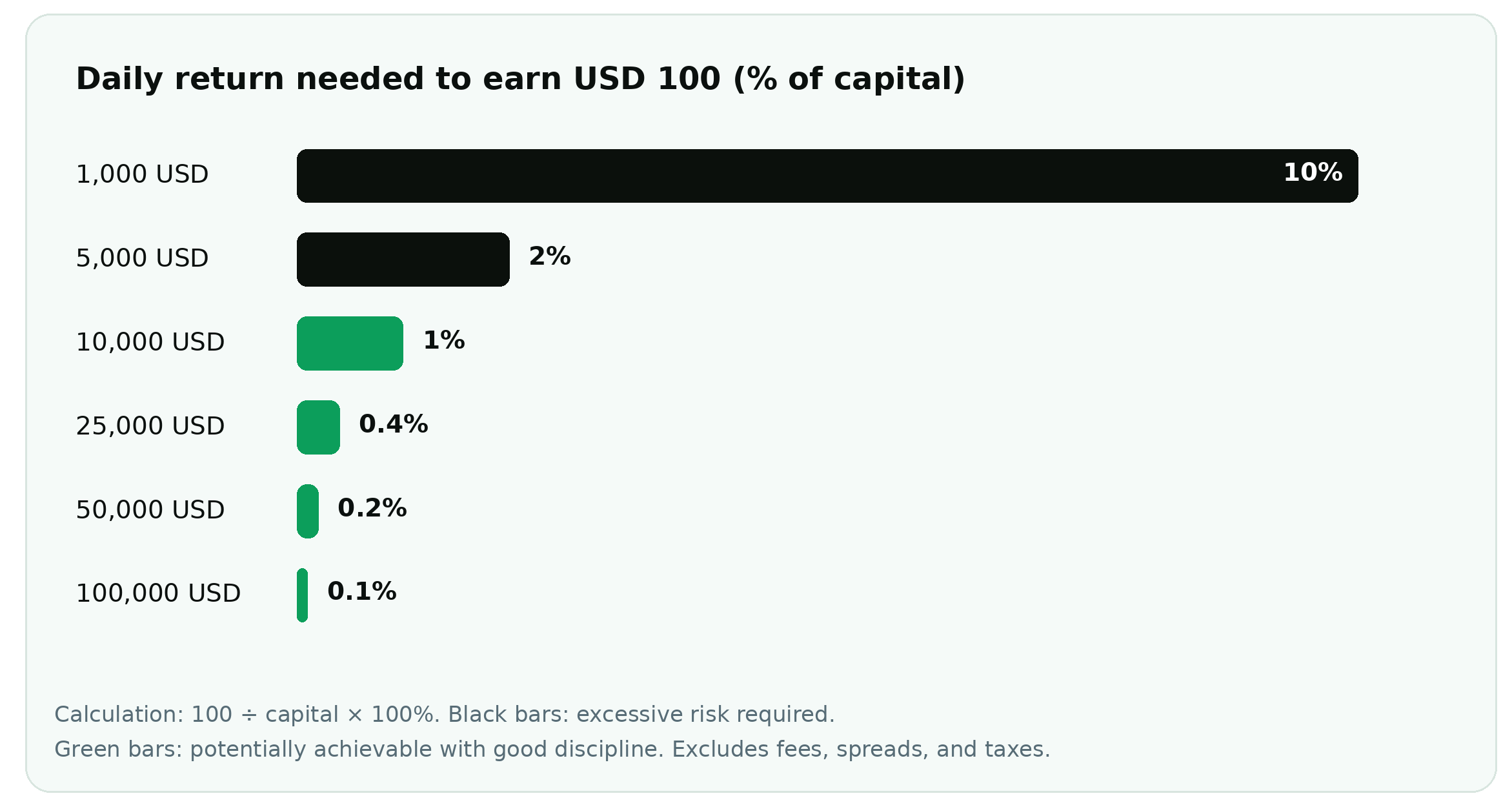
With a $5,000 account, you need to earn 2% every trading day. Compounded over roughly 21 trading days, that is a monthly return very few professional funds can sustain. The usual result is higher leverage, looser stop-losses and a blown account.
Comparison: Passive Income from Dividends
$100 a day equals $36,500 a year. With a 4% annual dividend yield, you would need a portfolio of about $912,500; at 3.65%, nearly $1 million. In other words, to earn $100 a day without trading at all, you need a very large amount of capital. This is exactly why many traders turn to active trading.
Market Data: Most Retail Traders Lose Money
$100 a day sounds like a small number, but research shows that achieving consistent profitability is already a rare accomplishment.
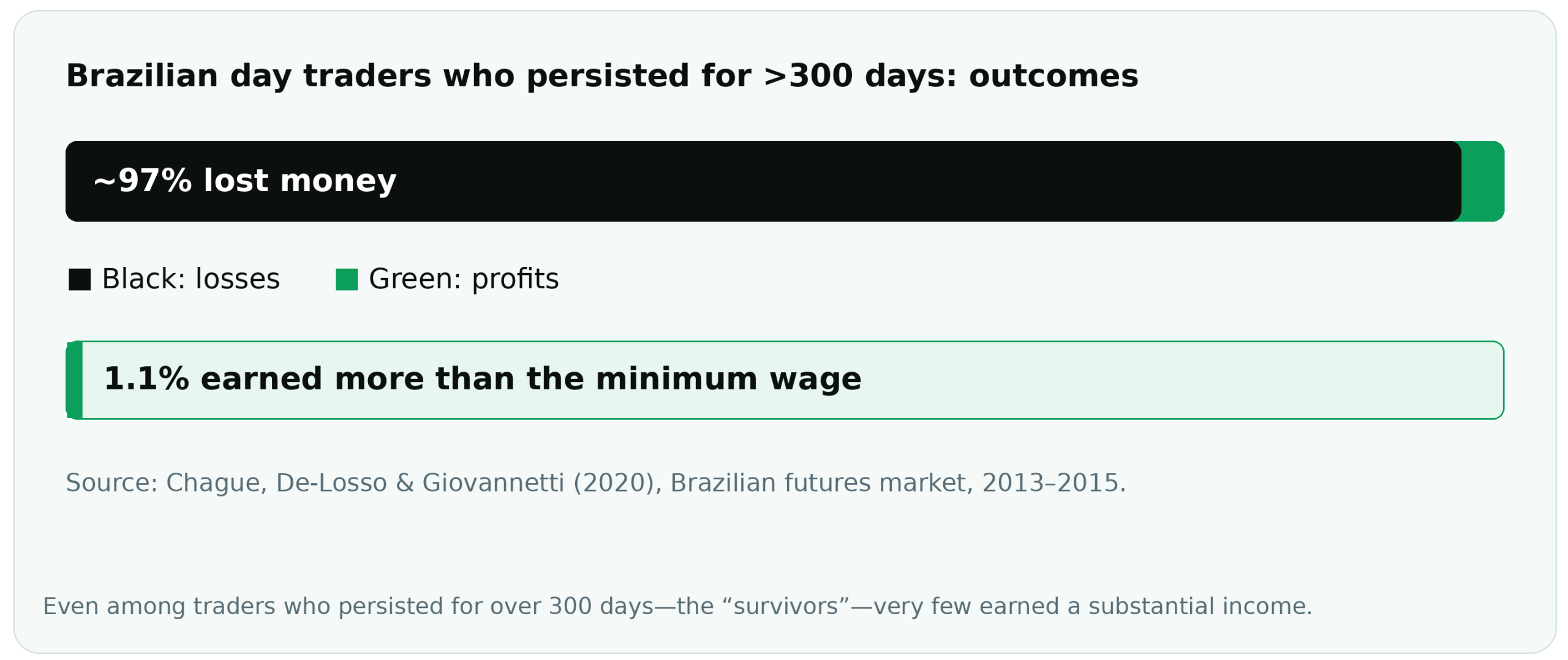
Around 97% of Brazilian day traders who persisted for more than 300 days still lost money, and only 1.1% earned more than the minimum wage (Chague, De-Losso and Giovannetti, 2020, Brazilian futures market, 2013–2015).
Case study 1: Taiwan. A study by Barber, Lee, Liu and Odean, covering the complete trading records of the Taiwan stock exchange, concluded that only about 1% of day traders earned predictable profits that persisted over several years after costs. Lesson: trading costs and high trade frequency erode profits.
Case study 2: Europe (CFD/Forex). European regulators (ESMA) require brokers to disclose the percentage of retail accounts that lose money trading CFDs, typically in the range of 74–89%. Lesson: high leverage magnifies both gains and losses.
Case study 3: The U.S. abolishes the PDT rule. On April 14, 2026, the SEC approved the elimination of the Pattern Day Trader rule and the $25,000 minimum equity requirement. The new framework took effect on June 4, 2026, replacing it with a risk-based intraday margin mechanism. The barrier of “you need $25,000 to day trade” is gone, but the risk is not: small accounts still face the same daily return pressure described in section 1. Lesson: an easier entry does not mean easier profits.
Why a Fixed “$100 a Day” Target Can Wreck Your Account
- Revenge trading: after a losing day, you increase your position size to win it back and lose even more.
- Inconsistency: real results fluctuate, with some days at +$200, others at +$50, and some negative. Professional traders are evaluated monthly or quarterly, not daily.
- Hidden costs: brokerage fees, spreads, swaps and taxes reduce net profit.
Illustration: Positive Expectancy Matters More Than a Daily Target
Suppose a $10,000 account, risking 1% ($100) per trade, with a 40% win rate and a 2:1 reward-to-risk ratio. Expectancy per trade = 0.4 × 2R − 0.6 × 1R = +0.2R, or about +$20. To average $100 a day, you would need roughly 5 trades a day, each following your process, not a single reckless trade. (Illustrative example, not a guarantee of results.)
The Prop Trading Model: A Solution to the Capital Problem
If capital is the biggest obstacle, the prop firm model allows traders to prove their skills through an evaluation process, then trade the firm’s capital and share the profits.
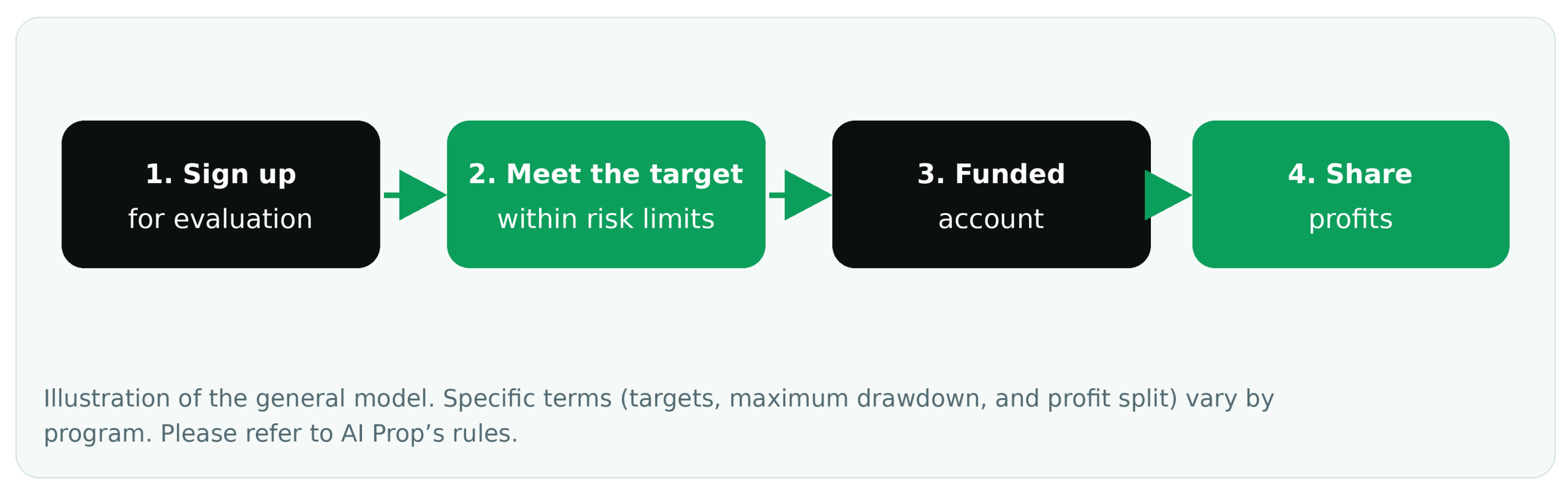
Note: specific conditions (profit target, maximum drawdown, profit split) vary by program. Please refer to AI Prop’s rules.
| Criteria | Small Personal Account | Prop Model |
|---|---|---|
| Trading capital | Your own money (e.g. $5,000) | The firm’s capital after passing the evaluation |
| Risk of capital loss | Your entire personal capital | Limited to the evaluation fee |
| Risk discipline | Self-imposed, easy to break | Mandatory drawdown rules |
| $100-a-day goal | Requires 2% of capital per day | Only ~0.1–0.2% on a larger account |
A Realistic Roadmap Toward $100 a Day
- Set monthly goals, not daily ones (for example, about $2,000 a month over 20 trading days).
- Keep risk per trade at 0.5–1% of capital and set a daily loss limit.
- Keep a trading journal and measure expectancy, win rate and maximum drawdown.
- Calculate your real costs (fees, spreads, taxes) to know your net profit.
- Scale up gradually once you have at least several months of consistent results.
Frequently Asked Questions (FAQ)
1. Can a beginner make $100 a day?
Rarely at the start. Research from Brazil and Taiwan shows that most day traders lose money, so treat the first 6–12 months as a period for learning and validating your process, not for earning income.
2. How much capital do I need to make $100 a day?
With a reasonable return of 0.2–0.5% per day, you need roughly $20,000–$50,000. A $5,000 account requires 2% a day, which is very hard to sustain.
3. Does the $25,000 PDT rule still apply?
No. According to the SEC and FINRA, the rule was abolished in the U.S. effective June 4, 2026, and replaced by an intraday margin framework. You should still check your broker’s specific policies.
4. Should I set a fixed daily target?
No. A fixed target easily leads to overtrading and revenge trading. Focus on your process and on weekly or monthly results.
5. Are profits subject to taxes and fees?
Yes. Trading fees, spreads and tax obligations, which vary by country, reduce your net income. Consult a tax professional where you live.
Ready to Test Your Trading Skills with AI Prop?
Instead of risking your personal capital chasing $100 a day, start with a clear evaluation process, transparent risk rules and the opportunity to trade with larger capital.
This content is for educational purposes only and is not investment advice. Trading involves risk of capital loss, and past performance does not guarantee future results. Calculation examples are illustrative. References: Chague, De-Losso and Giovannetti (2020); Barber, Lee, Liu and Odean (Taiwan day trader study); ESMA disclosures; SEC Release 34-105226 and FINRA notice on Rule 4210.