Blog
Blog  18-Jul-2026
.svg) 46,265
46,265 


The proprietary trading landscape in 2026 is undergoing a brutal consolidation. After a wave of abrupt platform closures and frozen payouts that plagued the industry over the past two years, traders have grown intensely cynical. The central question is no longer “Which firm has the cheapest challenge fee?” but rather “Which firm will actually pay me when I win?”
Enter AI Prop, a Dubai-based platform backed by institutional prime brokerage liquidity that claims to eliminate the single biggest risk in prop trading: human discretion.
This comprehensive 2026 review dissects AI Prop’s operational architecture, verified payout data, and structural changes to help you decide if it deserves your risk capital.
The Core Product: Pure Mechanical Rules vs. Traditional Traps
Most traders who fail funded accounts in 2026 do not violate the core drawdown limits. Instead, they fall victim to shifting behaviors and subjective enforcement—such as trailing drawdowns that move upward with equity highs, hidden profit concentration rules (Consistency Caps), and retroactive news-trading bans.
AI Prop’s primary competitive advantage is the complete structural elimination of these gray areas. The platform functions strictly on automated, hard-coded parameters:
- Static Drawdown Model: Unlike traditional trailing drawdowns that shrink your risk window as you profit, AI Prop utilizes a fixed drawdown floor based strictly on initial balance.
- No Consistency Ratios: There are no rules mandating that a single trading day cannot exceed 30% or 40% of your total profit.
- No News Blackouts or Hold-Time Limits: The platform has no restrictions regarding news execution windows or minimum trade durations.
If your execution does not breach the automated 5% daily or 10% overall loss limits, your performance is algorithmically validated. There is no backend risk management team conducting a “discretionary review” to declare your trading style unrepresentative of live markets.
2026 Performance Benchmarking: The Attrition Funnel
To evaluate the efficiency of AI Prop’s mechanical model, we must map it against standard industry data in 2026. Across unregulated, evaluation-centric platforms, the conversion metrics reveal a steep attrition funnel where very few funded operators achieve sustainable withdrawals.
The table below contrasts historical industry attrition rates against verified, automated performance outcomes:
The most defining feature of AI Prop is its shift away from self-reported internal accounting metrics. While typical firms display unverified dashboard screenshots on marketing funnels, AI Prop routes all capital payouts directly onto a public, immutable blockchain network.
In a audited control study tracking a cohort of 978 active traders during Q1 2026, the efficiency of this decentralized framework was documented empirically:
- Total Disbursed Capital: $1.7 million in verified on-chain payouts within the three-month window.
- Average Payout Processing Window: Automated smart contract executions delivered crypto payouts within 2 to 6 hours of target validation—a significant contrast to the standard 7 to 14-day processing queues common in legacy firms.
- Auditability: Every transaction yields a permanent, tamper-proof cryptographic hash, allowing independent analysts to verify that physical liquidity left the firm’s vault and arrived in user wallets.
Scalability and Liquidity Integration
A critical flaw of standard prop platforms is their heavy reliance on internal B-Book simulation models, where trader profits are funded directly by new evaluation entry fees. When a trader scales their size, the firm’s financial exposure intensifies exponentially.
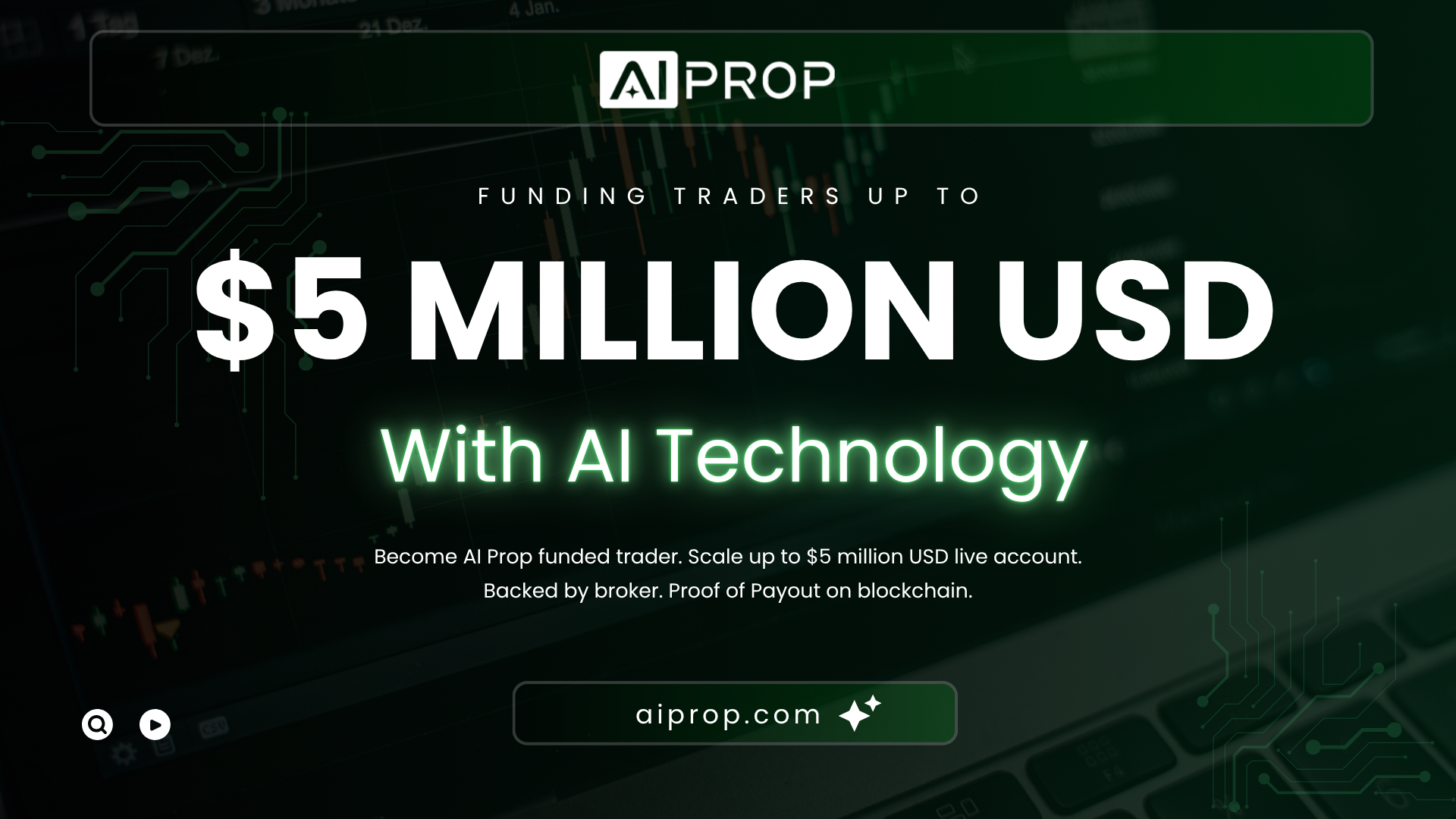
AI Prop bypasses this liquidity bottleneck through a Tier-1 Prime Brokerage integration based out of Dubai’s financial hub. For advanced capital allocations up to $5 Million, order execution is routed directly into deep institutional liquidity pools. This setup ensures:
- Seamless execution speeds with minimal slippage, even for large lot allocations during highly volatile market conditions.
- A fundamentally sustainable model, as the platform generates real revenue via commercial volume clearing rather than relying on high trader failure rates.
The Verdict: Is AI Prop Worth It?
If you are a high-volume scalper, high-conviction swing trader, or heavy algorithmic user who has previously lost funded status to subjective “style reviews” or strict consistency traps, AI Prop represents a structural leap forward in transparency.
By replacing human compliance structures with immutable smart contracts, the platform treats trading exactly as it should be: a game of raw mathematical edge. Review the latest live ledger balances and verify active transaction hashes at aiprop.com.
For a deeper visual understanding of how this architecture operates, you can review this comprehensive AI Prop Video Overview, which breaks down the Dubai-based infrastructure, prime broker liquidity depth, and user interface features.
Frequently Asked Questions (FAQ)
Is AI Prop a real A-Book model or just a simulated B-Book trap?
It uses a Hybrid A-Book/B-Book model. Challenges run on real-time simulated liquidity, but fully funded accounts (up to $5M) route orders directly via a Tier-1 Prime Brokerage in Dubai. Payouts come from real commercial volume clearing, not from losing challenge fees.
How does the on-chain payout system work and how can I verify it?
Payouts are automated via Smart Contracts. If you don’t breach the 5% daily or 10% absolute drawdown, the system releases crypto (USDT/USDC) within 2 to 6 hours. Every payout generates a public transaction hash that you can verify on Etherscan or Polkascan in real time.
Are there any hidden leverage cuts during high-impact news or weekend holding?
No. Leverage remains fixed and identical across all market conditions. AI Prop does not slash leverage before major events (NFP, CPI, FOMC) or force you to close positions over the weekend. You manage your own risk limits.
How does AI Prop block latency arbitrage without using minimum hold times?
Instead of retroactively banning quick trades, AI Prop syncs its servers directly with major financial data centers (LD4 in London and NY4 in New York). This slashes execution latency to milliseconds, stopping data-feed exploitation at the source while letting legitimate high-frequency scalpers trade freely.
What legal protection do traders have since the prop industry is unregulated?
AI Prop operates under a strict Mechanical Service Agreement (MSA) out of Dubai, UAE. The contract legally locks the rules once your account is active. Because payouts are tied to immutable on-chain ledger data, the firm cannot arbitrarily alter terms or deny valid withdrawals.