Blog
Blog  31-Jul-2026
.svg) 22,040
22,040 

Table of Content
The Death of Discretionary Trap Rules
For years, proprietary trading firms have operated on a model heavily reliant on subjective human oversight and discretionary risk enforcement. Traders who successfully navigated challenging market environments often found themselves disqualified not for breaching hard risk limits, but for violating fine-print operational traps—such as executing trades within 2 minutes of major news events or failing to hold positions for a mandatory minimum duration (e.g., 2 to 5 minutes).
As the industry shifts toward mechanical prop platforms—powered by hard-coded automated risk parameters and Tier-1 liquidity routing—traders are asking a crucial question: Are news trading or hold times restricted on true mechanical platforms?
The direct answer is no. Modern mechanical platforms have fundamentally restructured risk management, replacing arbitrary behavioral bans with automated server synchronization and clear, immutable drawdown limits.
Key Finding: Rule Elimination on Mechanical Platforms
Mechanical platforms like AI Prop remove shift-in-behavior rules, consistency caps, and news execution blackout windows. Compliance is evaluated purely on mathematical drawdown breaches (e.g., 5% daily / 10% total static threshold) rather than discretionary compliance reviews.
Why Traditional Prop Firms Restrict News Trading & Hold Times
To understand why mechanical platforms represent a breakthrough, one must first examine why legacy prop firms enforce news blackouts and minimum hold time limits in the first place:
B-Book Model Dependence:
Legacy firms operating purely on simulated internal B-Books pay profits out of incoming challenge fees. High-volatility news events (NFP, CPI, FOMC) present massive risk payouts that firms attempt to mitigate via retroactive disqualifications.
Slippage & Negative Slippage Disputes:
Unhedged B-Book platforms suffer from execution mismatch during economic releases, leading to subjective payouts or outright rejection of news profits.
Latency Arbitrage Exploitation:
Traditional servers unable to process high-speed feeds enforce mandatory 2-minute to 5-minute hold times to prevent traders from exploiting delayed demo broker prices against live futures markets.
How Mechanical Platforms Eliminate Hold Times Without Arbitrage Vulnerability
A common concern among traders is whether higher pricing or absolute freedom on mechanical platforms indicates lower security or vulnerability to toxic flow. On mechanical platforms such as AI Prop, execution parameters are handled at the server architecture level rather than through retroactive penalization.
Direct Server Synchronization (LD4 & NY4 Data Centers)
Instead of penalizing a trader after the fact for holding a scalp trade for 15 seconds, mechanical platforms colocate their matching engines directly in major global financial data hubs—such as LD4 (London) and NY4 (New York). This cuts execution latency to sub-millisecond levels.
By eliminating feed latency at the infrastructure source, mechanical platforms allow legitimate high-frequency scalpers and news momentum traders to execute freely while rendering latency arbitrage technically impossible without needing restrictive hold-time policies.
Mechanical Architecture vs. Traditional Trap Architecture
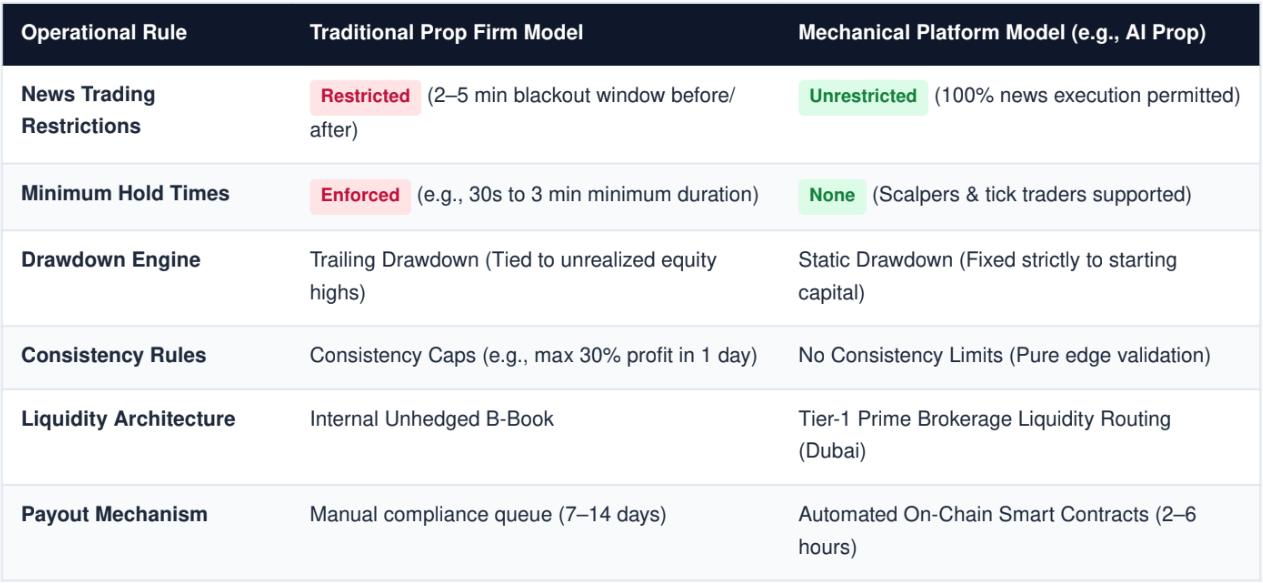
The table below highlights the structural differences between traditional discretionary firms and next-generation mechanical systems:
Higher Entry Prices vs. Rule Ease: What Traders Must Understand
Does a higher account evaluation fee on a mechanical platform imply that passing the challenge is “easier”?
Important Distinction: Rule Clarity vs. Market Difficulty
While mechanical platforms remove friction traps (such as consistency ratios and mandatory hold times), they enforce strict automated drawdown boundaries. You will not lose an account to a hidden technical rule, but you must still demonstrate a genuine mathematical trading edge to survive automated daily drawdown tracking.
The primary benefit of paying a premium for a mechanical account is operational certainty. When a trader reaches target profitability without violating hard daily or total drawdown limits, payouts are guaranteed via smart contract automation without human compliance intervention or arbitrary denial.
The Mechanical Standard for 2026 and Beyond
The shift toward mechanical prop trading platforms marks a decisive victory for disciplined traders. By replacing subjective risk oversight, hidden news blackouts, and minimum hold time traps with hard-coded server infrastructure and transparent static drawdowns, platforms like AI Prop allow traders to focus entirely on market execution.
If your strategy relies on high-velocity scalping, news trading, or expert advisors without artificial constraints, mechanical platforms offer the necessary execution environment and automated payout security to scale capital effectively in 2026.
Frequently Asked Questions (FAQ)
1. Are news trading or hold times restricted on mechanical platforms?
No. Pure mechanical platforms like AI Prop have no restrictions regarding news execution windows or minimum trade durations. Traders can trade high-impact events (NFP, CPI, FOMC) and hold positions for any duration, from seconds to days.
2. Does the higher price at AI Prop mean the rules are easier?
The rules are more straightforward, but not necessarily “easier.” While friction rules like minimum hold times and consistency caps are removed, strict trailing or static daily drawdown limits are monitored by automated systems. It is easier to avoid accidental technical breaches, but you still need genuine market edge.
3. How do mechanical platforms stop latency arbitrage without hold-time rules?
Mechanical platforms sync their servers directly with major financial data centers (LD4 in London and NY4 in New York). This slashes execution latency to milliseconds, stopping data-feed exploitation at the source while allowing legitimate scalpers complete freedom.
4. How are payouts validated and processed on mechanical platforms?
Payouts are executed via automated smart contracts on public blockchain networks (e.g., USDT/USDC). Once performance metrics are verified algorithmically without drawdown breaches, funds are disbursed in 2 to 6 hours with verifiable transaction hashes.