Blog
Blog  06-Aug-2026
.svg) 31,065
31,065 

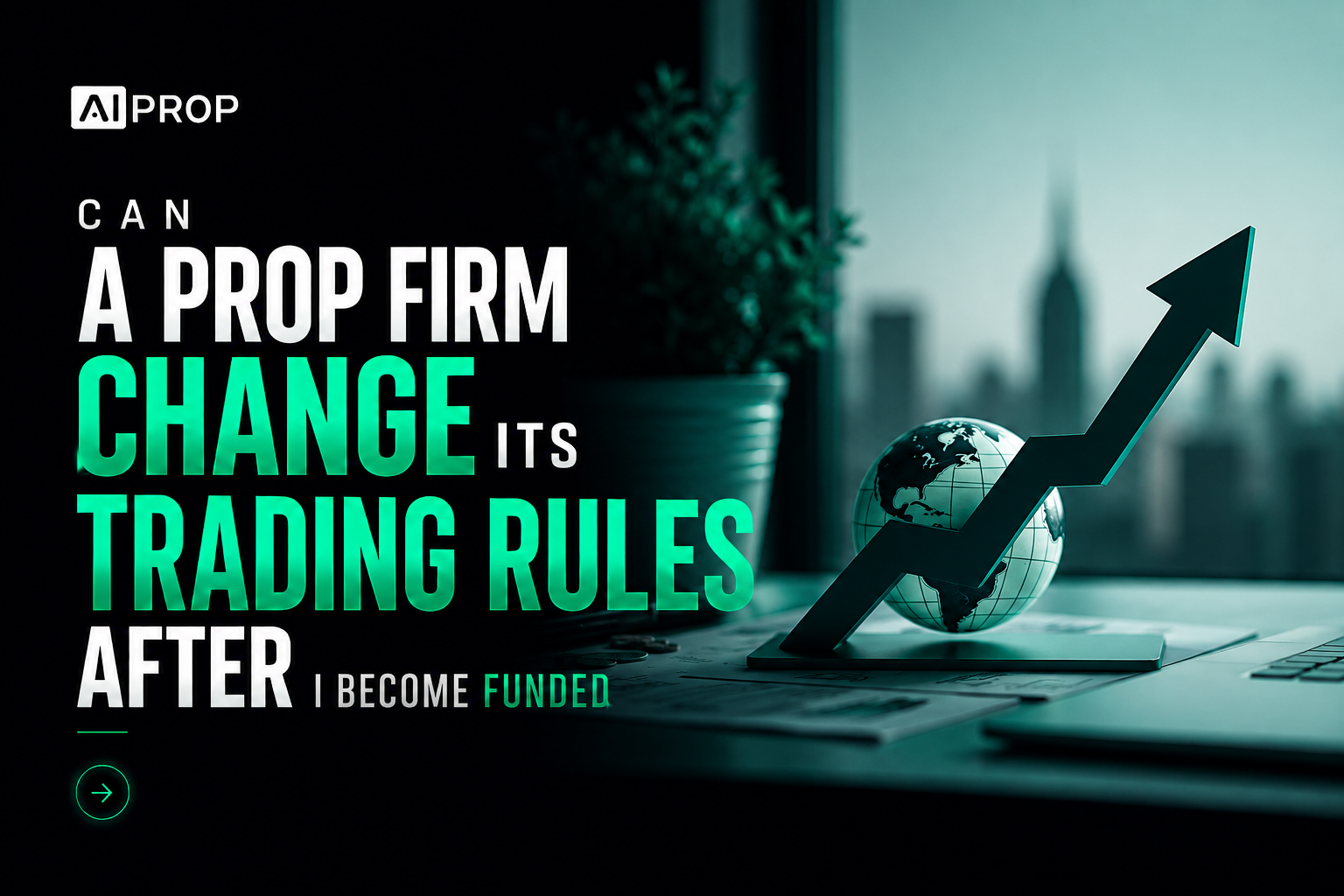
Why Rule Changes Matter After Funding
Passing a prop firm’s evaluation is only the beginning of the journey. For most traders, the real objective is maintaining a funded account and receiving consistent payouts.
One concern that has become increasingly common is whether a prop firm can change its trading rules after you’ve already become funded. Examples include introducing new consistency rules, reducing leverage, restricting news trading, or modifying payout conditions.
These changes can dramatically affect a trader’s strategy, especially if the account was earned under a different set of rules.
The answer depends largely on how the firm’s contractual framework is designed.
Can a Prop Firm Legally Change Your Trading Rules?
In most jurisdictions, the relationship between a trader and a prop firm is governed by a commercial service agreement, not by investment regulations.
A reputable prop firm generally should not retroactively modify the contractual terms of an active funded account without following the procedures outlined in its agreement.
The version of the contract accepted when the funded account is activated typically defines:
- Maximum daily drawdown
- Maximum overall drawdown
- Profit split
- Trading restrictions
- Payout procedures
- Account termination conditions
If a company later updates its general Terms & Conditions, those revisions usually apply only to new customers or newly issued accounts, unless the contract explicitly reserves the right to amend existing agreements.
For this reason, reading the funded account agreement is often more important than reading marketing material.
The Evolution of Rule Enforceability in 2026
The prop trading industry in 2026 has increasingly shifted toward hard-coded, mechanical rules to eliminate human discretion and rule ambiguity entirely. Platforms such as AI Prop represent this modern architecture, replacing subjective backend compliance teams with automated risk parameters and public blockchain payouts.
When risk management is hard-coded into smart contracts and server-level execution bounds, the firm physically lacks the ability to retroactively apply new parameters to an active account.
Key Protections to Look for Before Signing
To ensure your trading rules remain fixed throughout the life of your funded account, evaluate firms using these core criteria:
If a prop firm attempts to modify your trading terms after funding, take the following steps:
- Review Your Signed MSA: Check the specific clause governing terms, modifications, and retroactive adjustments.
- Audit Account Logs: Export all trade histories, equity curves, and dashboard metrics to prove compliance with original parameters.
- Verify Compliance Terms: Confirm whether the firm relies on vague “style review” clauses, which often grant them legal leeway to restrict specific strategy types.
For maximum security, select platforms operating under transparent jurisdictional frameworks (such as Dubai’s institutional financial hubs) that pair locked legal contracts with automated execution.
Frequently Asked Questions
1. Can a prop firm change leverage limits during major news events?
In legacy models, firms often temporarily cut leverage during high-impact news (like CPI or NFP). Modern mechanical firms maintain fixed leverage ratios across all market conditions, shifting risk management to the trader rather than imposing mid-session execution caps.
2. Are payout terms locked once I pass the challenge?
Yes. Your signed activation agreement dictates your payout schedule and profit split percentage. Firms operating on-chain execute these transactions automatically once performance thresholds are verified by the system.
3. How can I verify if a firm’s payout rules are being enforced fairly?
Look for platforms that publish cryptographic hashes on public blockchain ledgers (e.g., Ethereum or Polygon). Immutable transaction hashes allow you to verify that liquid capital was moved from the firm’s vault directly to trader wallets without manual intervention.