Blog
Blog  07-Aug-2026
.svg) 37,050
37,050 

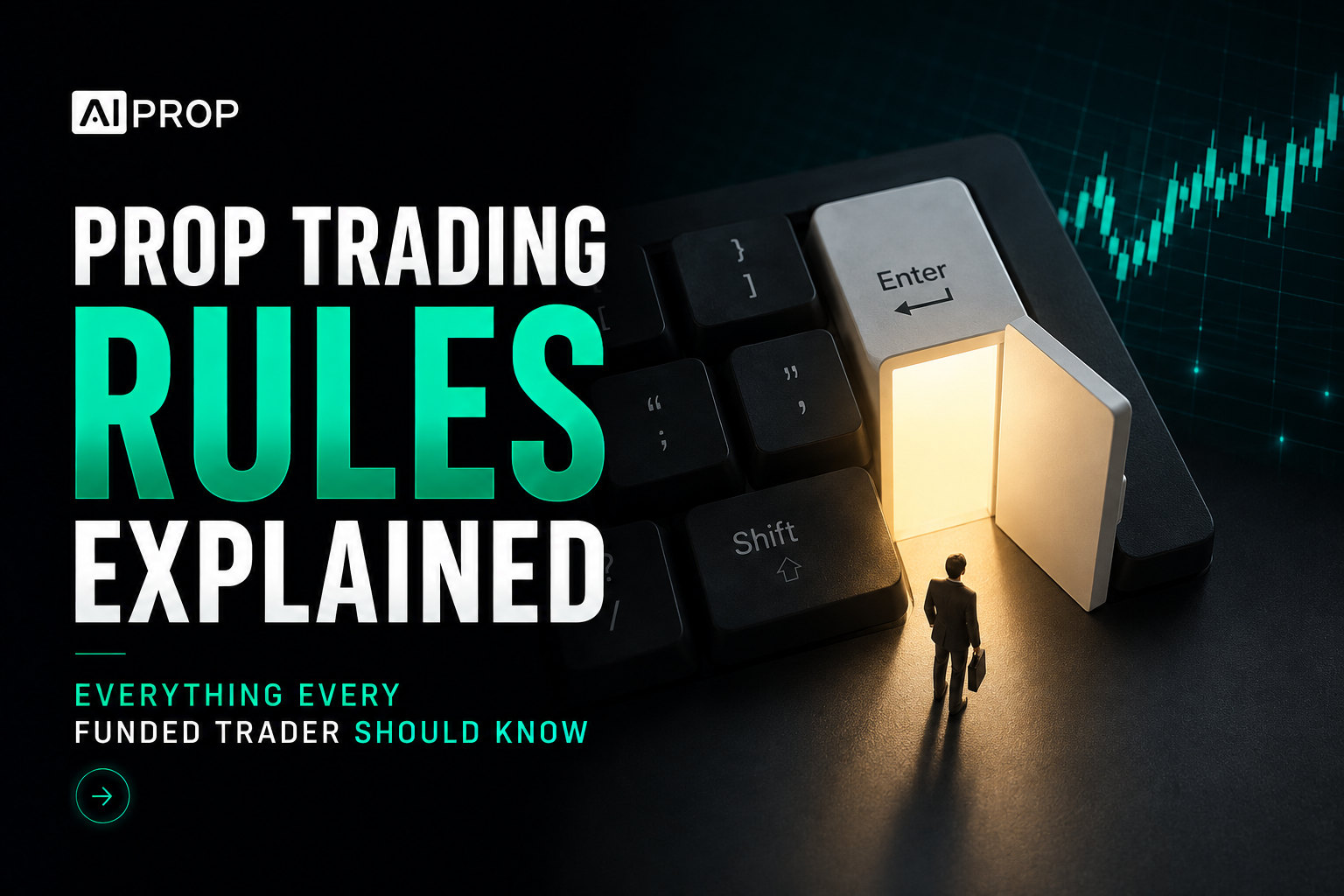
Many traders believe that profitability is the hardest part of becoming a funded trader. In reality, a significant number of funded accounts are lost not because traders fail to read the market, but because they violate the trading rules established by their proprietary trading firm.
Whether you’re preparing for an evaluation challenge or already managing a funded account, understanding how prop trading rules work is just as important as developing a profitable strategy. This guide explains the most common rules used by prop firms, why they exist, and how to avoid costly mistakes that could jeopardize your account.
What Are Prop Trading Rules?
Prop trading rules are the risk management guidelines established by proprietary trading firms to protect their capital and ensure fair trading practices. Every trader who joins a prop firm agrees to follow these rules during both the evaluation phase and the funded stage.
While specific requirements vary between firms, most rulebooks are designed around four primary objectives:
- Protect the firm’s trading capital
- Encourage disciplined risk management
- Prevent abusive or fraudulent trading practices
- Ensure operational and regulatory compliance
Understanding these objectives helps traders recognize that rules are not simply restrictions—they are part of the firm’s overall risk framework.
The Most Common Prop Trading Rules
Although each prop firm has its own policies, several rules appear consistently across the industry.
Maximum Daily Drawdown
Daily drawdown limits define how much a trader can lose within a single trading day before the account is considered in violation.
For example, if a $100,000 account has a 5% daily drawdown limit, the maximum allowable loss for that day is $5,000. Exceeding this threshold—even briefly—may result in an immediate account termination.
Professional traders monitor both realized and floating losses throughout the day rather than waiting until positions are closed.
Maximum Overall Drawdown
The maximum overall drawdown limits the total loss allowed on an account.
There are three common models:
- Static Drawdown: The loss limit remains fixed based on the initial account balance.
- Trailing Drawdown: The loss limit increases as the account reaches new equity highs.
- Absolute Drawdown: A fixed maximum loss that never changes.
Many experienced traders prefer static drawdown because it offers a more predictable risk buffer as profits grow.
Profit Target
During the evaluation phase, traders are usually required to achieve a predefined profit target before qualifying for funding.
A typical challenge may require an 8–10% return while remaining within the drawdown limits.
Once traders become funded, this requirement often disappears, allowing them to focus solely on consistent risk-adjusted performance.
Minimum Trading Days
Some firms require traders to remain active for a minimum number of trading days before completing an evaluation.
This rule is intended to discourage excessive risk-taking through a single oversized trade and encourages more consistent trading behavior.
However, many modern prop firms have begun removing this requirement to create a more flexible trading experience.
Trading Restrictions You Should Understand
Beyond risk limits, many firms impose additional restrictions that traders should review carefully.
News Trading
Some prop firms prohibit opening or closing trades during high-impact economic events such as Federal Reserve announcements, Non-Farm Payrolls (NFP), or Consumer Price Index (CPI) releases.
Other firms allow news trading without restrictions. Because policies vary significantly, traders should always review the firm’s rulebook before building a news-based strategy.
Overnight and Weekend Holding
Holding positions overnight or through weekends may be restricted depending on the firm’s business model and the assets being traded.
These limitations are more common in futures trading than in forex or cryptocurrency markets.
Expert Advisors (EA) and Copy Trading
Automated trading is becoming increasingly common, but not every firm permits Expert Advisors (EAs), algorithmic systems, or copy trading.
Some firms allow fully automated trading, while others prohibit:
- Trade copying between accounts
- Public signal services
- High-frequency trading
- Latency arbitrage
Using unauthorized software can lead to account suspension even if the trading strategy is profitable.
Understanding Drawdown Models
Drawdown rules are among the most important factors when selecting a prop firm.
A static drawdown keeps the maximum loss limit fixed throughout the life of the account. This provides greater flexibility because the allowable loss does not shrink as profits increase.
A trailing drawdown, by contrast, moves upward whenever the account reaches a new equity high. While this rewards consistent growth, it also reduces the trader’s available risk buffer over time.
Neither model is universally better. Swing traders often prefer static drawdown because it allows trades more room to fluctuate, while shorter-term traders may be comfortable operating within a trailing drawdown framework.
The key is understanding exactly how your firm’s drawdown is calculated before placing your first trade.
Hidden Rules Traders Often Miss
Some prop firms include additional operational and compliance provisions that may not appear prominently on their pricing or challenge pages. These rules can still affect account eligibility, payout approval, or continued access to a funded account.
| Rule or Provision | What Funded Traders Should Know |
|---|---|
| Account Inactivity | Some firms require traders to remain active by placing at least one trade within a specified period (e.g., 30–60 days). Failing to meet this requirement may result in account suspension or closure. |
| VPN or IP Address Usage | Frequent changes in IP address, country, or device may trigger security or compliance checks. Traders who travel or use VPNs should review the firm’s policy to avoid unnecessary account reviews. |
| Multiple Accounts Under One User | While multiple accounts are often allowed, firms may limit the total funded capital or prohibit using duplicate accounts to bypass trading restrictions. Always check the firm’s account allocation policy. |
| Manual Payout Reviews | Some firms manually review payout requests to verify rule compliance, trading activity, and account ownership. Understanding the review process helps avoid unexpected payout delays. |
| Suspicious Trading Behavior | Activities such as latency arbitrage, exploiting pricing errors, or other prohibited execution methods may be classified as suspicious trading. Reputable firms should clearly define these behaviors in their rulebook. |
| Account Sharing | Funded accounts are intended for the registered trader only. Allowing another person to access or trade the account may violate the firm’s terms and result in account termination. |
These provisions are not automatically unfair, but they should be written clearly and applied consistently. Before joining a prop firm, traders should review the complete terms and conditions rather than relying only on promotional summaries or FAQ pages.
Frequently Asked Questions (FAQs)
1. What are the most important prop trading rules to understand?
The most critical rules include daily drawdown, maximum overall drawdown, profit targets, position size limits, and trading restrictions such as news trading or overnight holding. Understanding these rules helps traders avoid accidental account violations.
2. Are prop trading rules the same for every prop firm?
No. While most firms use similar risk management principles, the specific rules, drawdown calculations, payout policies, and trading restrictions can vary significantly. Always review the firm’s official rulebook before purchasing a challenge.
3. What happens if I break a prop trading rule?
The outcome depends on the severity of the violation. A hard breach, such as exceeding the maximum drawdown, usually results in immediate account termination, while minor compliance issues may trigger a warning or manual review.
4. Can I use Expert Advisors (EAs) or copy trading on a funded account?
It depends on the prop firm. Some firms allow automated trading systems and EAs, while others prohibit copy trading, latency arbitrage, or certain algorithmic strategies. Check the firm’s trading policy before using automation.
5. How can I avoid violating prop trading rules?
Create a trading plan that includes strict risk management, monitor your drawdown in real time, review economic news before trading, and read the firm’s complete rulebook. Staying disciplined is the best way to maintain a funded account.