Blog
Blog  04-Mar-2026
.svg) 1,995
1,995 


Table of Content
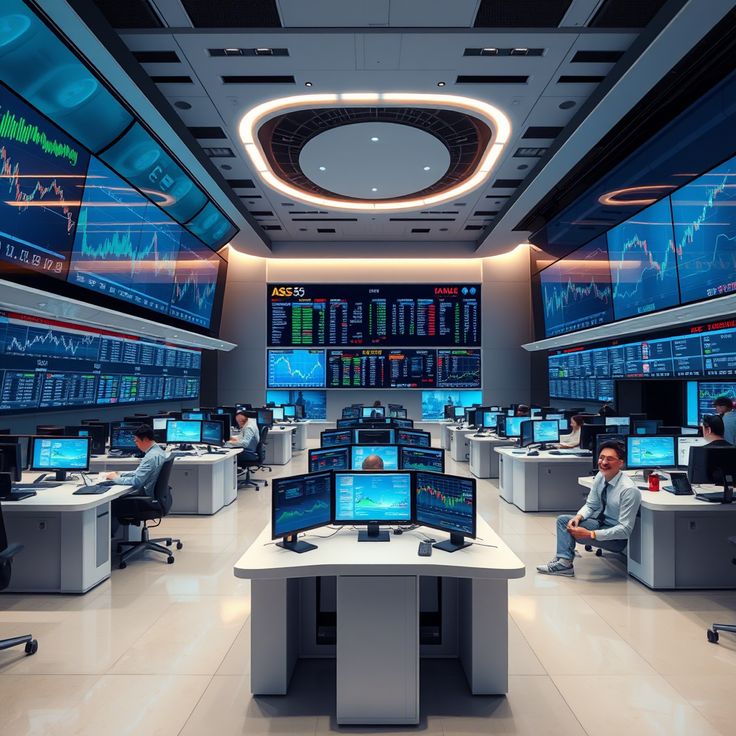
Over the past decade, funded trading has evolved from a niche opportunity for highly connected professionals into a globally accessible capital allocation model. What once required physical presence inside centralized proprietary desks in cities such as New York or London can now be accessed remotely by retail traders worldwide. This transformation is not merely technological progress. It represents a structural shift in how capital, risk, and performance are organized. The new infrastructure behind funded trading is built on automation, data science, probabilistic risk modeling, and scalable digital evaluation systems. Understanding this infrastructure is essential for any trader or investor seeking long term relevance in modern markets.
From Physical Desks to Distributed Digital Capital
Historically, proprietary trading firms operated from centralized financial hubs. Access to capital was restricted by geography, institutional networks, and organizational hierarchy. Capital allocation followed a principal agent framework where partners or senior managers controlled risk budgets and junior traders operated under supervision. The barriers to entry were high because the infrastructure required physical trading floors, internal clearing arrangements, and direct exchange memberships.
The emergence of cloud computing, low latency brokerage APIs, and global retail platforms dissolved these barriers. Remote traders can now participate in funded trading programs without relocating. This transformation mirrors the digitization of higher education, where elite knowledge once limited to physical campuses became accessible through online systems. In funded trading, the democratization of access does not imply a reduction in standards. On the contrary, evaluation metrics have become more mathematically structured and algorithmically enforced.
This transition reflects transaction cost economics theory. When technology reduces coordination costs and information asymmetry, organizations reorganize around more efficient structures. In funded trading, the cost of monitoring traders decreased because performance data can be tracked in real time. As a result, firms can scale evaluation programs globally while maintaining risk discipline.
Automation as the Operational Backbone

Between 60 and 70 percent of equity market trades in developed economies are now executed algorithmically. This statistic confirms that automation is no longer peripheral but central to execution. In funded trading, technology has shifted from a support tool to the operational backbone.
Modern funded trading infrastructure integrates automated risk engines that monitor drawdown limits, exposure caps, and consistency metrics continuously. Instead of relying on manual supervision, firms embed risk constraints directly into trading accounts. When a trader breaches maximum loss thresholds, the system automatically restricts or closes positions. This reflects principles from control theory, where feedback loops stabilize complex systems by responding immediately to deviations.
For example, consider a funded account of 100,000 dollars with a maximum daily drawdown of 5 percent and a maximum overall drawdown of 10 percent. In traditional settings, a risk manager might manually intervene. In the new infrastructure, algorithms monitor equity curves tick by tick. If unrealized losses approach predefined limits, automated protocols execute protective measures. The human element remains in strategy design, but execution discipline becomes system enforced.
This integration of automation reduces moral hazard, a concept from agency theory. When traders know that risk rules are objectively enforced, incentives align more closely with firm sustainability rather than short term speculation.
Data Driven Evaluation Models in Funded Trading
Global search demand for prop firm related terms increased by more than 4000 percent between 2020 and 2024. Such rapid expansion indicates strong retail interest in funded trading opportunities. However, scaling evaluation programs requires standardized performance measurement systems.
Modern funded trading firms rely on statistical performance metrics grounded in probability theory. Instead of evaluating traders solely on raw profit, firms analyze risk adjusted returns, win rate stability, payoff ratios, and distribution of returns across time. Concepts such as expected value and variance become central.
Assume a trader generates an average monthly return of 8 percent but with a highly volatile equity curve and frequent deep drawdowns. Another trader produces 4 percent monthly returns with smoother performance and lower variance. From a portfolio theory perspective introduced by Harry Markowitz, the second trader may represent a more efficient allocation of capital because risk adjusted return is superior.
Funded trading infrastructure incorporates these quantitative filters automatically. Evaluation dashboards track maximum adverse excursion, average holding period, and correlation with other funded traders. The goal is not simply to identify profitable individuals but to build diversified risk portfolios across multiple traders. This reflects modern portfolio theory applied at the firm level.
Intelligent Capital Allocation Systems
In the past, capital scaling decisions often depended on managerial discretion. Today, funded trading platforms increasingly use algorithmic scaling models. When traders meet predefined consistency and profitability benchmarks, capital increases follow structured formulas.
This approach mirrors reinforcement learning principles in artificial intelligence. The system rewards behavior that satisfies risk constraints and profitability objectives. For example, a trader who completes two evaluation phases while maintaining low variance and strict drawdown compliance may automatically qualify for a capital increase from 50,000 dollars to 200,000 dollars.
The advantage of this structured scaling lies in predictability. Traders understand the performance thresholds required for growth. Firms benefit from consistent capital deployment frameworks that reduce emotional bias in decision making. Game theory also plays a role here. Clear incentive structures encourage cooperative behavior between trader and firm because both parties benefit from sustainable performance rather than excessive risk taking.
Market Microstructure and Execution Efficiency
Another layer of the new infrastructure behind funded trading involves market microstructure. With algorithmic trading dominating execution, spreads, slippage, and liquidity dynamics influence performance significantly. Funded trading firms integrate advanced execution analytics to ensure traders operate under realistic market conditions.
Consider a high frequency strategy operating during low liquidity sessions. Without proper infrastructure, slippage could erode profitability. Modern systems simulate realistic fill conditions during evaluation phases. This aligns with microstructure theory, which studies how order flow, bid ask spreads, and information asymmetry affect price formation.
By embedding these simulations into evaluation models, firms ensure that funded traders demonstrate strategies resilient to real market friction. The objective is to prevent inflated backtest results and ensure external validity of trading performance.
One of the most underappreciated aspects of funded trading infrastructure is aggregation risk management. While individual traders focus on their accounts, firms view the entire funded ecosystem as a composite portfolio.
Suppose a firm manages 1000 funded traders across different strategies. If most traders concentrate on similar currency pairs or equity indices, systemic risk increases. The infrastructure must therefore analyze correlation matrices among trader returns. Techniques from multivariate statistics help determine how individual performance contributes to overall firm volatility.
This approach resembles insurance underwriting models. Risk is distributed across many participants to reduce concentration exposure. When properly diversified, the firm can maintain profitability even if a subset of traders underperform.
Behavioral Discipline Through Structural Constraints
Behavioral finance research shows that cognitive biases such as overconfidence and loss aversion impair decision making. The new infrastructure behind funded trading addresses these biases structurally rather than psychologically.
By imposing objective rules such as maximum daily loss limits and minimum trading days, firms counteract impulsive behavior. Prospect theory explains that individuals tend to take excessive risk when facing losses. Automated drawdown restrictions interrupt this tendency by limiting exposure before emotional escalation occurs.
In this sense, infrastructure becomes a behavioral correction mechanism. It does not eliminate bias but constrains its financial impact.
The Convergence of Human Skill and Intelligent Systems
Funded trading no longer depends solely on individual intuition. Success emerges from the interaction between trader skill and intelligent infrastructure. The trader develops strategy logic, market interpretation, and risk understanding. The system enforces discipline, monitors statistical stability, and scales capital based on measurable criteria.
This convergence reflects cybernetic theory, where human and machine systems form feedback driven loops. The trader generates actions. The platform measures outcomes. The data refines evaluation standards. Over time, the ecosystem evolves toward greater efficiency.
The structural shift is clear. Funded trading is not simply about access to capital. It is about integration into a digitally governed capital allocation network. Automation dominates execution. Data science shapes evaluation. Portfolio theory guides allocation. Behavioral economics informs risk constraints. Control systems enforce discipline.
The new infrastructure behind funded trading represents the financial industry’s broader transition toward intelligent, scalable, and globally distributed systems. For traders, understanding this infrastructure is as important as mastering technical analysis or macroeconomic trends. In modern markets, edge does not come solely from prediction. It emerges from operating effectively within a system designed around probability, automation, and structural risk management.
In this environment, funded trading becomes more than an opportunity for retail participation. It becomes a model of how financial capital is organized in the digital era.