Blog
Blog  04-Dec-2025
.svg) 23,940
23,940 


Table of Content
In funded trading environments, technical skill alone is never enough. Many traders enter prop firms with proven strategies, solid backtests, and years of experience, yet still fail to maintain funded accounts. The missing piece is rarely market knowledge. More often, it is fear mindset — a subtle but powerful psychological pattern that quietly undermines decision-making under capital pressure.
Fear mindset does not always appear as panic or emotional breakdown. In most funded trading environments, it manifests in more controlled, rational-looking behaviors: hesitation, over-caution, inconsistency, or rule-following without conviction. Understanding how fear mindset forms, how it influences trader behavior, and how it differs from healthy risk awareness is essential for anyone operating with funded capital.
What Is Fear Mindset in Trading?
Fear mindset refers to a persistent psychological state where the fear of loss dominates the trader’s decision-making process, even when objective conditions support execution. In funded trading, this fear is amplified by external capital, strict risk limits, and performance-based evaluation.
Unlike beginners who fear the market itself, funded traders fear consequences:
-
Losing the funded account
-
Violating drawdown rules
-
Failing evaluations after long preparation
-
Damaging self-identity as a “competent trader”
This mindset shifts focus away from process execution and toward outcome avoidance. Trades are no longer taken because they meet criteria, but avoided because of what could go wrong.
Why Fear Mindset Is Stronger in Funded Trading

Funded trading environments introduce psychological pressures that do not exist in personal trading accounts.
First, the capital does not belong to the trader. Even though financial risk is limited, perceived responsibility increases. Traders often feel they must “protect” the firm’s money, leading to excessive caution.
Second, rule-based constraints intensify mental load. Daily drawdowns, maximum loss limits, and profit targets turn every decision into a potential account-ending event. This makes fear mindset systemic rather than emotional.
Third, evaluations convert trading into a performance test. When each trade contributes to a pass-or-fail outcome, traders stop thinking probabilistically and start thinking defensively.
In short, funded environments transform trading from a skill-based activity into a psychological stress test.
How Fear Mindset Alters Trading Behavior
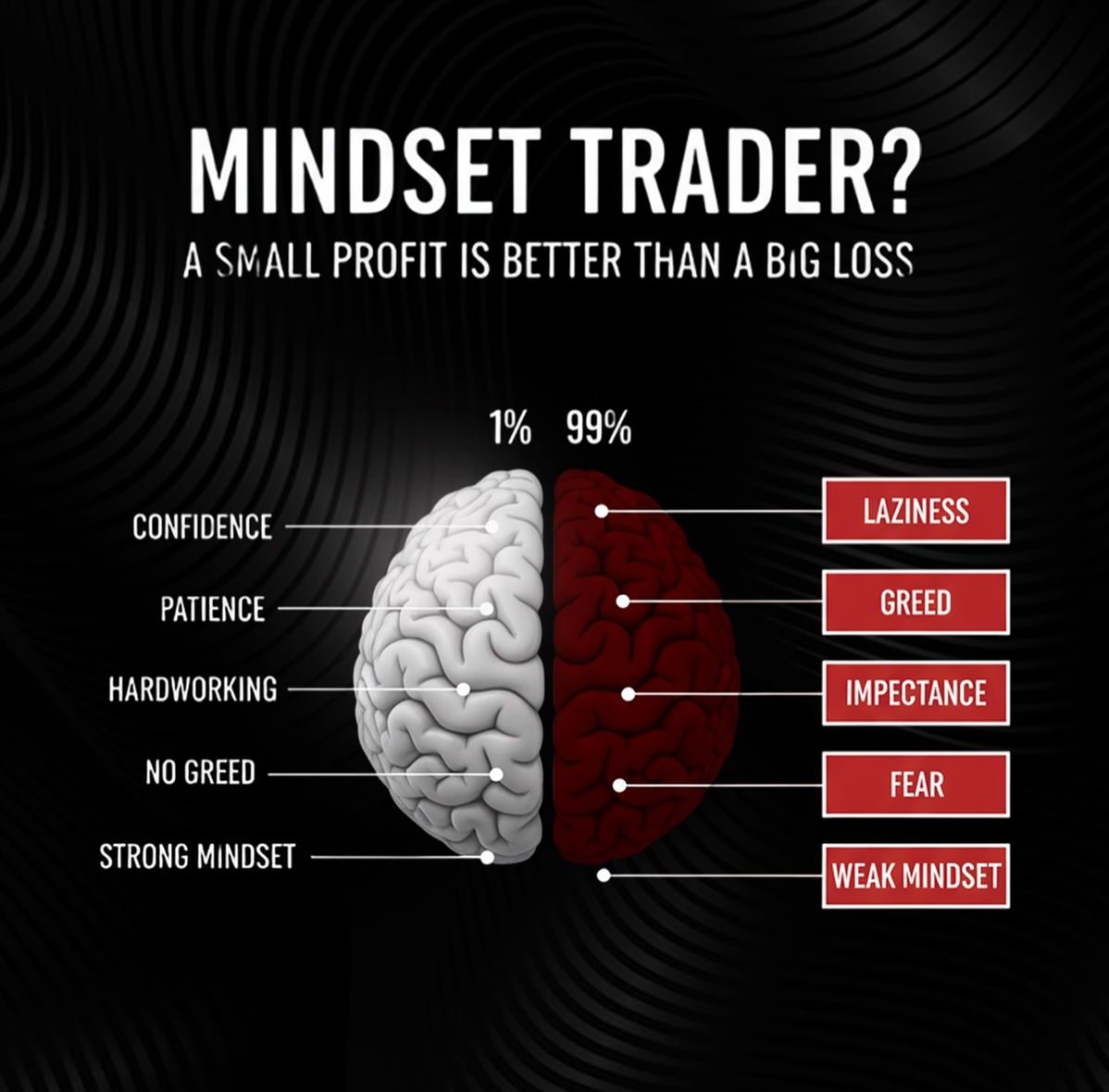
Fear mindset rarely causes reckless behavior. Instead, it produces patterns that appear disciplined on the surface but are destructive over time. One common behavior is hesitation. Traders see valid setups but delay entry, waiting for extra confirmation that never comes. Missed trades accumulate, confidence erodes, and frustration grows.
Another pattern is premature exit. Fear-driven traders cut winning trades early to “lock something in,” sacrificing expectancy for emotional relief. Over time, this leads to poor reward-to-risk ratios and failure to meet profit targets. Fear mindset also causes over-compliance with rules. Traders obsess over drawdown buffers, trade smaller than planned, or stop trading entirely after minor losses. While rule adherence is essential, fear-based compliance removes strategic flexibility.
Finally, fear mindset leads to inconsistency. Traders switch between aggression and passivity depending on recent outcomes, breaking the statistical edge of their system.
Fear Mindset vs Risk Awareness
At a surface level, fear mindset and risk awareness can look similar. Both traders may trade cautiously, respect drawdown rules, and avoid impulsive behavior. However, the underlying cognitive mechanisms driving their decisions are fundamentally different — and this difference determines long-term performance in funded trading environments.
Risk awareness is rooted in statistical acceptance. A risk-aware trader understands that no individual trade matters in isolation. Each trade is simply one data point within a larger sample size.
This trader evaluates:
-
Whether the setup aligns with predefined rules
-
Whether position sizing fits the risk model
-
Whether the trade contributes positively to long-term expectancy
Once these conditions are met, execution becomes mechanical. Emotional engagement is minimal because the outcome is already accepted as part of a probabilistic system.
In this mindset, losses do not threaten identity, confidence, or future decisions. A losing trade is not a mistake unless it violates process. This allows the trader to maintain behavioral consistency, which is the true edge in funded trading. Risk awareness, therefore, is detached, anticipatory, and forward-looking.
Fear mindset operates in the opposite direction. Instead of probabilities, the trader focuses on consequences. The fear-driven trader evaluates the same setup through a different internal filter:
-
What happens if this trade loses?
-
How close am I to daily drawdown?
-
Will this jeopardize my funded account or evaluation?
Even when rules are met, the trade feels emotionally unsafe. The trader is no longer executing a system but negotiating with fear.
This leads to micro-adjustments that appear rational but distort the edge:
-
Slightly reducing position size below plan
-
Waiting for extra confirmation
-
Exiting early to reduce emotional discomfort
Each decision is influenced not by expectancy, but by loss avoidance. Fear mindset is therefore reactive, defensive, and backward-looking.
A crucial insight is that both traders may take the exact same trade. The chart looks identical. The entry price is the same. Risk is technically controlled. The difference lies entirely in internal state. The risk-aware trader enters with acceptance. The loss is already priced in mentally. There is no emotional urgency during the trade.
The fear-driven trader enters with tension. The trade becomes something to monitor, manage, and emotionally survive. Even if the trade wins, it reinforces relief rather than confidence — strengthening the fear loop. Over time, this difference compounds. The risk-aware trader builds trust in the process. The fear-driven trader builds dependence on outcomes.
Funded trading environments reward repeatability, not intelligence or bravery. Risk awareness supports repeatability because it removes emotional variance. The trader behaves similarly regardless of recent wins or losses. Fear mindset destroys repeatability. Decisions fluctuate based on emotional state, recent drawdowns, or proximity to evaluation targets. This inconsistency is what causes most traders to fail — not a lack of strategy.
In other words, fear mindset turns trading into a self-regulating emotional system, while risk awareness turns it into a structured execution process. Prop firms are not looking for traders who avoid losses. They are looking for traders who can control behavior under uncertainty.
From a firm’s perspective:
-
Losses are expected
-
Drawdowns are normal
-
Emotional instability is the real risk
A trader operating from risk awareness can be scaled, monitored, and trusted. A trader operating from fear mindset cannot, regardless of short-term performance.
This is why many prop firms invest in journaling tools, behavioral analytics, and coaching systems — not to improve strategy, but to stabilize decision-making psychology.
The Role of Identity in Fear Mindset
Fear mindset is deeply tied to trader identity.
Many funded traders define success not as long-term consistency, but as passing the evaluation. When identity becomes attached to being “funded,” every trade becomes a referendum on self-worth.
This creates performance anxiety similar to professional sports or high-stakes exams. Traders stop acting as operators and start acting as candidates.
The irony is that prop firms evaluate consistency, not perfection. Yet fear mindset pushes traders to seek flawless execution, which is impossible in probabilistic systems.
Why Fear Mindset Persists Even After Getting Funded?
Receiving a funded account does not automatically remove fear mindset. In many cases, it intensifies it.
Once funded, traders fear losing what they worked to obtain. The account becomes something to protect rather than a tool to deploy. This leads to underperformance, slow equity growth, and eventual violation of rules due to stagnation or forced trades.
This explains why some traders pass evaluations multiple times but fail to scale capital. Fear mindset creates a ceiling on performance long before technical limits are reached.
Breaking the Fear Mindset Loop
Overcoming fear mindset requires structural changes, not motivational advice. First, traders must redefine success around process execution, not outcomes. Each trade should be judged by rule adherence, not profit or loss.
Second, risk must be internalized as already accepted. Once a trade is entered, its outcome is irrelevant. This mental accounting reduces emotional attachment.
Third, traders need repetition in stable conditions. Familiarity reduces fear. The more often a trader executes the same process under similar constraints, the weaker fear mindset becomes.
Finally, supported environments matter. Systems that provide feedback, behavioral analysis, and performance tracking help externalize fear instead of letting it dominate internal dialogue.
Fear Mindset as a Structural Issue
One of the most damaging beliefs among traders is that fear mindset is a sign of weakness. In reality, fear mindset is a predictable response to high-pressure, rule-constrained environments. It is not solved by confidence alone, but by aligning psychology, risk structure, and evaluation design. Professional funded trading is less about bravery and more about emotional neutrality. The goal is not to eliminate fear, but to prevent it from influencing execution.
Understanding fear mindset in funded trading environments is essential for long-term success. Most traders do not fail because they lack strategy, but because fear quietly distorts their behavior under pressure. Fear mindset transforms trading from a probabilistic process into an emotional negotiation. It causes hesitation, inconsistency, and underperformance — all while appearing rational. Funded trading rewards traders who can separate identity from outcomes, process from results, and risk from emotion. Those who master this separation move beyond fear mindset and into professional-level execution.
In the end, funded trading is not about avoiding loss. It is about operating effectively in the presence of uncertainty — without fear deciding for you.