Blog
Blog  11-Jun-2026
.svg) 39,330
39,330 


Table of Content
The Hidden Rules Problem in the Prop Trading Industry
Over the past few years, the proprietary trading industry has experienced explosive growth, providing millions of retail traders worldwide with unprecedented access to substantial trading capital. However, alongside this rapid expansion has emerged a troubling reality: a complex web of hidden terms and conditions, commonly referred to as “Hidden Rules.” Prop firms continuously launch flashy marketing campaigns featuring low-cost challenges, high leverage, and seemingly attainable profit targets. Yet, these attractive offers often represent only the visible tip of a much larger and more deceptive iceberg.
The true purpose of many of these hidden rules is not genuine risk management for a firm’s capital. Instead, they function as sophisticated mechanical restrictions designed to delay or deny profit payouts after traders have successfully passed the evaluation process. Among the most restrictive of these policies, the Consistency Rule stands out as an invisible barrier with one of the most damaging impacts on consistently profitable traders.
The Nature of the Consistency Rule
The Consistency Rule is a provision that limits the proportion of total profits that can be generated from a trader’s single best trading day (or best trading week) during the funded phase. Typically, this threshold is set within a highly restrictive range of 30.0% to 50.0% of the trader’s total accumulated profits.
According to a large-scale survey conducted in early 2026 involving more than 500 active proprietary traders, 53.0% of respondents identified the Consistency Rule as the most harmful restriction they actively seek to avoid at all costs. It ranked second only to trailing drawdown rules among the most criticized prop-firm constraints. This finding highlights the widespread frustration and sense of helplessness felt by traders when confronted with these unreasonable technical barriers.
The Mathematical Trap Behind the Consistency Rule
To understand why the Consistency Rule is such a sophisticated trap, we need to examine its mathematical foundation. Prop firms typically apply the following formula in a strictly mechanical manner:
Consistency Score = (Best Trading Day Profit ÷ Total Profit During the Evaluation/Funded Period) × 100%
Now consider the following example.
Suppose you enroll in a trading challenge with a publicly advertised profit target of $10,000, while the firm’s Consistency Rule requires that your best trading day must not exceed 30.0% of your total profits—one of the most restrictive thresholds in the industry.
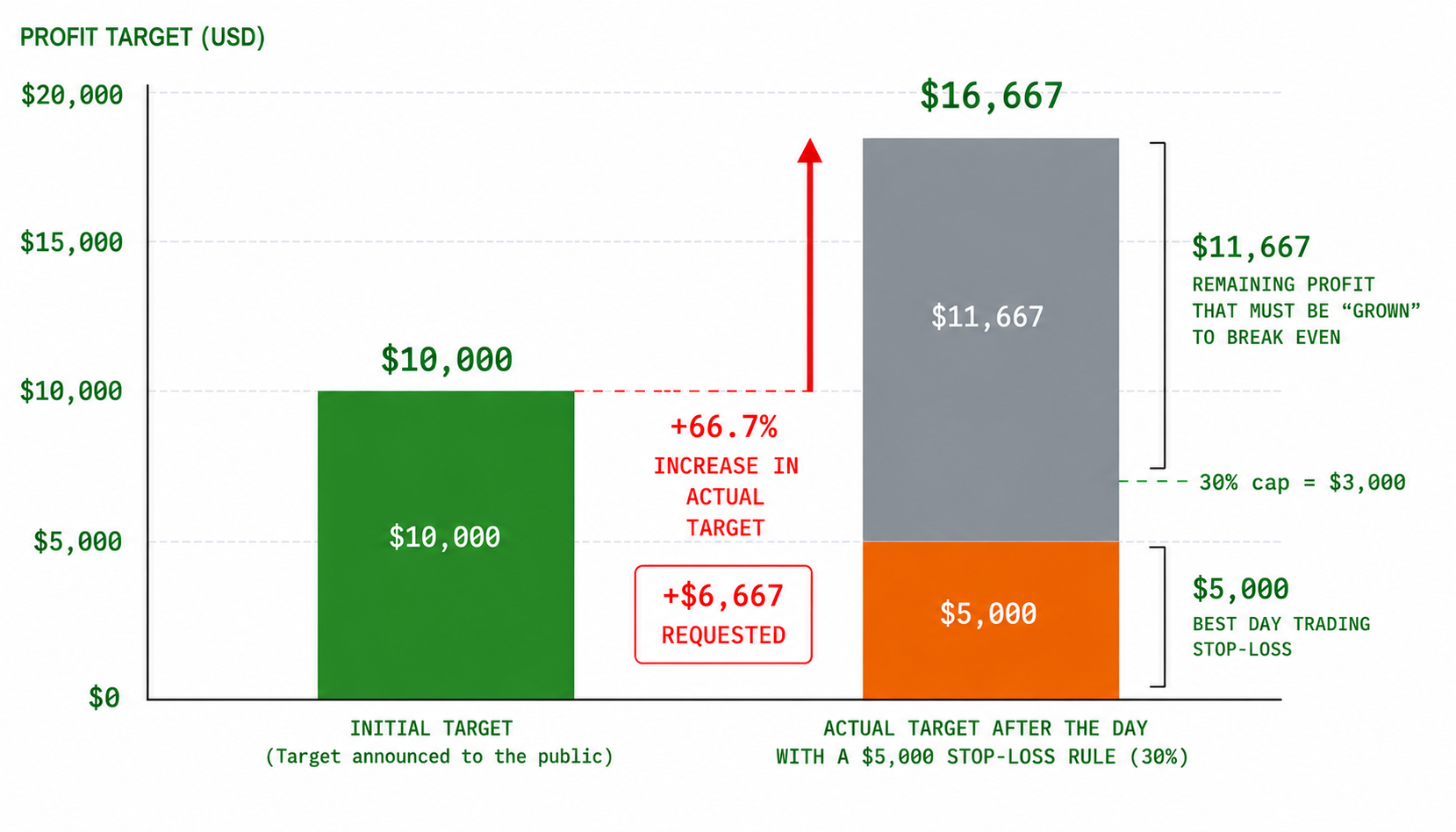
On a day when the market presents a clear directional trend following the release of the Non-Farm Payrolls (NFP) report, your trading system performs flawlessly, allowing you to generate $5,000 in profit during a single trading session.
At this point, the mathematical trap becomes apparent.
For that $5,000 winning day to remain compliant with the Consistency Rule and represent no more than 30.0% of your total profits, your required profit target is no longer the original $10,000. Instead, the actual calculation becomes:
Required Total Profit = $5,000 ÷ 0.30 = $16,666.67
As a result, simply because you had one exceptionally successful trading day, your effective profit target has been silently pushed from $10,000 to approximately $16,667.
In other words, your performance requirement has effectively increased by 66.7%, and you have unintentionally made the challenge significantly harder to complete simply because you traded exceptionally well on a single day.
The fundamental problem with this hidden rule is that it transforms strong trading performance into a penalty. Rather than rewarding traders for capitalizing on high-probability market opportunities, the rule quietly shifts the finish line further away. Most importantly, this hidden increase in the effective profit target is rarely communicated clearly to traders when they purchase the challenge, creating a significant gap between the advertised objectives and the actual conditions required for success.
The Difference Between “Account Termination” and “Account Freeze”
Prop firms often argue that violating the Consistency Rule merely results in a temporary withdrawal restriction rather than immediate account termination, unlike a breach of the daily loss limit. They present this policy as a more trader-friendly and lenient alternative, making it appear less punitive on the surface.
However, from a practical risk-management perspective, an account freeze can be even more damaging and psychologically destructive than a straightforward account termination.
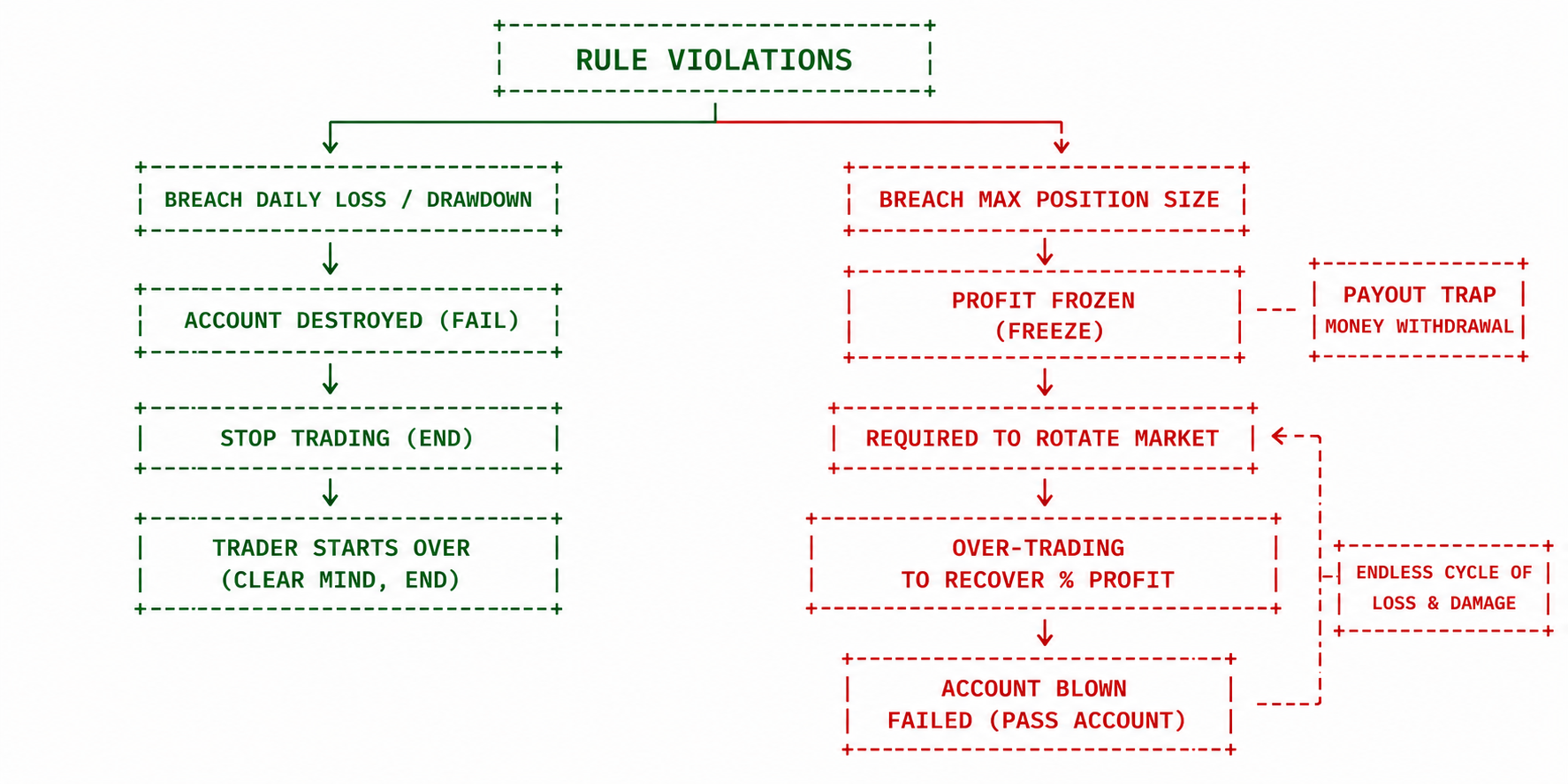
When an account is terminated for breaching the daily loss limit, the outcome is clear: the account is closed, and the trader accepts the loss and starts over. In contrast, when profits are frozen due to a Consistency Rule violation, the trader is placed in an extremely stressful dilemma.
The trader must now find a way to “dilute” the impact of that large winning day by generating additional profits through further trading activity, thereby increasing the overall profit base and reducing the percentage contribution of the original winning day.
To unlock profits that were earned legitimately, the trader is effectively forced to place the very account that successfully passed the evaluation process back into the market’s line of fire. The constant need to generate additional trades simply to reduce a percentage ratio often destroys trading discipline, encouraging excessive and unnecessary market participation.
This is precisely the point at which even the most disciplined traders can begin to break down psychologically. They do not lose their accounts because they lack trading skill. Rather, they become trapped in a cycle of overtrading and emotional exhaustion while attempting to satisfy a hidden algorithm imposed by the firm—an algorithm designed to withhold access to profits that, by all reasonable standards, should already belong to them.
AIProp and the “No Hidden Rules” Standard
Recognizing the frustration, financial harm, and unfair treatment that traders around the world have endured, AIProp (the trading platform behind aiprop.com) was created with a transformative mission: to eliminate hidden rules entirely and establish a new standard of absolute transparency within the global proprietary trading industry.
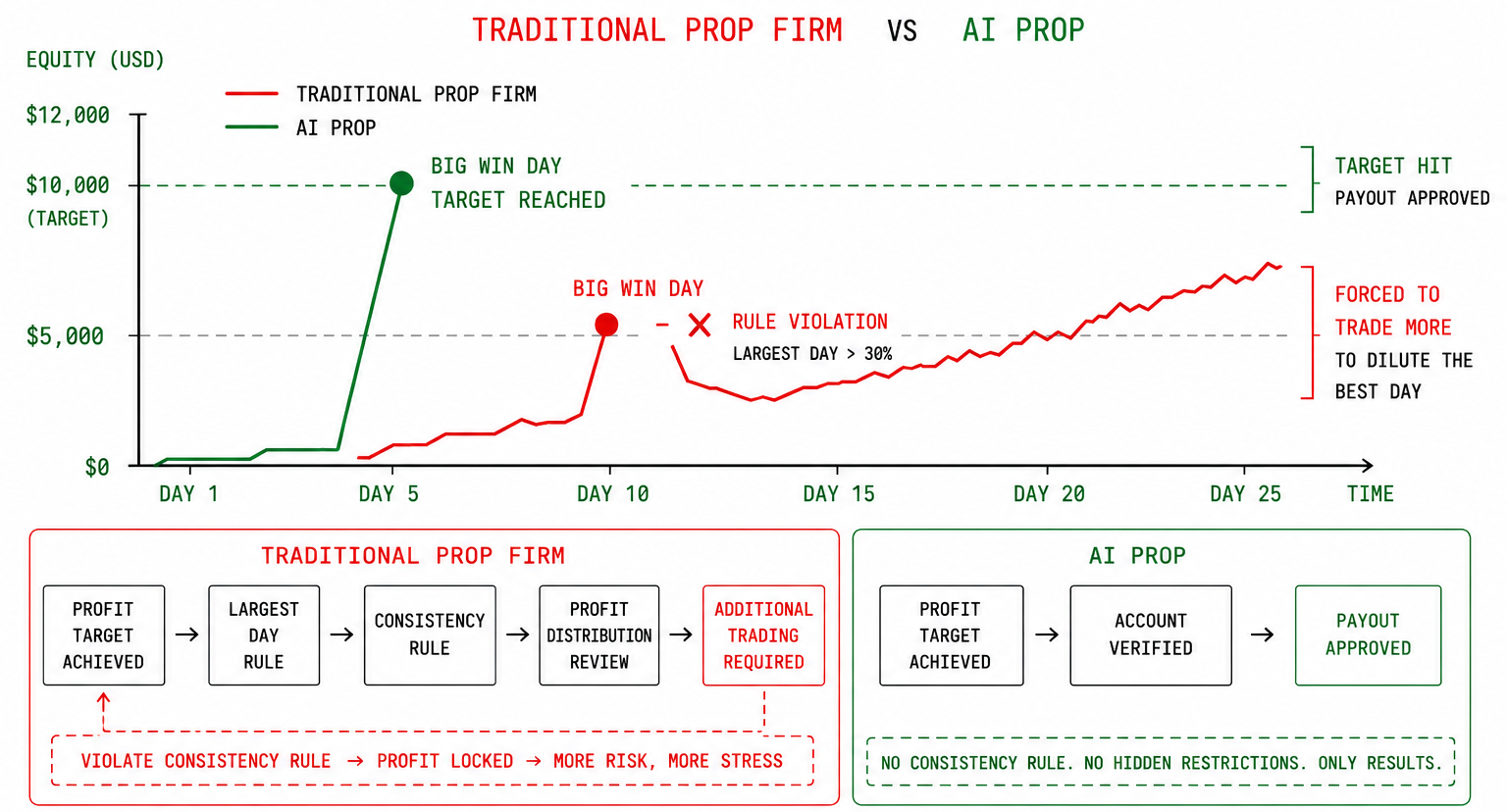
At AIProp, the Consistency Rule has been completely eliminated at every stage, from the evaluation process to fully funded accounts. The structure, pattern, or “shape” of a trader’s profit curve is entirely irrelevant to the evaluation system.
Whether a trader reaches the entire profit target through a single exceptional trading day or accumulates profits gradually over dozens of trading sessions, AIProp treats both outcomes exactly the same. There are no hidden consistency calculations running in the background, no restrictions on the percentage contribution of a trader’s best day, and absolutely no scenario in which profits are frozen simply because a trader performed exceptionally well.
According to proprietary research officially published by AIProp’s Data Analytics Division, the platform has achieved a perfect Friction Score of 0/6. This means that all six of the industry’s most common trader-restrictive rules—including the Consistency Rule, late-trading restrictions, mechanically enforced weekend stop-loss requirements, and other similar constraints—have been completely removed.
Bringing Payout Transparency On-Chain
AIProp’s innovation extends far beyond simply claiming to eliminate hidden rules on paper. To establish a higher level of trust and accountability, the platform has moved its entire profit payout process on-chain, leveraging public blockchain infrastructure for transparency and verification.
Rather than relying on a closed internal ledger controlled exclusively by the firm—where traditional prop firms may retain the ability to alter records, delay withdrawals, or reject payouts based on opaque internal procedures—AIProp records payout activity on a publicly verifiable digital ledger.
As a result, all successful payout transactions and fund movements are permanently recorded and can be independently verified through blockchain explorers by anyone, anywhere in the world.
This approach introduces a level of transparency rarely seen within the prop trading industry, allowing traders to validate payout activity without relying solely on company-issued statements or internal reporting systems.
According to data from AIProp’s internal research cohorts, the combination of eliminating hidden restrictions and implementing on-chain transparency mechanisms has been associated with significantly higher trader account retention rates when compared with broader industry averages. This suggests that reducing unnecessary friction and increasing operational transparency may contribute to a more sustainable and trader-friendly trading environment.
Technical Specification Comparison: AIProp vs. Competitors
| Technical Specification / Rule | AIProp | FTMO / Traditional Prop Firms | cTrader-Based Models (Common Industry Setup) |
|---|---|---|---|
| Consistency Rule | Not Applied (0%) | Applied (Typically 30.0%–35.0%) | Depends on Configuration (Typically 35.0%–50.0%) |
| Rule Friction Score | 0/6 (Friction-Free) | High (Typically 4/6–6/6) | Moderate (Typically 3/6–5/6) |
| Payout Ledger Management System | On-Chain Blockchain (100% Publicly Verifiable) | Internal Ledger (Centralized and Closed) | Internal Ledger Managed by Individual Brokers/Firms |
| Effective Profit Target After a Large Winning Day | Remains Fixed According to the Original Plan | May Increase by up to ~66.7% (Mathematical Trap) | Increases Depending on the Daily Profit Cap |
| Treatment of Exceptional Trading Days | Fully Accepted; Withdrawals Processed Normally | Profits May Be Frozen Pending Compliance Requirements | Subject to Manual Review and Potential Withdrawal Delays |
| Trading Style Freedom | Maximum Flexibility (News Trading, Swing Trading, Scalping) | Often Restricted Around Major News Events | Limited by Risk-Management Algorithms and Firm Policies |
User Response and Market Impact
The industry’s shift from a model based on hidden restrictions to one centered on full transparency, as championed by AIProp, has generated significant discussion throughout the global trading community in 2026. Resistance toward firms enforcing strict consistency requirements reached new heights as several firms faced strong pushback after attempting to tighten such restrictions.
One notable industry incident occurred when a well-known prop firm introduced a 50.0% Consistency Rule on funded accounts. Within less than two weeks, widespread user criticism and a substantial decline in sales reportedly forced the firm’s leadership to publicly address the issue and subsequently remove the rule. The firm acknowledged concerns that consistency restrictions could negatively impact traders whose strategies naturally generate uneven profit distributions.
In another example, a major prop firm reportedly relaxed its consistency threshold from 30.0% to 50.0% in an effort to remain competitive as increasing numbers of traders began seeking alternatives that offered fewer trading restrictions.
Across popular trading communities such as Trustpilot, Reddit’s r/PropTrading, and other industry forums, discussions surrounding transparency, payout reliability, and trading freedom have become increasingly prominent. Many traders who previously experienced difficulties accessing profits due to restrictive payout conditions have expressed appreciation for models that place greater emphasis on clear and predictable rules.
For many traders, the appeal of a transparent environment lies in the ability to focus on what matters most: analyzing markets, executing trading strategies, and managing risk—rather than constantly calculating whether a profitable day may inadvertently create compliance issues later.
Restoring Trust in the Prop Trading Industry
The proprietary trading industry is entering a period of significant transformation. Business models that rely heavily on complex restrictions, opaque payout conditions, or hidden operational rules are facing increasing scrutiny from a more informed and experienced trading community.
Understanding a firm’s payout policies, risk-management framework, and operational rules before purchasing a challenge remains one of the most effective ways for traders to protect both their capital and their efforts.
For traders who prioritize transparency, operational clarity, and a trading environment designed to minimize unnecessary restrictions, AIProp positions itself as an alternative built around the principles of openness and fairness. Through its commitment to eliminating hidden rules and leveraging on-chain technology to enhance transparency, AIProp seeks to create an ecosystem where trader performance—not hidden conditions—remains the primary determinant of success.
To learn more about AIProp and explore its approach to transparent prop trading, visit aiprop.com. Here, traders can discover a new generation of prop trading infrastructure where rules are openly defined, payouts are transparently verifiable, and trading talent is given the opportunity to thrive without unnecessary barriers.
Frequently Asked Questions
1. What exactly is the Consistency Rule used by traditional proprietary trading firms?
The Consistency Rule is a provision that limits the highest profit earned in a single trading day (or trading week) from exceeding a fixed percentage—typically ranging from 30.0% to 50.0%—of the total profit you generate throughout the funded period. The hidden purpose of this rule is to block payout requests if you reach your profit target too quickly through a small number of large winning trades.
2. How is the Consistency Score calculated?
This score is calculated by dividing the profit from your largest trading day by the total profit currently accumulated in the account, then multiplying the result by 100%. If this percentage exceeds the firm’s specified threshold (for example, the 35.0% level that is commonly used across the industry), your payout request will be suspended immediately.
3. If I violate the Consistency Rule, will my account be terminated completely?
No. Violating this rule does not directly terminate your account in the same way as breaching a drawdown limit. Instead, it freezes your payout request. However, it forces you to return to the market and continue trading in order to increase your total profit, thereby reducing the proportion contributed by your largest winning day below the required threshold. This process exposes your account to the risk of giving profits back to the market.
4. How does AIProp solve the Consistency Rule problem?
AIProp completely removes the Consistency Rule across 100% of all account stages. The distribution pattern of your profits is entirely unrestricted. You can achieve your profit target in a single trading day and request a payout as normal. AIProp’s Rule Friction Score stands at a perfect 0/6.
5. What benefits does AIProp’s on-chain payout system provide for traders?
By recording the entire profit payout history on a public blockchain, AIProp delivers absolute transparency. The firm cannot arbitrarily alter records, manipulate its ledger, or cite unfounded technical reasons to withhold trader funds, as can occur within the centralized internal ledger systems used by traditional prop firms.
6. What should I do to protect myself if I have already purchased a challenge from a firm that enforces a Consistency Rule?
You must establish a capital management plan from the very first day: proactively keep daily profits below 20.0% of the overall profit target, and deliberately reduce position sizes when a trading day is already producing substantial gains in order to prevent the percentage from becoming excessively high. However, the most comprehensive and psychologically stress-free solution is still to trade with platforms that operate without hidden rules, such as AIProp.