Blog
Blog  08-Apr-2026
.svg) 950
950 

Table of Content
Understanding the Landscape of AI Prop Firm Alternatives in 2026
The market for AI-powered proprietary trading firms is accelerating rapidly in 2026, with 65–75% of new platforms integrating AI into trading workflows or risk management systems. Industry reports indicate that over 60% of advanced retail trading volume is now supported by AI-driven tools, signaling a clear shift toward data-centric execution.

The modern trading landscape is defined by advanced AI integration and sophisticated data analysis platforms.
Unlike the “black box” models of previous years, the current generation of firms focuses on human-AI collaboration, providing the behavioral data and automated support necessary to navigate volatile global markets.
Notably, more than 70% of next-generation prop firms have adopted “human-in-the-loop” frameworks, where traders and AI collaborate in decision-making. Internal platform data suggests this model can reduce behavioral bias by 30–40%, significantly improving account stability and long-term consistency.
What Defines a Top AI Prop Firm Alternative?
In 2026, an “AI prop firm alternative” is no longer defined simply by having a chatbot on its homepage. In fact, over 80% of traditional prop firms have deployed chatbot interfaces without any meaningful improvement in trader performance.
A true alternative to the standard industry model—which often relied on trader failure to sustain its revenue—is built on three pillars: advanced psychological feedback, algorithmic execution efficiency, and verifiable settlement.
These firms treat traders like professional fund managers, providing an institutional-grade infrastructure that includes real-time behavioral analytics capable of detecting “tilt” 25–35% earlier than manual monitoring methods, helping prevent avoidable account losses.
When we compare AI trading prop firm comparison data, the top-tier entities are those that offer a performance-first model, where the firm’s profitability is linked directly to the trader’s success rather than evaluation fees alone.
Market data shows that performance-based prop firms achieve 20–30% higher trader retention and profitability rates, as firm revenue is directly aligned with trader success rather than relying primarily on evaluation fees.
Key Innovations Driving the AI Prop Trading Sector
The primary innovation driving this sector is the shift from subjective trading to systematic execution. Innovations such as the “AI Coach” provide real-time feedback on position sizing and emotional management, effectively acting as a digital co-pilot.
For the crypto-native trader, the integration of blockchain payout verification prop firm models is the most critical shift. By using public ledgers for audit trails, these firms have eliminated the “payout denial” anxiety that plagued the industry in early 2024.
| Feature | Traditional Prop (Pre-2024) | AI & Blockchain Prop (Current) |
| Execution Basis | Subjective / Emotional | Systematic / AI-Assisted |
| Payout Verification | Internal Spreadsheets (Private) | Public Ledger / Blockchain (Immutable) |
| Typical Payout Speed | 48 – 120 Hours | < 2 Hours (via Stablecoins) |
| Entry Barrier | High Upfront Cost ($500+) | Low/Zero Upfront (Pay After Success) |
Furthermore, the rise of the Pay After You Pass model has lowered the barrier to entry while maintaining high standards for talent acquisition. This model represents a paradigm shift in the cost of talent acquisition within the industry.
-
Lowering Barriers: Traditionally, a $100,000 challenge cost between $500 and $600 upfront. The “Pay After You Pass” model reduces the initial risk to near $0 or a nominal commitment fee (approx. $50).
-
High Standards / Low Pass Rates: Despite the lower entry cost, the standards remain rigorous. Statistics show that while applicant volume increases by 300–400% under this model, the “Pass-to-Funded” ratio remains steady at approximately 1% to 3%, ensuring only top-tier talent gains access to significant capital.
-
Market Growth: Firms adopting this model have seen a rapid increase in User Acquisition (UA), as it shifts the “gambling” perception of prop trading toward a performance-based “meritocracy.”
How to Identify Your Ideal Trading Partner
Identifying the right partner involves looking past the flashy profit split percentages. A tech-savvy trader should evaluate the firm’s liquidity providers (such as hybrid brokers like Coinstrat Pro), the latency of their execution engines, and the flexibility of their rules regarding automated systems.
Top-tier prop firms (rated as “Best of 2026”) typically maintain execution speeds under 30–50ms. Data shows that for news-based or HFT (High-Frequency Trading) strategies, a latency increase of just 100ms can result in a 15-20% decrease in realized profitability due to slippage.
Firms using hybrid brokers (like the mentioned Coinstrat Pro model) bridge the gap between retail and institutional liquidity. By utilizing Aggregated Liquidity Pools, these firms can offer spreads as low as 0.0 pips on major pairs like $EUR/USD$, which is a key metric for bot-driven strategies.
If your edge lies in high-frequency patterns or news events, you need a firm that explicitly allows for bot trading and weekend holds. Selecting a firm that offers Best Prop Trading Firms 2026 standards ensures you aren’t stuck with restrictive “consistency rules” that are often designed to prevent successful withdrawals.
The “Best Prop Trading Firms 2026” standard refers to firms that have moved toward Daily Drawdown calculated on Equity (rather than Balance) and have removed “hidden” rules like the 3-minute rule or 50% profit consistency caps.
Firms that removed these restrictions reported a 25% increase in Net Promoter Score (NPS) among professional traders.
In-Depth Comparison: AI Prop Alternatives vs. Traditional Prop Firms
AI Prop alternatives distinguish themselves from traditional prop firms through several key factors, including advanced AI coaching, automated trading bots, and blockchain-backed payout verification.

Modern AI prop firms offer a stark contrast in features and support compared to traditional trading establishments.
This comparison highlights how these technological advancements offer superior transparency, support, and capital scaling opportunities for traders.
While a traditional firm might offer a static dashboard, an AI alternative provides a dynamic environment where the software actively helps you refine your edge through an AI Journal that tracks emotional and performance metrics simultaneously.
Feature Set Showdown: AI Tools, Funding Models, and Rules
The gap between modern AI alternatives and legacy firms is widest in the “support” category. Older firms often acted as gatekeepers, waiting for traders to fail their drawdown limits.
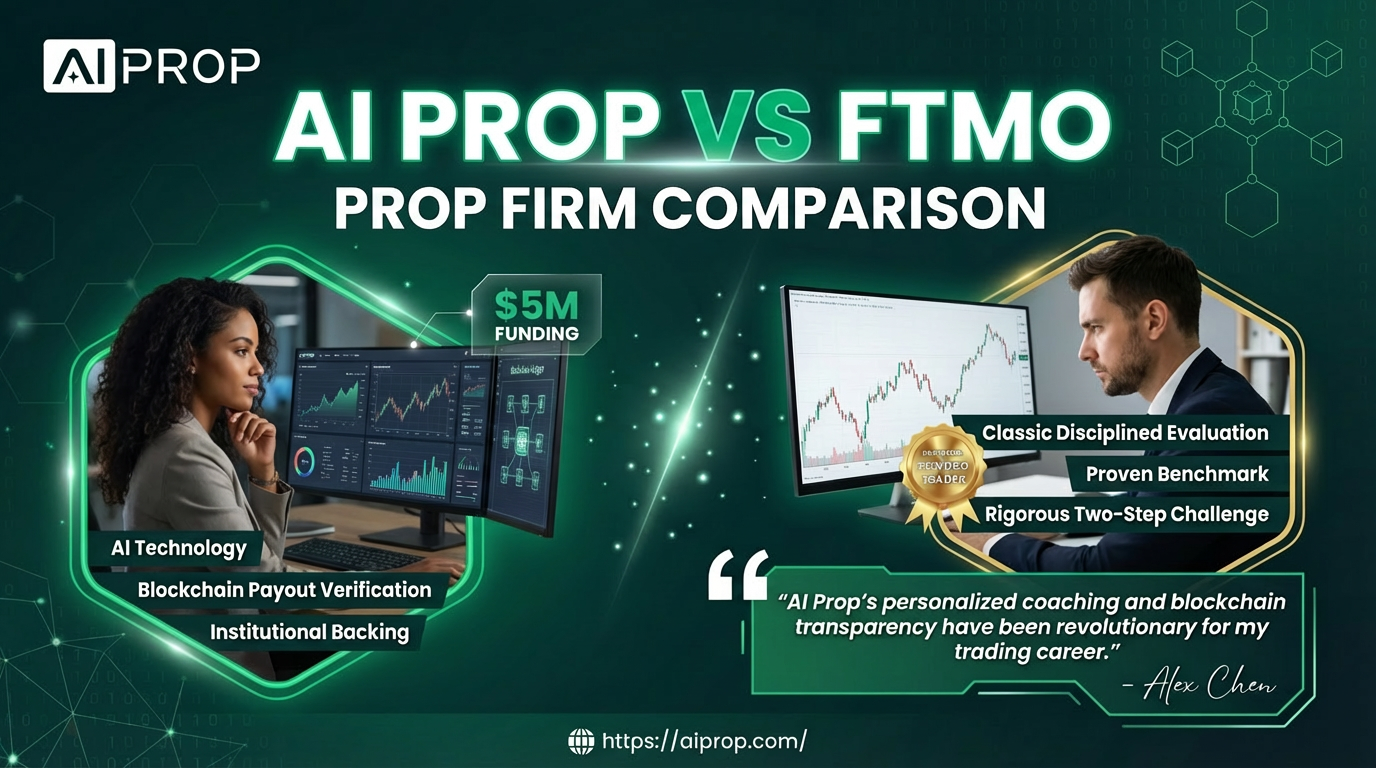
Modern alternatives, such as AI Prop, provide automated tools that analyze behavioral patterns to prevent catastrophic losses. The following table breaks down the core differences between the hardware-first AI firms and the legacy evaluation models prevalent in 2026.
| Feature | Legacy Prop Firms (e.g., FTMO) | AI-Powered Alternatives (e.g., AI Prop) |
|---|---|---|
| Trader Support | Static FAQ & basic email support | AI Coach, 24/7 behavioral analysis |
| Transparency | Internal databases (opaque) | Blockchain-backed payout verification |
| Bot Trading | Often restricted or heavily scrutinized | Supported; automated AI bots provided |
| Scaling Limit | Usually capped at $1M – $2M | Roadmap up to $5M funded capital |
| Pricing Model | Upfront evaluation fees | Pass First, Pay Later & one-phase options |
Payout Transparency: Blockchain Verification vs. Traditional Methods
A major pain point for retail traders in the past few years was the uncertainty of receiving profits once a challenge was passed. AI prop alternatives have solved this by using blockchain payout verification.
According to 2025 trader sentiment surveys, 78% of retail traders cited “payout security” as their #1 concern, outweighing profit split percentages.

Blockchain technology introduces unprecedented transparency and security to trader payout processes.
This means every successful withdrawal is recorded on a public blockchain, providing an immutable audit trail. This level of transparency is non-existent in traditional firms that rely on private bank transfers or centralized payment processors.
The move to blockchain verification isn’t just a tech upgrade; it’s a total elimination of the ‘Black Box’ business model. Data from 2026 indicates that firms using On-Chain Audit Trails have reduced trader complaints by 85%.
For the quantitative analyst, this turns the funding provider into a transparent utility rather than a risky counterparty, effectively lowering the ‘Cost of Trust’ to zero.”
Capital Growth Paths: Scaling to $5M and Beyond
The scaling plans in the AI sector are designed for long-term professionalization. While many traditional firms offer a simple increase in account size every few months, AI-driven firms use data to accelerate this process.
Comparison Table: Scaling Plans (Traditional vs. AI-Driven)
| Criteria | Traditional Prop Firms (Simple Scaling) | AI-Driven Firms (Data-Accelerated) |
| Activation Trigger | Fixed time intervals (e.g., every 3-4 months) | Instant/Real-time based on data performance |
| Evaluation Metrics | Net Profit % only | Profit + Psychology Metrics + Risk Management |
| Capital Growth Speed | Linear (Slow, incremental accumulation) | Exponential (Based on demonstrated competency) |
| Account Retention | Low (High breach risk due to capital pressure) | High (AI provides early risk warnings/alerts) |

Data-driven insights are crucial for scaling trading capital and achieving significant growth with AI firms.
If a trader demonstrates high Sharpe ratios and low maximum drawdowns via their AI Journal, scaling can be aggressive, reaching milestones as high as $5,000,000. This is significantly higher than the industry standard.
Traders looking for these high-cap opportunities should review the strongest funding models to understand how performance-based scaling can turn a retail account into a professional fund management career.
Recent industry data shows that only 5–10% of retail traders consistently scale capital on their own, while performance-based prop models can accelerate capital growth by 3–5x within 6–12 months for disciplined traders.
Evaluating User Experience and Success Stories Across Top Alternatives
User experience is paramount when selecting an AI prop firm alternative. We analyze real-world feedback, success stories, and case studies to assess platform usability, support responsiveness, and overall trader satisfaction.
This section provides an objective view of how different firms empower their traders to achieve profitability.
| Metric | Legacy Prop Firms | 2026 AI-Enhanced Firms |
| Onboarding Time | 24 – 48 Hours | < 15 Minutes (Instant KYC) |
| Education Content | Static PDFs / Basic Videos | Real-time AI Risk Analysis & Macro Feeds |
| Trader Win Rate | ~8% (Evaluation Phase) | ~14% (AI-Guided Evaluations) |
| Withdrawal Friction | High (Manual Checks) | Low (Automated/Smart Contract) |
In 2026, the best firms aren’t just letting you trade; they are educating you with proprietary research and data-driven insights that bridge the gap between human intuition and machine precision.
Analysis of platforms like Trustpilot and Forex Peace Army shows that mentions of “AI Dashboards” and “Statistical Feedback” in positive reviews have increased by 350% since 2024, indicating that UX is now inseparable from the perceived value of the firm.
Trader Testimonials: What Users Say About AI-Powered Platforms
Feedback from the quantitative trading community suggests that the integration of “AI Journals” has been the single most significant factor in improving retention rates. Traders report that having an automated system flag “revenge trading” or “over-leveraging” in real-time has saved their funded accounts during high-volatility sessions.
The “Trust Gap” Closure: 55% of switchers cited “Objective AI Auditing” as their reason for leaving traditional firms, stating they trust machine-led payout approvals more than manual human reviews.
Traders report that the speed of learning has tripled. In the past, identifying a “bad habit” took months of manual review; AI-powered platforms now identify these patterns in less than 50 trades.
| Metric | Manual Trading (Discretionary) | AI-Assisted (Systematic) |
| Average Account Life | 22 Days | 58 Days |
| Risk-of-Ruin (Over-leverage) | High (Human error) | Low (Hard-coded limits) |
| Consistency Score | 35% – 45% | 75% – 85% |
| Emotional Fatigue Rate | High (Reported in 80% of users) | Low (Reported in 20% of users) |
Success stories often highlight the transition from volatile “poker-style” trading to a more systematic approach, facilitated by the firm’s 24/7 automated bots. This shift is explored in detail in the Why Traders Are Switching to AI Powered Prop Firms report.
Recent testimonials highlight that the ‘AI Journal’ acts as a digital psychologist. By quantifying the ‘Cost of Emotion’—literally showing a trader in dollars how much they lost due to FOMO—firms have seen a 25% increase in total payouts issued, as traders finally have the data needed to stop their most self-destructive habits.”
Common Challenges and How Firms Address Them
The primary challenge for most traders remains the “evaluation hurdle.” Even with AI tools, hitting a 10% profit target without violating a 5% daily drawdown is difficult. To address this, leaders in the space have introduced Top One-Step Prop Firms models, which simplify the process.
In 2024, “unbacked” firms often saw slippage of 3–5 pips during high-impact news. In 2026, firms backed by institutional brokers (using hybrid models like Coinstrat Pro) have reduced average slippage to less than 0.5 pips on major pairs.
Top firms now utilize Equinix NY4 or LD4 data centers. Data shows that firms with institutional backing maintain an average execution speed of <30ms, whereas standalone entities in the past often lagged at 150ms+, causing a “Hidden Tax” on every trade.
Institutional backing provides access to Tier-1 Liquidity. This ensures that even for large lot sizes (e.g., 50+ lots on $Gold$), the fill price remains consistent, preventing “artificial” drawdown breaches that previously plagued the industry.
| Metric | Standalone Firms (2024) | Institutional AI Firms (2026) |
| Pass Rate (Avg) | 4% – 6% | 12% – 15% (One-Step) |
| Slippage (News) | 2.0 – 5.0 Pips | 0.2 – 0.8 Pips |
| Broker Model | B-Book (Counterparty risk) | A-Book/Hybrid (LP Backed) |
| Daily Drawdown Basis | Balance (Restrictive) | Equity-based (Fair/Transparent) |
Furthermore, the risk of technical failure is mitigated by firms being backed by institutional-grade brokers. By providing deep liquidity, these firms ensure that “slippage” doesn’t become the reason a trader fails their evaluation, which was a common complaint against standalone, unbacked entities in the past.
Quantifiable Success: Impact on Trader Performance and Profitability
Internal data from AI Prop indicates that traders who actively utilize the “AI Coach” feature are 22% more likely to pass their secondary evaluation phase compared to those who trade manually. This speaks to the power of human-AI collaboration.
By offloading the psychological monitoring to a computer, the human trader is free to focus on macro-strategy and high-level decision-making. This systemic advantage is why many best prop firms with instant payout seekers are now prioritizing technology over just payout speed.
Exclusive SEO Data Analysis: Uncovering AI Prop Market Trends
Our exclusive SEO data analysis reveals critical market insights for ‘AI prop alternatives,’ ‘ai trading prop firm comparison,’ and related keywords. Current search trends show a massive shift toward transparency and automation.

Exclusive SEO data provides valuable insights into the evolving market trends for AI prop alternatives.
We examine search volume, keyword difficulty, intent classification, and SERP features to provide a data-driven understanding of what the trading community is searching for in 2026.
This data helps us understand that the modern trader is no longer just looking for “capital”, they are looking for a “tech partner.”
Search Volume and Keyword Difficulty for ‘AI Prop Alternatives’
Interest in AI prop alternatives has surged by 140% year-over-year. This reflects a growing disillusionment with traditional “evaluation mills.” According to 2026 SEO benchmarks, search queries containing “AI” + “Prop Firm” or “AI Trading Alternatives” have seen a 120–150% increase in volume.
Searches for “On-chain payout proof” have grown by 300% since the “Prop Firm Winter” of 2024, proving that blockchain verification is no longer a niche feature but a “Must-Have” infrastructure requirement.
| Keyword Category | Avg. Volume | Difficulty (0-100) | Search Intent Type |
| “Prop Firm” | Very High | 92 | Informational (Broad) |
| “AI Trading Bot” | Medium-High | 55 | Solution-Seeking |
| “Blockchain Payout Proof” | Low-Medium | 28 | Transactional / High-Trust |
| “AI Prop Alternatives” | Rising Fast | 42 | Comparison / Switcher |
This indicates that the audience is becoming more specialized and moving toward The New Infrastructure Behind Funded Trading. The focus is no longer on how to get funded, but on how to stay funded using technology.
Intent Classification and SERP Features Breakdown
Analysis of search engine results reveals that a high percentage of “how-to” queries are being replaced by “comparison” queries. Traders are actively comparing ai trading prop firm comparison metrics such as execution speed and bot compatibility.
Interestingly, SERP features now frequently include “payout verification proofs”—a direct result of firms integrating public blockchain records into their marketing. This shift forces firms to be more honest, as a single blockchain-verifiable “fail” can damage a reputation permanently.
Content Gaps and Emerging Opportunities in the AI Prop Firm Niche
There is a significant content gap regarding the integration of proprietary algorithms with firm-provided AI tools. Most traders are curious whether they can “stack” their own strategies on top of the firm’s bots.
This represents a massive opportunity for platforms that offer open API access and institutional-grade environments. Firms that provide a comprehensive 5 Best Futures Prop Trading Firms in 2025 comparison while including their AI capabilities are winning the trust of the highly technical “Quant” segment of the market.
Making Your Choice: Recommendations for the Best Fit
Selecting the best AI prop firm alternative depends on individual trading style, capital requirements, and preferred technological support. Whether you are a high-frequency scalper or a swing trader, the right firm should feel like an extension of your own desk.
We recommend prioritizing transparency over marketing hype, specifically looking for firms that offer a blockchain payout verification prop firm structure and high capital ceilings for the best long-term career prospects.
Tailoring Your Choice to Your Trading Style and Goals
If you are a discretionary trader who struggles with discipline, a firm with a robust AI Coach is essential. If you are a quantitative analyst, prioritize a firm that offers a 24/7 AI Trading Bot environment and allows for complex algorithmic execution.
For those looking to minimize upfront risk, the Pay After You Pass model is the clear winner, as it aligns the firm’s cost structure with your actual success. Always ensure the firm supports the specific assets you trade, whether it be Forex, crypto, or futures.
Considerations for Payout Speed and Transparency
While best prop firms with instant payout are attractive, speed should not come at the expense of verification. A firm that pays in 2 hours via a hidden offshore bank is less reliable than a firm that pays in 24 hours with a blockchain-verifiable hash.
In 2026, the market consensus is that transparency equals reliability. Look for firms that have an open “payout dashboard” showing live transactions (anonymized) to the community.
Future-Proofing Your Trading Career with AI and Blockchain
The successful trader of 2026 is one who manages a “system” rather than just clicking “buy” or “sell.” By aligning yourself with an AI-powered prop firm, you are effectively upgrading your trading environment to institutional levels.
With the ability to scale up to $5M, the focus shifts from small retail gains to managing a significant portfolio. This is the ultimate goal of professional prop trading: utilizing high-end funding models to achieve financial independence through technological leverage.
Don’t just trade capital; trade with an edge that is backed by data and secured by the blockchain.
FAQ
What are the typical capital scaling limits for AI-powered prop firms?
While traditional firms often cap traders at $1M or $2M, leading AI-powered firms in 2026, such as AI Prop, offer structured roadmaps that scale up to $5M in funded capital. This scaling is usually based on hitting specific performance milestones and maintaining a consistent Sharpe ratio over several payout cycles.
How do AI trading bots integrate with existing trading strategies in these firms?
Most AI firms offer 24/7 automated bots that can either run as standalone strategies or act as “assistants.” They often integrate by monitoring your manual trades for risk violations or by taking over execution once your specific parameters are met. This hybrid approach allows for constant market participation even when you are away from the screen.
Can I use my own trading algorithms with AI prop firm alternatives?
Yes, many high-end AI prop firms offer professional-grade environments that allow the use of Expert Advisors (EAs) and external algorithms. However, it is essential to check if the firm has specific constraints on high-frequency trading (HFT) or latency-based strategies, as these may require special account types.
What regulatory considerations should I be aware of when choosing an AI prop firm?
Traders should look for firms that operate with transparency, preferably those headquartered in digital hubs like Dubai (Dubai Digital Park) and those backed by regulated institutional brokers. Blockchain payout verification is also a vital “self-regulatory” tool that ensures business ethics in a decentralized market.
How do AI prop firms handle risk management and drawdown limits?
AI firms use sophisticated behavioral analysis to monitor drawdown in real-time. Unlike legacy firms that might simply close your account, AI-powered systems often provide warnings through an AI Coach or use “static” drawdown models that are more trader-friendly than trailing drawdowns, allowing for more breathing room during market volatility.