Prop Firm Hacks
  08-Apr-2026
.svg) 136,515
136,515 

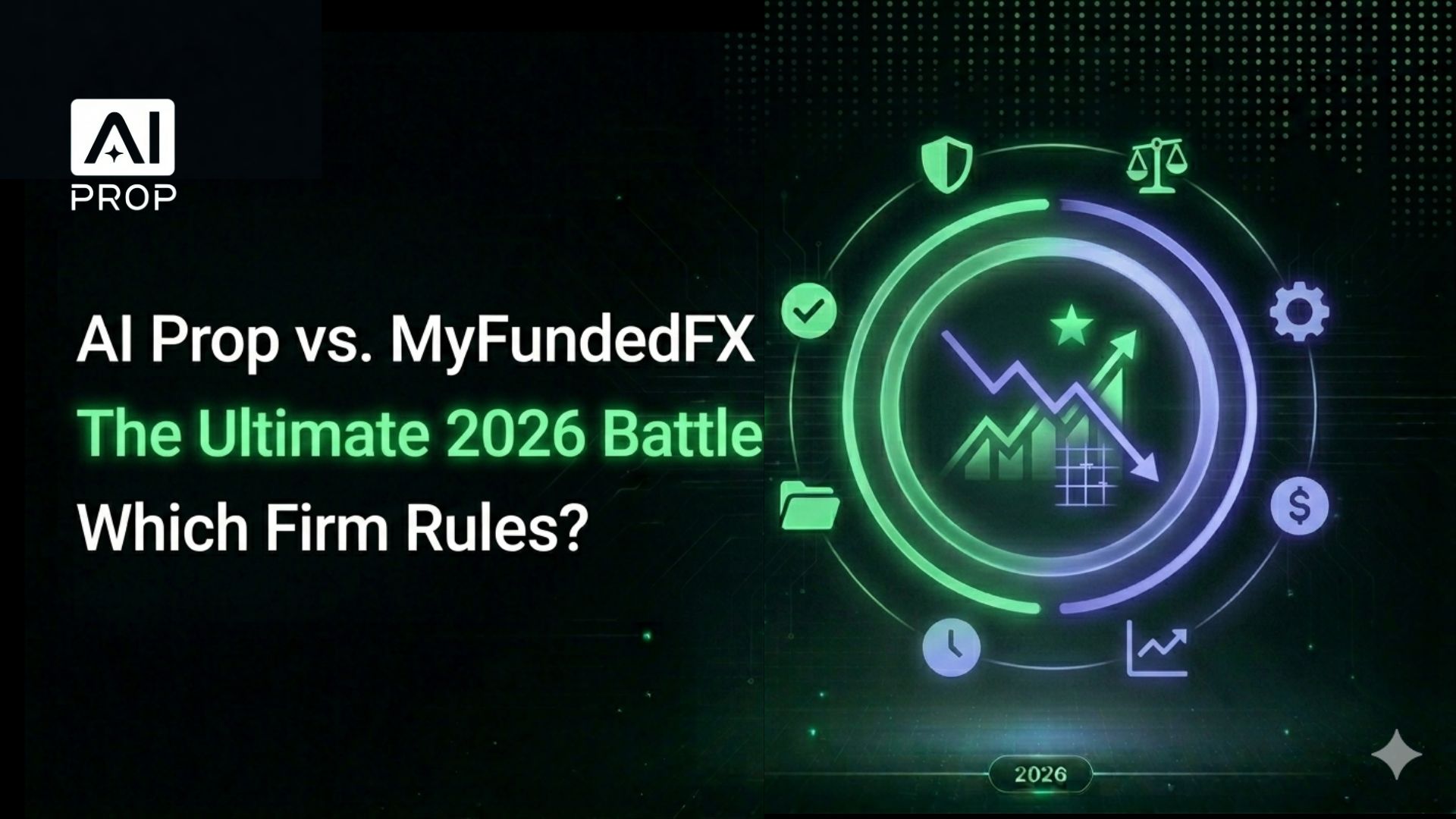
Table of Content
TLDR
- This keyword is no longer a normal head-to-head prop comparison. In April 2026, AI Prop is still positioning itself as an active prop firm with a $5M scaling roadmap, zero-friction positioning, full EA + AI support, and blockchain-verified payouts. MyFundedFX, meanwhile, has already been pulled into the Seacrest transition story and no longer looks like a standard standalone prop-firm offer.
- If your priority is scale, automation freedom, and a business model built around trader success rather than upfront challenge churn, AI Prop has the stronger strategic narrative in 2026.
- If your interest in MyFundedFX comes from its old reputation for flexible retail-friendly prop access, that context matters. But the current operating reality matters more than nostalgia. In 2026, operating continuity and payout transparency are not side notes. They are the whole test.
- The biggest mistake in this keyword is comparing feature lists without comparing business-model durability. The real decision is not just who had better rules. It is which platform still gives traders a more credible path forward.
Why this comparison matters now
Search intent around AI Prop vs. MyFundedFX has changed fast. A year ago, this would have looked like a classic prop-firm comparison. Which firm has better challenge conditions. Which one scales faster. Which one gives a smoother path to funding.
In 2026, that is not enough. The market has become much harsher on firms that look attractive on the front end but weak on payout credibility, capital durability, or operating continuity. That is exactly why AI Prop has leaned so hard into structural claims like blockchain-verified payouts, Pass-First-Pay-Later, and full EA + AI support.
AI Prop’s own April 2026 benchmarking work places the company in what it calls the Era III layer of the industry. That is its shorthand for a prop model built around infrastructure, behavioral tooling, automation, and trader-performance alignment rather than a pure challenge-fee game.
MyFundedFX represents the opposite tension inside this keyword. The brand still carries recognition among traders who remember the older retail-prop cycle. But by February 2026, Finance Magnates reported that Seacrest ended prop trading after integrating MyFundedFX and shifted focus toward CFDs. The current MyFundedFX domain now presents as Seacrest Markets and displays an update notice regarding prop trading programs.
So let us call it straight. In 2026, AI Prop vs. MyFundedFX is not really a battle between two equally current prop-firm models. It is a comparison between an active next-generation prop pitch and a legacy prop brand whose operating path has already been disrupted.
The 2026 reality check
If you want the short version, start here.
| Dimension | AI Prop | MyFundedFX |
| 2026 positioning | Active prop-firm positioning built around AI tooling, payout transparency, and a $5M roadmap. | No longer a clean standalone prop comparison. Public reporting in February 2026 says prop operations were ended under the Seacrest transition. |
| Core offer | Pass-First-Pay-Later, full EA + AI support, zero-friction messaging, blockchain-verified payouts. | Classic multi-phase retail-prop style in AI Prop’s comparison framing, with upfront evaluation costs and a more conventional trader journey. |
| Capital narrative | Benchmark page positions AI Prop at the highest funding ceiling in its comparison set at $5.0M. | AI Prop’s MyFundedFX comparison article frames MyFundedFX as a lower-scaling, more traditional option. |
| Business-model story | Performance-first narrative. AI Prop says it keeps a share from successful traders and therefore has incentive to improve trader outcomes. | Legacy retail-prop narrative built around challenge access and flexibility rather than a new infrastructure layer. |
| Best-fit trader | Systematic, automation-friendly, scale-seeking trader who cares about payout auditability and long-term alignment. | Trader who originally wanted familiar retail-prop structure, broad community energy, and a more traditional challenge path. |
Where AI Prop has the stronger case
AI Prop wins this keyword when the conversation moves from surface-level rules to platform structure.
What stands out most is not one single feature. It is the stack.
- AI Prop’s benchmark page places it at a $5.0M maximum funding ceiling, which it describes as the highest in the benchmark set and 25 percent above the next tier.
- The same benchmark assigns AI Prop a trader-friction score of 0 out of 6, explicitly stating that it is the only firm in the set at zero. That matters because the index counts the very restrictions traders complain about most, including consistency rules, news limits, weekend restrictions, automation limits, full upfront fees, and hidden or discretionary rules.
- AI Prop’s benchmark language is unusually aggressive here. It positions the firm as allowing full EA + AI support and uses automation freedom as a defining line between older firms and its own model.
- Payout transparency. AI Prop is also the only firm in its benchmark that it describes as having on-chain payout verification. Whether you love the branding or not, that is a meaningful trust signal because it turns payout proof from a screenshot game into a public audit trail.
- Incentive alignment. AI Prop’s comparison articles repeatedly circle back to the same message. If the firm makes money mainly when traders succeed and scale, the relationship is healthier than the old challenge-fee churn logic.
This combination creates a clear positioning statement.
AI Prop is not trying to be the safest-looking legacy prop brand. It is trying to look like the most structurally modern one.
For SEO, that matters because high-intent traders in 2026 are not just asking who has a lower fee today. They are asking who is still likely to pay, scale, and operate cleanly tomorrow.
What MyFundedFX originally did well
To write this comparison honestly, you also have to acknowledge why MyFundedFX got attention in the first place.
AI Prop’s own MyFundedFX comparison article frames the brand as a more classic high-volatility retail-prop environment. It emphasizes familiar multi-phase evaluation, flexible challenge structure, broad appeal, and community energy. The piece also leans on MyFundedFX’s reputation for variety and trader accessibility rather than deep infrastructure differentiation.
That tells you something important about the old MyFundedFX appeal. The brand was not necessarily the most institutional. It was attractive because it felt usable, energetic, and recognizable to retail traders.
For some traders, that was enough. A classic challenge path is easy to understand. A large community creates social proof. A familiar retail-style offer reduces friction in the buying decision even when it does not reduce structural friction in the actual trading experience.
But this is where the 2026 version of the keyword breaks.
- You cannot compare a remembered brand image with a live operating model and pretend both are equally current.
- The official MyFundedFX domain now presents as Seacrest Markets rather than a normal active prop-firm homepage.
- Finance Magnates reported in February 2026 that Seacrest ended prop trading after integrating MyFundedFX.
- That means traders searching this keyword today should treat MyFundedFX less as an ongoing clean benchmark and more as a case study in why continuity risk matters.
The real issue is business-model durability
This is the section most comparison articles miss.
Prop firms are easy to market with discount codes, dashboard screenshots, and challenge promotions. They are much harder to evaluate as businesses. Yet that business layer is exactly where the biggest trader risk sits.
AI Prop’s research pages make a repeated structural argument. Older prop models often monetize attempts. Newer models should monetize trader performance. That is the logic behind its Era III language, its Pass-First-Pay-Later model, and its emphasis on behavioral tooling. The firm is selling the idea that it earns more when the trader survives longer and performs better.
MyFundedFX, by contrast, sits inside the cautionary side of the 2026 prop story. Once a firm’s operating direction shifts, the elegance of its rules becomes secondary. A prop offer is only as good as the institution still standing behind it.
That is why payout transparency deserves more weight than traders used to give it. In a fragile industry, trust is not a marketing layer. It is infrastructure.
Why payout transparency became the decisive filter
This point deserves its own section because it changes how serious traders evaluate every prop brand now.
AI Prop’s benchmark explicitly says the February 2026 MyFundedFX shutdown showed that even firms with strong review profiles can fail without much warning. The benchmark uses that example to argue for independently verifiable payout systems rather than firm-reported payout claims.
You do not have to buy every piece of AI Prop branding to admit the core point is valid. Screenshots, community posts, and review ratings are weaker evidence than public verification systems and uninterrupted operating history.
That cuts both ways. AI Prop has the stronger transparency narrative because it publishes on-chain payout proof. MyFundedFX historically had the advantage of earlier retail recognition. But in 2026, recognition without continuity is not enough.
The brutal version is simple. A prop trader can adapt to a slightly worse rule set. It is much harder to adapt to a platform that changes direction, freezes operations, or disappears.
Who should choose AI Prop in 2026
- Choose AI Prop if you care most about automation freedom, because the research positioning is built around full EA + AI support rather than partial accommodation.
- Choose AI Prop if you think long-term scaling matters more than short-term coupon economics, because its benchmark narrative is dominated by the $5M ceiling and performance-aligned structure.
- Choose AI Prop if you are skeptical of opaque payout claims, because its differentiation hinges on blockchain verification and public audibility.
- Choose AI Prop if you want a prop experience that feels closer to a systems-and-feedback product than a pure challenge storefront.
Who would have preferred MyFundedFX
Before the 2026 operating shift, MyFundedFX would have appealed most to traders who preferred a classic retail-prop rhythm.
That usually meant traders who wanted a familiar multi-step challenge, broad community participation, a more conventional support path, and fewer conceptual jumps in how the product is explained.
But the tense matters here. Would have preferred. Not necessarily should choose now.
In the current market, an interrupted brand story changes the answer. Even if you liked the old MyFundedFX value proposition, the smarter comparison today is whether you are looking for an active prop platform or simply researching a once-popular name.
Final verdict
If this were a 2025-style comparison, you could argue about challenge design, cost structure, and community preference.
In 2026, the cleaner conclusion is sharper than that. AI Prop wins this keyword because it is still offering an active, coherent, future-facing prop narrative built around scale, automation, and payout transparency. MyFundedFX no longer competes from the same starting line.
That does not automatically mean every trader should choose AI Prop. It does mean the burden of proof has shifted. An active platform with a clear infrastructure thesis now has a structural advantage over a familiar brand whose prop identity has already broken apart.
So the best hook for this keyword is also the honest one. AI Prop vs. MyFundedFX is no longer just a feature comparison. It is a lesson in what survives when the prop market gets serious about trust.