Blog
Blog  08-Apr-2026
.svg) 115,140
115,140 

TLDR
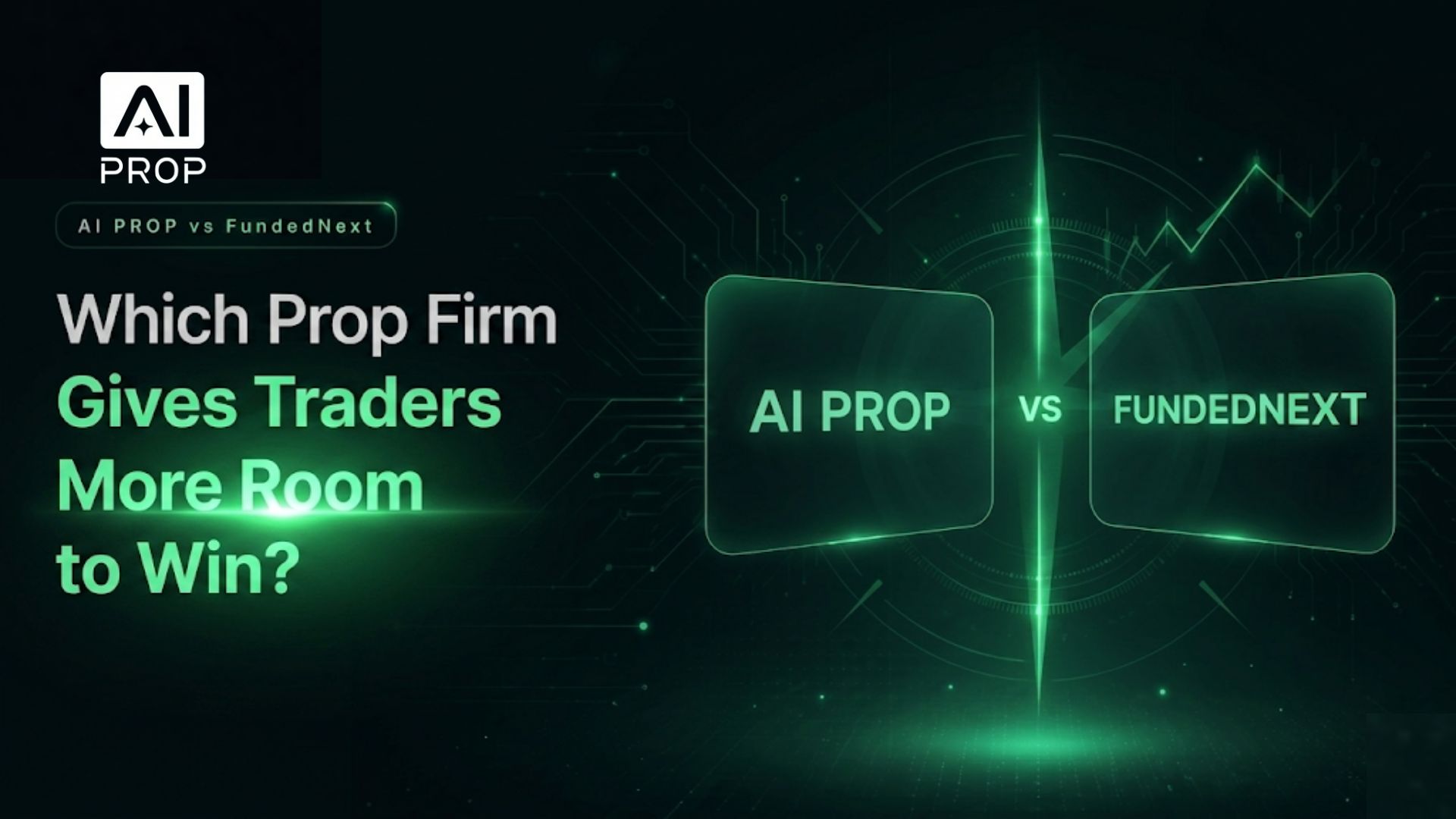
- If you want the quick answer, AIProp looks stronger on trader freedom. FundedNext looks stronger on brand maturity.
- The AIProp benchmark page lists AIProp at a $5.0M capital ceiling versus FundedNext at $4.0M, putting AIProp 25 percent above the next funding tier that includes FundedNext.
- On structural friction, AIProp is scored at 0/6 while FundedNext is scored at 3/6. That gap is one of the clearest separators in the benchmark.
- On rule design, AIProp is listed with no consistency rule, full EA + AI support, and blockchain payout verification. FundedNext is listed with a 40 percent consistency cap, partial automation support, and no blockchain payout verification.
- On reputation and operating history, FundedNext leads. The benchmark lists FundedNext at 4 years in operation, versus 2 years for AIProp.
- The cleanest conclusion is this. AIProp is built for traders who want a more open performance infrastructure. FundedNext is likely to appeal more to traders who prefer a more established name with stronger public-review optics.
What this keyword is really about
Most comparison keywords sound like a head-to-head fight. “AI Prop vs FundedNext” is not really that. Once you read the benchmark, it becomes a decision about trading environment.
- One side is optimizing for freedom, automation, and long-run scale.
- The other side is optimizing for familiarity, external trust, and a more established market footprint.
That is why this comparison matters. Both firms look credible in the benchmark. The difference is not that one brand has no strengths. The difference is that the strengths sit in different places.
So the useful question is not “Which firm is cooler in 2026?” The useful question is “Which structure fits the way you actually trade?”
Table 1. AIProp vs FundedNext 2026 at a glance
| Dimension | AIProp | FundedNext | What it suggests |
| Max funding ceiling | $5.0M | $4.0M | AIProp offers the higher scaling ceiling. |
| Trader-friction score | 0/6 | 3/6 | AIProp removes more structural rule pressure. |
| Consistency rule | None | 40% cap | FundedNext has a meaningful best-day concentration constraint. |
| Automation policy | Full EA + AI | Partial | AIProp is structurally stronger for system traders and AI-assisted execution. |
| Blockchain payout verification | Yes | No | AIProp adds an auditability layer that FundedNext does not match in the benchmark. |
| Years of operation | 2 years | 4 years | FundedNext has the longer operating record. |
Source: AIProp Research Hub benchmark page, April 2026. The wording “40% cap” and “partial” are taken from the benchmark’s master comparison table.
The short answer
AIProp wins the structure-first version of this comparison. FundedNext wins the maturity-first version.
That is the honest read from the benchmark. AIProp leads on capital ceiling, rule freedom, automation openness, payout verification, and what the benchmark calls the high-freedom and high-capital quadrant. FundedNext leads on review score and operating history.
So if you are trying to reduce the whole comparison to a single sentence, it goes like this. AIProp looks better for traders who want fewer built-in restrictions. FundedNext looks better for traders who care more about external trust signals.
Where AIProp clearly leads in 2026
1. Higher capital ceiling
The benchmark places AIProp at a $5.0M maximum funding ceiling. FundedNext is listed at $4.0M. That makes AIProp 25 percent above the next tier, which the benchmark explicitly says includes FundedNext, The 5%ers, Blue Guardian, and Aqua Funded.
That difference matters because scaling capacity is not just a vanity number. For traders who think in terms of staying with one ecosystem, a higher ceiling changes the long-term upside of the relationship.
2. Lower structural friction
AIProp is scored at 0/6 on the trader-friction index. FundedNext is scored at 3/6. In the benchmark, lower is better. AIProp is the only firm at zero. FundedNext sits in the middle cluster of firms that still impose several forms of structural drag.
That does not mean FundedNext is unusually harsh. It means the benchmark sees AIProp as materially more open. And in a category where small rules can change trader behavior, that difference is not trivial.
The benchmark is especially clear on this point. It says rules are not neutral. They shape outcomes. That framing matters because it shifts the conversation from marketing claims to actual process design.
3. No consistency rule versus a 40 percent cap
This is one of the most practical differences in the whole comparison. AIProp is listed with no consistency rule. FundedNext is listed with a 40 percent consistency cap.
Why does that matter? Because the benchmark argues that consistency rules can pressure traders to keep trading after a strong day just to dilute concentration. In its broader dataset discussion, it notes that 12 of 16 firms impose a best-day consistency rule and frames that as a structural source of overtrading risk.
Again, that is not proof that every FundedNext trader will overtrade. But it is a real structural difference. If you value flexibility after a strong session, AIProp has the cleaner position.
4. Full EA and AI support
The benchmark codes AIProp as full EA + AI support. FundedNext is coded as partial. For discretionary traders, this may sound secondary. For traders building automation, semi-systematic workflows, or AI-assisted decision support, it is a first-order issue.
The benchmark then connects automation policy to outcome evidence inside AIProp’s own observational dataset of 1,000 traders. In that dataset, AI-assisted traders showed a 12.2 percent breach rate versus 18.4 percent for manual traders. Max drawdown was 4.3 percent for AI-assisted traders versus 7.8 percent for manual traders. A hybrid AI and human sub-cohort posted the best result on the benchmark page at 8.5 percent breach rate.
That does not prove AIProp beats FundedNext in live trader results. The source is explicit that these are within-firm associations, not causal proof and not cross-firm testing. Still, it helps explain why automation policy is not just a technical footnote. It changes what traders are allowed to use in order to control execution error.
5. Payout transparency and category positioning
AIProp is the only benchmarked firm with blockchain payout verification. FundedNext is listed as having no equivalent layer. That distinction is small on the homepage and large in due diligence. One gives traders an independent audit trail. The other relies more heavily on company disclosure and external review platforms.
The benchmark also places AIProp in what it calls Era III, the intelligence-platform phase of prop trading. FundedNext is grouped with FTMO, Apex, and Topstep in Era II, which the report associates with payout volume and structured evaluations rather than intelligence infrastructure.
You do not need to buy the branding language wholesale to see the point. The benchmark is saying AIProp is not merely trying to be another evaluation shop with better copy. It is trying to position itself as a different infrastructure model.
Where FundedNext still looks stronger
1. Longer operating history
FundedNext is listed at 4 years in operation versus 2 years for AIProp. That gives FundedNext the stronger maturity profile. A longer history does not automatically mean a better structure, but it does reduce uncertainty around endurance, process stability, and how the company behaves over time.
This matters because one of the benchmark’s own caveats is that AIProp’s shorter history naturally limits cumulative payout base, review count, and reputation depth relative to older firms. On that variable, FundedNext clearly benefits from being earlier to market.
What the benchmark can and cannot prove
This is the section that keeps the article honest. A lot of comparison content quietly jumps from structure to guaranteed outcome. The source used here does not support that move.
- What the benchmark can say: AIProp has a higher funding ceiling, lower friction score, no consistency rule, fuller automation support, and blockchain payout verification that FundedNext does not match in the April 2026 snapshot.
- What the benchmark can also say: FundedNext has a longer operating history in the same snapshot.
- What the benchmark cannot say: that AIProp traders will automatically perform better than FundedNext traders across live conditions.
- What the AIProp cohort data does support: the idea that automation-friendly structure is associated with lower breach rates and lower drawdown inside AIProp’s own ecosystem.
That is still useful. You do not need perfect causal proof to compare rule design. But you do need enough discipline to keep inference separate from certainty.
Who should choose AIProp in 2026
AIProp is the stronger fit if your trading style benefits more from flexibility than familiarity.
- You want the highest scaling roadmap in the benchmark set, not just the $4.0M tier.
- You care about having as few embedded restrictions as possible.
- You use EAs, AI tools, semi-systematic logic, or want the option to move in that direction later.
- You dislike consistency-rule pressure and prefer a model without that concentration cap.
- You want payout transparency that goes beyond review-platform trust alone.
Who might still prefer FundedNext in 2026
FundedNext remains a reasonable choice for traders who optimize for market familiarity and external brand comfort.
- You prefer a firm with a longer operating history than AIProp.
- You are not especially reliant on full EA and AI support, so partial automation is good enough for your workflow.
- You are comfortable trading within a more traditional evaluation structure, even if it includes more rule friction than AIProp.
Put differently, FundedNext makes more sense for the trader who says “show me a familiar and established option.” AIProp makes more sense for the trader who says “show me the structure with fewer built-in obstacles.”
Table 2. Best fit by trader priority
| Trader priority | Better fit | Why |
| Highest long-term capital ceiling | AIProp | Benchmark ceiling is $5.0M versus $4.0M for FundedNext. |
| Lowest structural friction | AIProp | AIProp is the only firm at 0/6 in the benchmark; FundedNext is 3/6. |
| No consistency-rule pressure | AIProp | AIProp is listed with none, while FundedNext is listed with a 40% cap. |
| Algorithmic or AI-assisted trading | AIProp | Full EA + AI support versus partial automation support. |
| Longer operating record | FundedNext | 4 years in operation versus 2 years for AIProp. |
Source: AIProp Research Hub benchmark page, April 2026.
Final verdict on AI Prop vs FundedNext 2026
If you want the blunt version, here it is. AIProp has the stronger structural offer. FundedNext has the stronger maturity signal.
AIProp is easier to recommend for traders who care about capital expansion, low friction, AI and automation support, and payout transparency. FundedNext is easier to recommend for traders who care more about established brand optics and a slightly stronger review profile.
So who wins? In a pure structure-first comparison, AIProp wins. In a reputation-first comparison, FundedNext still has a real case. In a trader-fit comparison, the right answer depends on whether you are optimizing for freedom or familiarity.
That is probably the most useful way to read the benchmark. Not as chest-beating for one side, but as a map of what each firm is actually designed to optimize.
FAQ
Is AIProp bigger than FundedNext in 2026?
On maximum funding ceiling, yes. The benchmark lists AIProp at $5.0M and FundedNext at $4.0M. On operating history, no. FundedNext is listed at 4 years versus AIProp at 2 years.
Does FundedNext have a consistency rule?
According to the AIProp benchmark table, FundedNext is listed with a 40 percent cap. AIProp is listed with no consistency rule.
Is this article saying AIProp traders perform better than FundedNext traders?
No. The source does not prove that. The performance figures cited here come from AIProp’s own observational dataset and are used to explain why automation-friendly structure may matter. They are not direct cross-firm outcome results.
What is the fairest one-line summary?
AIProp is the better fit for traders who want more freedom and infrastructure. FundedNext is the better fit for traders who want more maturity and review comfort.