Blog
Blog  11-Jun-2026
.svg) 283,385
283,385 

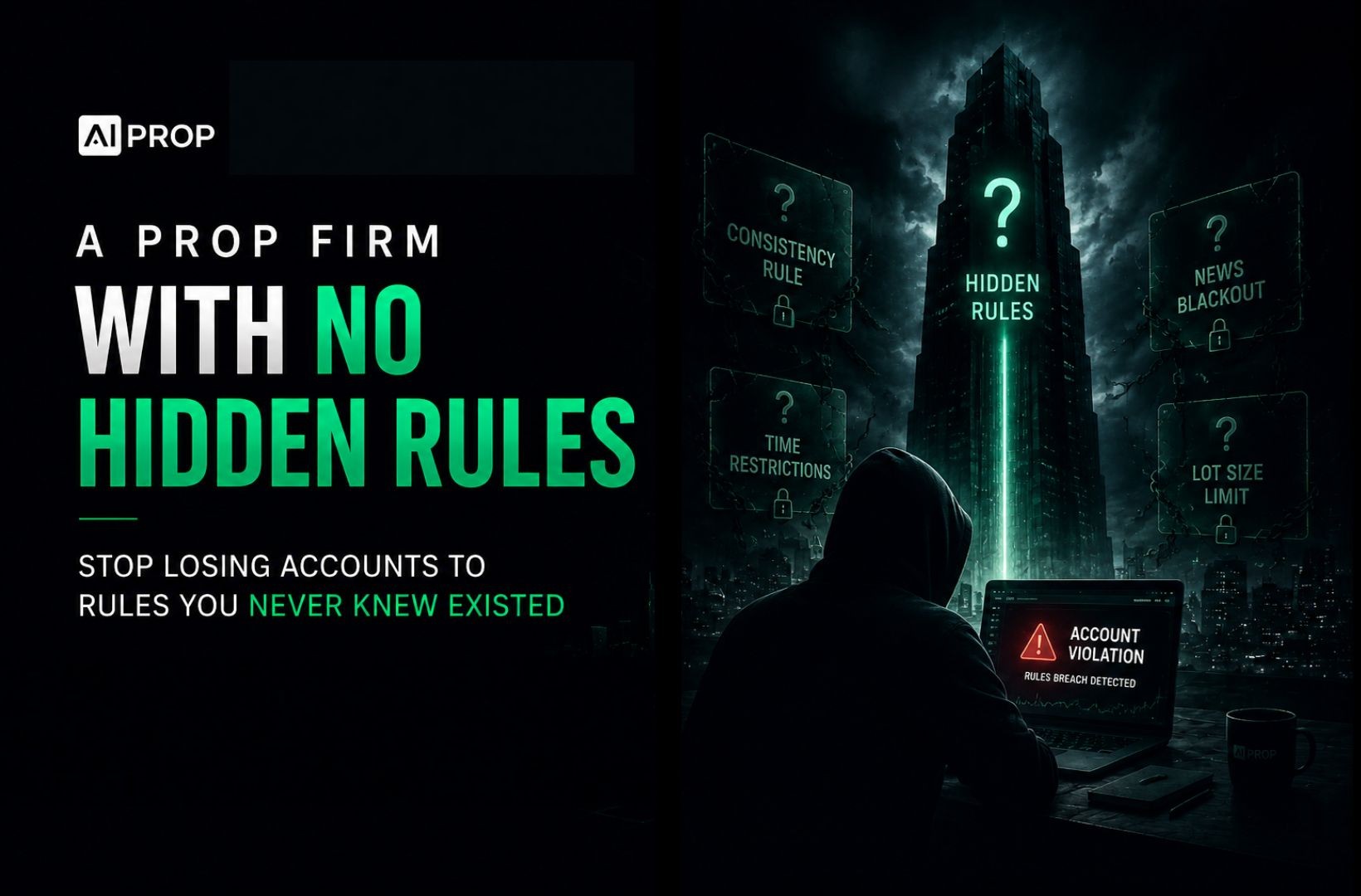
Table of Content
Imagine generating $42,936 in profit on a $200,000 funded account while fully complying with every published rule. You submit a payout request, only to receive a notice that your account is under “discretionary risk review.”
Despite breaking no objective rule, your payout is denied because the firm determines that your trading style does not reflect “real market conditions.” This highlights a major issue in the prop industry: passing the challenge does not always guarantee payment.
While traditional prop firms rely on these hidden filters to protect their bottom lines, AIProp has fundamentally re-engineered the evaluation model by eliminating the discretionary layer entirely.
The Illusion of the Single Rule Book: Visible vs. Hidden Rules
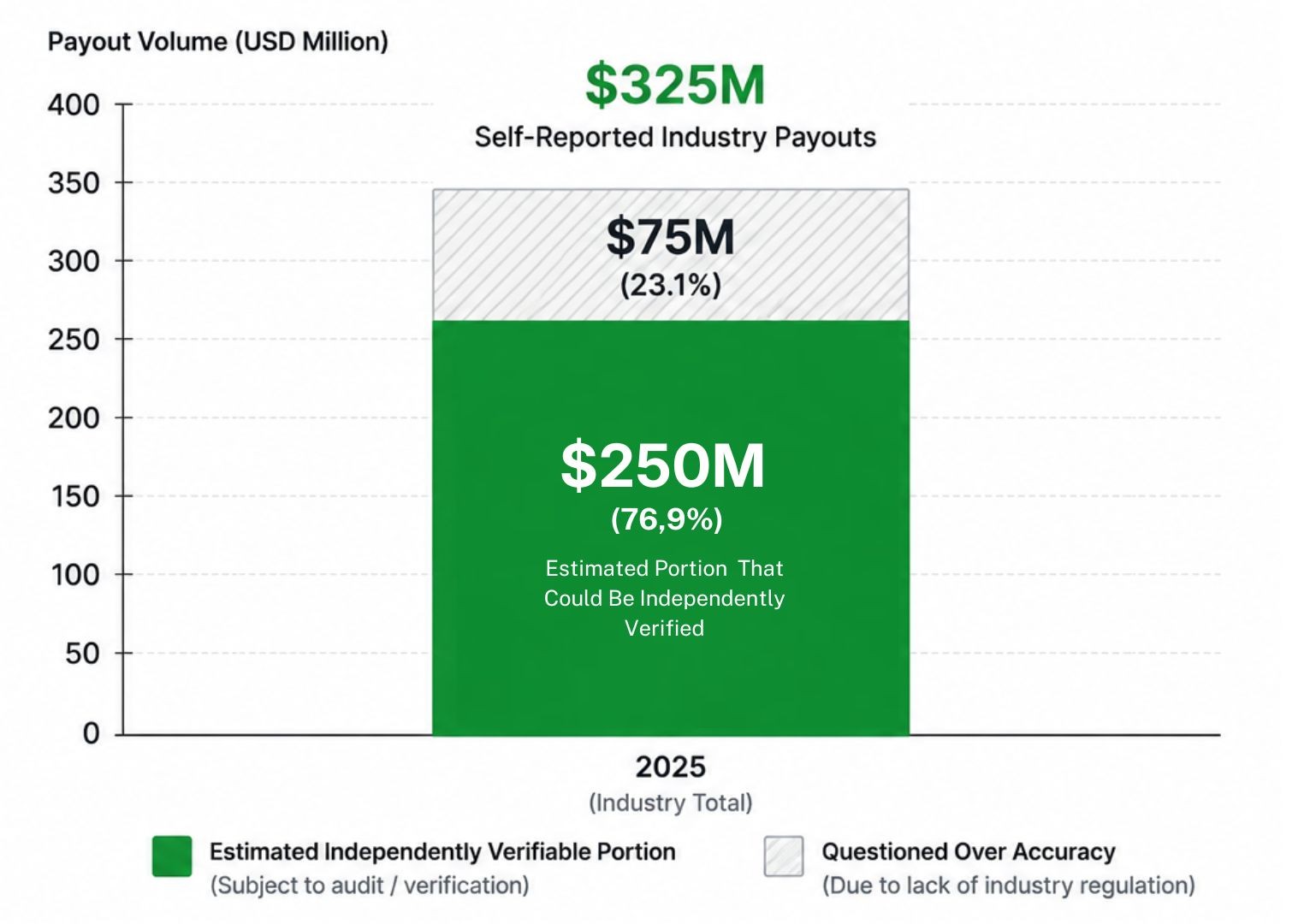
The prop firm industry has experienced explosive growth. An industry tracker recorded approximately $325 million in self-reported payouts across participating firms in 2025. However, as major financial publications note, because the prop sector remains largely unregulated, these payout totals are often questioned over their accuracy.
The structural friction point lies in how these firms design their operational frameworks. Most prop platforms run on two completely separate rule books.
1. The Visible Rules
These are the mechanical, quantifiable metrics displayed prominently on landing pages and marketing funnels. They include standard parameters such as a 5% maximum daily loss (calculated from the higher of balance or equity at session open) and a 10% maximum overall drawdown. These rules are fair, transparent, and mathematically verifiable; traders can build clear risk-management systems around them.
2. The Hidden Rules
These clauses are frequently buried deep within extensive Terms of Service (ToS) agreements or applied retroactively as subjective judgment calls. They serve as behavioral filters designed to mitigate costs when a trader successfully extracts capital from the system.
When a firm retains the power to interpret your trading strategy after the fact, compliance becomes a moving target.
The Anatomy of a Payout Trap, Common Hidden Rules
To understand how traders lose funded status without technically breaching their drawdown limits, one must analyze the specific mechanisms hidden within traditional prop contracts.
The Consistency Rule
This rule mandates that no single trading day or individual position can contribute more than a fixed percentage—typically 30% to 50%—of the total profit target or withdrawal accumulation.
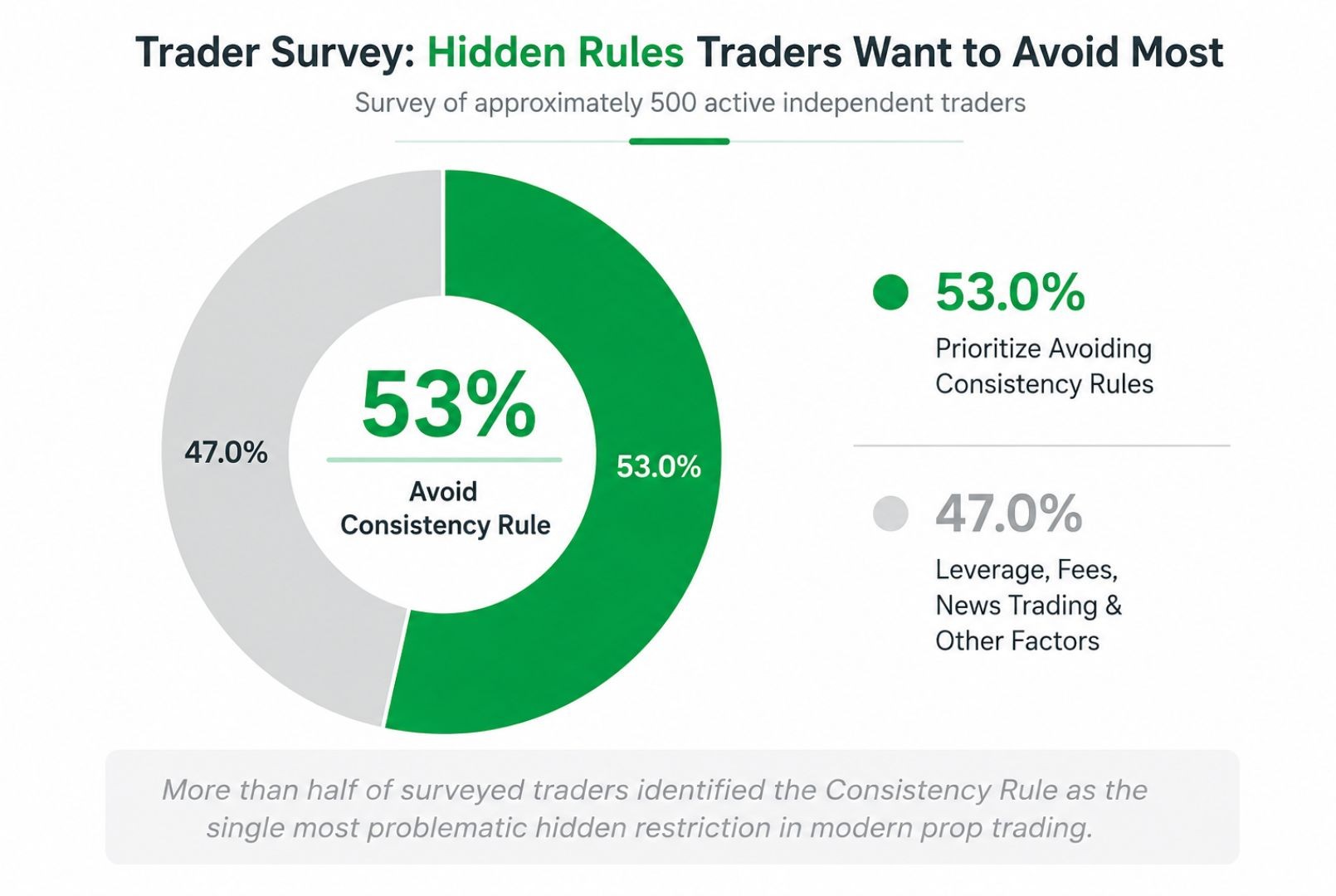
In a comprehensive industry survey of approximately 500 active traders, 53.0% explicitly identified the consistency rule as the primary operational hurdle they seek to avoid.
If a swing trader captures a high-probability macroeconomic breakout that accounts for 60% of their monthly gains, the firm freezes the payout. The trader is forced to continue executing arbitrary trades simply to dilute the concentration of that profitable session.
Prop firm founders have openly acknowledged that the consistency rule functions primarily as a “payout trap” rather than a genuine risk-management tool. Statistical analyses across hundreds of thousands of evaluation accounts reveal that up to 80% of traders fail or forfeit their evaluations due to these rigid, artificial distribution patterns.
News-Trading Blackout Windows
Many platforms enforce strict 2 to 4 minute blackout windows before and after high-impact economic announcements (such as NFP or CPI data). Under these conditions, opening, closing, or modifying a position is strictly prohibited.
The hidden catch is that many firms apply this restriction retroactively to automated stop-loss or take-profit orders triggered by sudden market volatility within the window. A trader who properly manages risk with a stop-loss can still have their account terminated because an exchange execution coincided with a restricted economic event.
Retroactive Minimum Hold Times
To prevent latency arbitrage or high-frequency scalping, firms frequently implement minimum hold times (e.g., positions must remain open for at least 60 seconds).
The risk intensifies when firms introduce or alter these rules without prior notice. In documented community disputes, firms have applied new hold-time restrictions retroactively to historical trading data, clawing back balances dramatically (e.g., reducing a trader’s validated balance from $3,200 down to $751 overnight).
The “Good Faith” Catch-All Clause
The most critical point of vulnerability is the broad, non-specific clause embedded in standard prop contracts regarding “fair trading practices” or “trading that mirrors real market conditions.” Because it lacks explicit quantitative boundaries, this clause provides an absolute legal backdoor for firms to deny payouts to consistently profitable traders without citing a specific numerical breach.
The Economic Necessity of Discretionary Layers
To understand why traditional firms maintain these discretionary layers, one must examine the underlying business model of the evaluation sector.
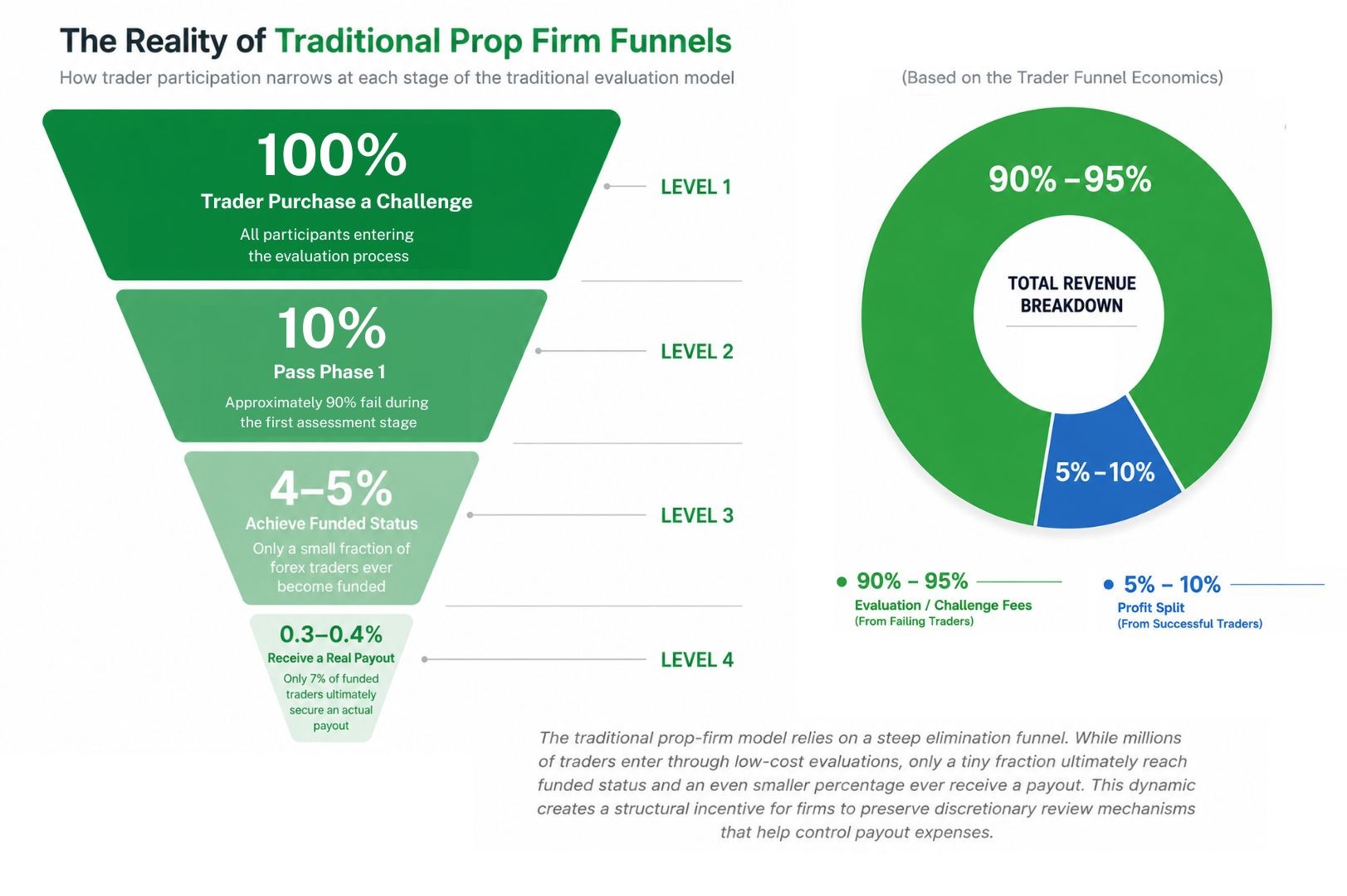
The traditional prop firm model operates as a high-volume funnel:
- 90% to 95% of participants fail to clear the initial Phase 1 assessment.
- Large-scale account analytics show that only about 4% to 5% of forex traders ever successfully achieve funded status.
- Out of the select group that secures funding, a mere 7% ever successfully secure a real payout.
Consequently, the vast majority of traditional prop firm revenue is generated from upfront evaluation fees rather than shared trading profits. When a trader defies these statistical benchmarks, passes the evaluation, and requests a substantial payout, they transition from a revenue source to an immediate operational expense.
The subjective, discretionary review layer serves as a structural tool to manage these capital outflows. Without hard regulatory oversight, firms face a direct financial incentive to keep these interpretation vectors open.
How AI Prop Permanently Eliminates the Discretionary Layer
A secure payout architecture cannot simply offer better customer service; it must entirely remove the structural surface area where subjective human intervention occurs. AI Prop was designed around this exact philosophy, replacing human interpretation with strict, immutable, and verifiable systems.
1. The Total Removal of Arbitrary Constraints
AI Prop operates exclusively on mechanical rules. There are no consistency restrictions, meaning net outcomes are the sole metric of evaluation. If you achieve your targets or account growth in two high-conviction sessions, your performance is validated identically to a trader who distributes gains across twenty separate sessions.
Furthermore, there are no news-trading restrictions or sudden hold-time adjustments. Risk parameters are fully defined before you pay a fee: you either respect the hard daily and overall drawdown formulas, or you do not. Because there are no interpretative rules, there is no opportunity for an internal reviewer to claim your strategy “isn’t real.”
2. Absolute Transparency Via On-Chain Ledger Verification
Traditional firms process payouts through private internal databases, leaving traders with no way to verify if a platform’s displayed payouts are real or fabricated marketing metrics.
AI Prop resolves this transparency gap by publishing all trader payouts directly on-chain. By moving the financial record onto a public, immutable ledger, the data cannot be rewritten or modified retroactively to justify an account suspension or an internal “risk review.”
Instead of relying on unverified corporate assertions, any market participant can audit the public blockchain ledger to confirm the platform’s execution history.
3. Empirical Performance Data
To demonstrate the viability of this mechanical approach, verified cohort research conducted by AI Prop tracked a specific control group of 978 traders during Q1 2026.
Unlike standard self-reported industry numbers, this cohort achieved $1.7 million in fully verified, on-chain payouts during that three-month window. This data proves that when traders are freed from artificial rules and psychological manipulation, skilled operators can successfully secure regular payouts.
Traditional Restrictions vs. AI Prop Execution
To contextualize how these structural differences impact daily trading operations, let us examine two practical market scenarios.
Case Study A: The Macroeconomic Event Scalper
-
The Setup: A trader specializes in trading short-term momentum during the Federal Reserve’s interest rate announcements. They enter a long position on EUR/USD precisely at the release, capturing a sharp 80-pip expansion, and exit the position 45 seconds later with a $12,000 profit. This single trade fulfills their entire profit milestone.
-
The Traditional Outcome: The firm flags the account on two fronts: first, for executing a transaction within the 2-minute news restriction window; second, for violating the 60-second minimum position hold time. The trade is voided, the profits are stripped, and the account is terminated due to “prohibited execution styles.”
-
The AI Prop Outcome: Because AI Prop enforces no news restrictions and no minimum hold times, the execution is fully valid. The $12,000 profit is credited directly to the account equity. The trader is eligible for a standard withdrawal cycle because the trade complied with the only rules that matter: staying within the absolute drawdown limits.
Case Study B: The High-Conviction Swing Trader
-
The Setup: A trader identifies an accumulation pattern on Gold (XAU/USD) over a weekend. On Monday, they execute a disciplined, multi-lot position. Over the next 72 hours, the position moves deeply into profit, generating 70% of the total monthly payout allocation. The trader closes the position cleanly ahead of weekend liquidity drops.
-
Traditional Outcome: The payout is frozen under the Consistency Rule because a single trade contributed too much of the total profit. The trader must continue trading to dilute the percentage, increasing the risk of giving profits back to the market.
AI Prop Outcome: The profit is recognized immediately. With no Consistency Rule or profit distribution requirements, the trader can proceed with a normal payout request.
Before risking your next evaluation fee, examine your current prop firm’s terms of service. If you find hidden consistency traps or discretionary review clauses, consider exploring a transparent alternative. Review AI Prop’s verified, on-chain payout records and clear, mechanical trading rules at aiprop.com.
Frequently Asked Questions (FAQ)
1. What are the most common “Hidden Rules” enforced by modern prop firms?
Hidden rules are rarely displayed on sales pages; instead, they are buried deep within complex Terms of Service (ToS) agreements or applied retroactively when a withdrawal is requested. The four most predatory hidden rules include: The Consistency Rule, News-Trading Blackout Windows, Minimum Hold Times and The “Good Faith” Catch-All Clause.
2. Why do traditional prop firms intentionally maintain these subjective review layers?
Most prop firms generate the majority of their revenue from challenge fees because only a small percentage of traders ever reach funded status, and even fewer receive payouts. As a result, successful traders become a direct cost to the firm. Subjective review mechanisms help some firms limit or delay these payout obligations.
3. How does AI Prop permanently eliminate the risk of hidden rules?
AI Prop removes subjective decision-making by relying solely on clear, objective risk limits: a 5% maximum daily loss and a 10% maximum overall drawdown. It also publishes payouts on a public blockchain ledger, creating transparent, verifiable records that cannot be altered, delayed, or removed.
4. Are self-reported industry payout numbers accurate, and how does AI Prop prove its data?
Industry payout figures are often self-reported and difficult to independently verify. To solve this trust deficit, AI Prop relies on verifiable cryptographic proof rather than marketing claims. In an exclusive research study tracking a controlled cohort of 978 traders at AI Prop in Q1 2026, the system recorded $1.7 million in fully verified, on-chain payouts. Because these transactions live on a public ledger, any trader or independent analyst can audit the blockchain hashes to verify that the capital was actually disbursed to traders’ wallets.
5. What four questions should I ask a prop firm to protect myself before buying a challenge?
Before committing any capital or evaluation fees to a prop firm, submit a ticket to their support team and demand clear, written answers to these four critical questions:
- Can an account that has met all profit targets be denied a payout based on subjective “trading style” reviews, even if no numerical drawdown limit was breached?
- Do you enforce a “Consistency Rule,” “Best Day Cap,” or any profit distribution ratios that restrict concentrated trading gains?
- Is your historical payout ledger independently verifiable on a public blockchain network (on-chain), or must clients rely entirely on your internal, private database?
- Does the firm reserve the right to retroactively amend trading terms (such as leverage limits, news rules, or hold times) for accounts that are already funded?
If the firm responds with ambiguous answers or refuses to address these points directly, you know exactly which platforms to avoid.