Blog
Blog  02-Jul-2026
.svg) 33,345
33,345 

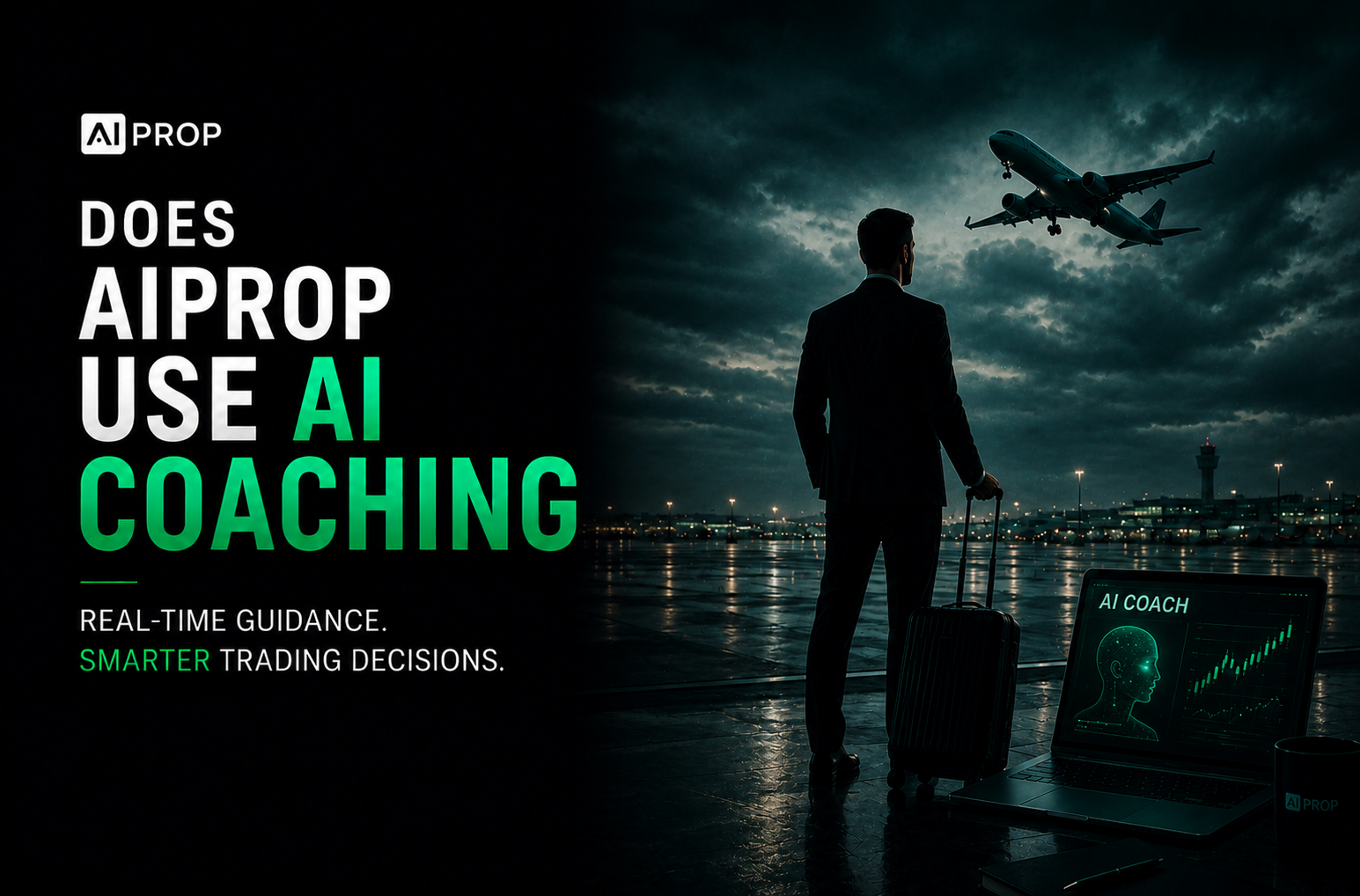
Table of Content
Table of Content
- The $5,200 Psychological Melt: Why Good Strategies Fail in Isolation
- The Human Deficit: Standard Prop Firms vs. Data-Driven Guardrails
- Does AI Prop Use AI Coaching? Inside the Cognitive Architecture
- The Economic Reality of Behavioral Edge
- Traditional Isolation vs. AI Prop Execution
- A 4-Step Audit to Evaluate Your Trading Psychology Ecosystem
- Frequently Asked Questions (FAQ)
The $5,200 Psychological Melt: Why Good Strategies Fail in Isolation
Imagine executing a flawless technical setup on Bitcoin (BTC/USD). The trade moves $1,200 into profit, within inches of your target. Suddenly, a sudden whale liquidation spikes the price backward. Your profit evaporates, turning into a minor $400 loss.
Objectively, your risk management handled the move. Subjectively, your brain undergoes an immediate cognitive hijack. Driven by revenge, you double your lot size, override your maximum daily loss boundary, and trigger a cascading series of trades that wipes out a $100,000 funded account in exactly 14 minutes.
You did not lose the account because your strategy lacked edge; you lost it because you traded in a psychological vacuum.
Traditional prop firms thrive on this exact human vulnerability, treating emotional liquidations as pure corporate profit. However, the modern prop landscape is shifting toward structural intervention. Traders are increasingly asking a fundamental question: Does AIProp use AI coaching to actively mitigate these psychological deficits, or are users left entirely to their own cognitive biases?
Standard Prop Firms vs. Data-Driven Guardrails
The proprietary trading industry has scaled aggressively, with self-reported evaluation sign-ups hitting unprecedented volumes. Yet, internal risk analytics from leading clearing groups reveal a stark bottleneck: over 85% of blown accounts do not stem from bad technical indicators, but from identifiable, repetitive behavioral anomalies.
Traditional platforms structure their frameworks to exploit this gap.
1. The Isolation Protocol
Standard prop models isolate the trader. You are given a dashboard, a MetaTrader or TradingView login, and an absolute directive: hit the target or get liquidated. There is no feedback loop, no warning system, and no real-time risk assessment. When an account enters a period of drawdown, the firm remains silent, waiting for the hard boundary violation that returns the evaluation fee to their treasury.
2. The Algorithmic Guardrail
A truly systematic prop architecture cannot simply watch a trader slide into tilt. It must deploy active, preventative data layers to stabilize the portfolio before the terminal drawdown limit is breached. By tracking real-time metrics—such as average hold times, tick velocity, and deviation from historical position sizing—the platform can intercept a destructive trading spiral before it becomes fatal.
Does AI Prop Use AI Coaching? Inside the Cognitive Architecture
To address the industry’s core question directly: Yes, AI Prop fully integrates a native, proprietary AI Coach into its core execution environment.
Rather than functioning as a passive text bot or a generic post-trade analytical report, the AI Coach operates as a low-latency behavioral layer tied directly to your account ledger.
Predictive Tilt Shield
The system continuously references your rolling historical trading data. If your baseline pattern shows that you typically execute 2-3 trades per session with a maximum lot size of 1.5, and you suddenly open 8 overlapping positions within 90 seconds at a cumulative 5.0 lots, the AI Coach identifies a “High Probability Tilt Event.” It immediately generates explicit platform alerts and dynamically surfaces metrics to force an analytical pause, breaking the psychological loop of revenge trading.
Dynamic Expectancy Optimization
Most traders fail to optimize their winning streaks. The AI Coach continuously calculates your real-time Profit Factor and Win-Rate Expectancy. If data shows your EUR/USD long positions yield a 68% win rate when held for over 4 hours but drop to 22% when managed as short-term scalps, the AI Coach provides automated, inline portfolio adjustments on your trading dashboard to steer you back toward your verified mathematical edge.
The Economic Reality of Behavioral Edge
Why do legacy firms resist implementing internal AI coaching layers? The answer lies inside their corporate balance sheets.
AIProp’s model flips this incentive. Because payouts are written directly to a public, immutable ledger, the platform scales only when its funded pool extracts capital successfully from live liquidity providers.
Traditional Isolation vs. AI Prop Execution
To visualize how automated behavioral coaching impacts real-world equity curves, let us evaluate two standard market conditions.
Case Study A: The Post-Loss Sizing Escalation
- The Setup: A trader drops 3% of their account balance on a highly volatile Nasdaq (NAS100) breakout that fails to find acceptance above resistance.
- The Traditional Outcome: Feeling an immediate sense of injustice, the trader triples their risk exposure on the next session to “make back the loss quickly.” No system prevents the transaction. The index whipsaws, dropping another 4%, crossing the rigid 5% daily drawdown threshold. The account is terminated instantly.
- The AI Prop Outcome: The moment the user attempts to scale their lot sizes significantly higher following a sharp drawdown sequence, the AI Coach intercepts the execution. It tags the behavior as anomalous and alerts the trader with clear visual data showing the exact probability of account failure under these skewed risk parameters. The system anchors the trader back to their baseline structure, preserving the account.
Case Study B: The Partial Profit Liquidation Trap
- The Setup: A swing trader catches an early-stage trend on Gold (XAU/USD). The position moves 2R (two times the initial risk) into green territory. The macro target is 5R.
- The Traditional Outcome: Out of unguided fear of losing a winning trade, the trader cuts the position manually at 2R. Over the next 48 hours, the market targets the original 5R line flawlessly. By cutting winners short due to unstructured anxiety, the trader’s long-term expectancy turns negative.
- The AI Prop Outcome: The AI Coach cross-references the trade with the user’s long-term historical matrix, flashing a clean dashboard diagnostic: “Your historical retention on Gold trends shows a 72% probability of reaching full target when 2R is cleared. Closing now reduces your net portfolio profit factor by 0.4.” Armed with objective statistics rather than emotional fear, the trader leaves the position open to maximize capital extraction.
A 4-Step Audit to Evaluate Your Trading Psychology Ecosystem
Before risking capital on an evaluation, use this framework to audit whether your current prop firm is actively setting you up for behavioral failure.
1. Detect Passive Versus Active Monitoring
Review the platform’s dashboard features. If the firm only calculates your proximity to failure (drawdown lines) without providing real-time data on your internal trading metrics, you are operating within a passive liquidation model designed to benefit from your mistakes.
2. Confirm the Presence of Keyword-Driven Insights
Verify if the firm offers algorithmic assistance by checking their platform documentation for explicit tech specifications. Look closely at how they answer the operational query: Does AIProp use AI coaching? If the platform cannot outline a specific, automated behavioral architecture, it lacks authentic machine-learning support.
3. Evaluate Sizing Over-Saturation Guardrails
Analyze whether your dashboard tracks your rolling historical volume variances. A performance-driven platform will alert you when your current contract load deviates dangerously from your historical standard deviation baseline.
4. Cross-Reference Payout Transparency
Ensure your platform’s performance metrics are tied directly to an immutable ledger. True behavioral coaching data should coordinate with transparent, audited payout lines, proving that the platform is actively designing tools to optimize successful funding scale.
Frequently Asked Questions (FAQ)
1. Does AI Prop use AI coaching to trade for me automatically?
No. AI Coach does not trade on your behalf. You stay in full control, while AI provides risk analysis, behavioral insights, and alerts when your trading deviates from your normal strategy.
2. How does real-time AI coaching prevent a trader from blowing an account?
AI detects behavioral patterns associated with revenge trading or excessive risk, then sends real-time warnings to help you pause and make more disciplined decisions before placing risky trades.
3. What specific metrics does the AI Prop coaching system monitor?
It monitors key trading metrics such as profit factor, position sizing, win/loss duration, trading frequency, and asset performance, then converts the data into simple, actionable insights.
4. Can I opt-out of the AI coaching layer if I prefer unassisted execution?
No. AI coaching is built into the platform’s risk management system. You can customize how alerts appear, but performance monitoring remains active to support consistent and disciplined trading.