Blog
Blog  04-Jun-2026
.svg) 48,070
48,070 

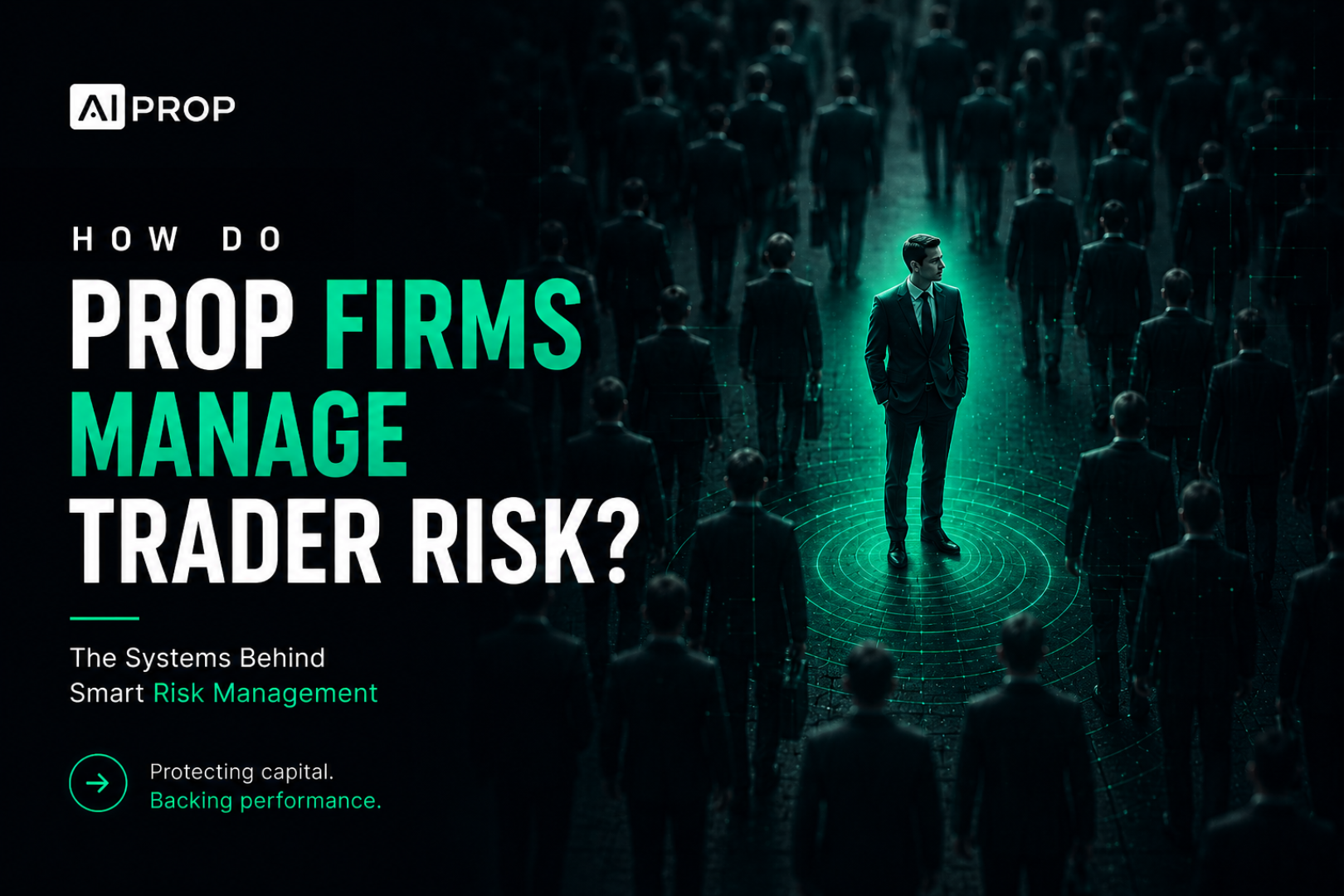
Proprietary trading firms (prop firms) do not operate as traditional asset management funds, nor are they benevolent institutions giving out free capital. They are, at their core, sophisticated risk management engines.
To survive in an industry where the vast majority of retail participants lose money, prop firms must deploy strict technological, mathematical, and operational frameworks to insulate their corporate capital from trader errors.
The Core Conflict of the Prop Firm Model
To understand how risk is managed, one must look at the baseline behavior of the traders entering these ecosystems. Public regulatory data from the European Securities and Markets Authority (ESMA) consistently shows that 74% to 89% of retail CFD accounts lose money.
When traders migrate to a prop firm, their natural tendency toward high-risk behavior is often amplified by the use of leverage and the fact that they are not risking their own substantial downside capital. Left unchecked, a small group of highly volatile traders could easily bankrupt a firm’s liquidity pool overnight.
Therefore, prop firms utilize a multi-layered matrix of hard rules, automated liquidations, and statistical filters to maintain equilibrium.
The Hard Math of Drawdown Limits
The primary line of defense for any prop firm is the automated drawdown limit. Unlike a traditional broker that relies on margin calls based on remaining equity, prop firms use two distinct, non-negotiable metrics:
1. Daily Drawdown Limit (Typically 5%)
This is calculated based on the previous day’s closing balance or equity (depending on the firm’s specific terms). If a trader’s floating or realized losses hit this threshold at any point during the trading day, an automated script instantly closes all open positions, cancels pending orders, and freezes the account.
2. Maximum Overall Drawdown (Typically 10%)
This is the absolute floor of the account. It is usually fixed to the initial starting balance of the account. For example, on a $100,000 account with a 10% maximum drawdown, if the account equity ever touches $90,000, the account is permanently terminated.
By enforcing these boundaries via server-side plugins (such as MetaTrader Manager tools), the firm ensures that no single trader can lose more than a predetermined percentage of the allocated virtual capital.
The Evaluation Funnel as a Risk Filter
Prop firms do not hand live capital to unproven talent. They utilize a strict evaluation funnel designed to leverage the natural failure rate of undisciplined strategies as a secondary risk buffer.
Data compiled from major platform disclosures, such as FTMO and Fintokei, reveals exactly how tight this filter is:
Beyond the standard drawdown limits, institutional-grade prop firms deploy advanced operational filters to mitigate systematic risk, style drift, and market manipulation:
-
Consistency and “Best Day” Rules: To prevent traders from passing evaluations or hitting payout milestones through a single, lucky, high-risk bet, firms implement rules stating that no single day’s profit can represent more than 50% of the total target or earnings.
-
IP and Copy-Trading Trackers: Firms use automated software to detect if multiple accounts are executing identical trades simultaneously. This prevents third-party EA (Expert Advisor) vendors or algorithmic syndicates from exposing the firm to highly correlated, massive systemic risk across hundreds of accounts.
-
Inactivity Cleanups: Accounts that remain inactive for more than 30 days are automatically closed to free up server bandwidth and reallocate operational capital pools.
How Prop Firms Hedging Strategies Actually Work
A common misconception is that all prop firm traders are executing live orders directly on the interbank market. In reality, firms manage risk on the backend through a dual-routing system:
The B-Book (Simulated Execution)
The vast majority of retail prop traders execute trades in a simulated environment. The prop firm acts as the counterparty.
Because historical data guarantees that over 80% of these traders will eventually violate a drawdown rule or lose money, the firm safely internalizes this risk without ever exposing real capital to the live market.
The A-Book (Live Market Hedging)
When a trader demonstrates long-term consistency, low account volatility, and a strict adherence to risk parameters (the top 1% to 2% of the funnel), the firm shifts their account parameters.
The firm’s internal risk management desk will automatically mirror the trader’s positions onto a live institutional liquidity pool via an STP (Straight-Through Processing) model. In this scenario, the firm hedges its exposure: if the trader wins, the firm makes money from the live market to pay out the trader’s profit split.
Summary of Risk Mitigation Frameworks
Key Takeaway: Prop firms do not manage risk by teaching traders how to trade; they manage risk by building a rigid containment structure around the trader.
Through automated server-side liquidations, upfront fee structures that offset statistical failure rates, and algorithmic tracking tools, prop firms ensure that human emotion and behavioral volatility are neutralized long before they can impact the firm’s bottom line.