Blog
Blog  28-Apr-2026
.svg) 56,715
56,715 

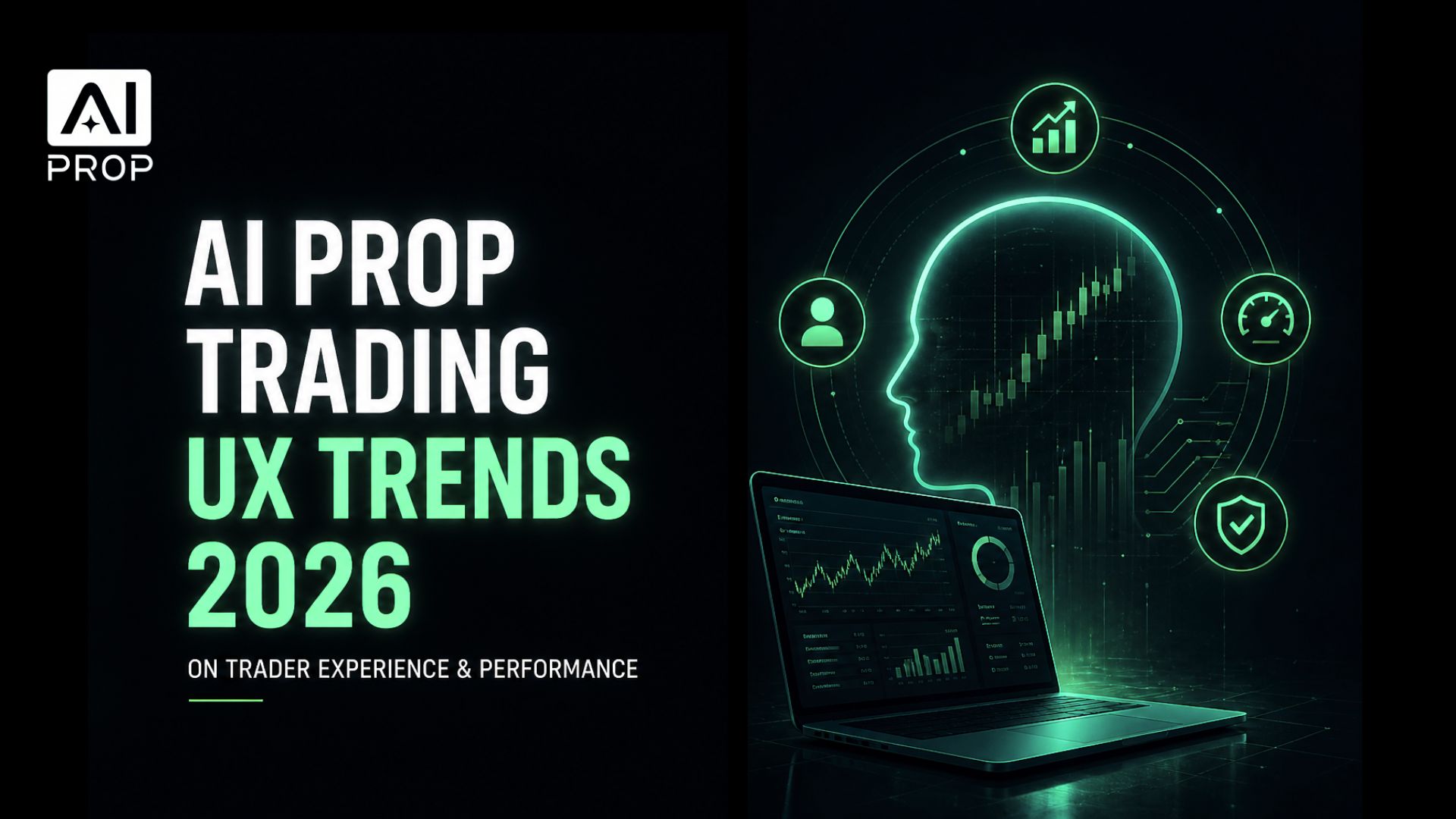
Table of Content
The Evolution of UX in Proprietary Trading
Proprietary trading user experience (UX) is undergoing a radical transformation, shifting from static displays of price action and balance metrics to dynamic, AI-driven predictive interfaces by 2026.
This evolution moves the trader from a reactive state, constantly chasing lagging indicators, to an anticipatory environment where the platform provides intelligent feedback and foresight, fundamentally optimizing decision-making and performance.
The modern trading experience is evolving with dynamic, AI-driven interfaces.
The future of the prop firm industry in 2026 is no longer just about providing capital; it is about providing a high-fidelity technological ecosystem that acts as a cognitive extension of the trader.
Understanding Traditional Prop Trading UX Limitations
For over a decade, the “standard” prop firm dashboard has been remarkably stagnant. Traders are usually greeted with a basic web portal that displays current equity, balance, and a countdown timer for their evaluation.
These interfaces are often disconnected from the actual trading terminal (like MT4 or MT5), creating a fragmented experience.
- The primary issue is that these systems are purely historical. They tell you what happened, that you hit your drawdown limit or failed a consistency rule, but they offer zero guidance on why it happened or how to prevent it in real-time.
- This “post-mortem” approach to UX is a major contributor to the low success rates seen across the industry, where only 5% to 10% of traders typically pass initial evaluations.
The Paradigm Shift: Predictive & Personalized Interfaces
By 2026, the industry is moving toward “Predictive UX.” This concept, which is already reshaping fintech and B2B software, involves interfaces that adapt based on user intent and behavioral modeling.
In a prop trading context, this means the dashboard doesn’t just show a drawdown number; it anticipates a potential breach based on current volatility and the trader’s historical over-leveraging habits.
Layouts shift dynamically: if you are a news trader, your interface might auto-prioritize economic calendars and sentiment heatmaps ten minutes before a high-impact release.
This hyper-personalization ensures that the most critical data points are always at the forefront, reducing cognitive load and the “analysis paralysis” that often leads to fatal errors.
Setting the Stage: AI as the Foundation of Future Trading UX
AI is no longer a bolt-on feature; it is the foundation of the modern trading environment. We are seeing a transition where the platform functions as a “living” environment.
For instance, advanced systems now integrate predictive analytics in prop trading to scan for patterns not just in the markets, but in the trader’s own execution.

AI forms the foundational layer for sophisticated, predictive trading platforms.
If the system detects a “rage-clicking” pattern, a series of rapid, losing trades that deviate from a proven strategy, the UX can intervene with a “soft lock” or a cooling-off prompt.
This is the hallmark of 2026: a move away from passive shells toward responsive environments that actively co-create success with the user.
Real-Time Impact: 5 Statistics on AI Adoption in Prop Trading (2024-2026)
The integration of AI into prop trading is not merely a trend for the sake of novelty; it is backed by concrete data showing improved outcomes for both firms and traders.
Statistics from 2024 through early 2026 indicate that AI adoption leads to a measurable increase in evaluation pass rates, a reduction in catastrophic drawdown events, and a significant improvement in payout efficiency.
These metrics serve as a clear indicator that the future of prop firm industry 2026 is inextricably linked to algorithmic and behavioral intelligence.
- Increased Pass Rates: Firms utilizing AI-driven behavioral feedback have reported a 15% to 20% increase in evaluation pass rates compared to traditional “static” firms (Source: QuantVPS 2026 Industry Report).
- Reduced Drawdown Breaches: Real-time AI risk alerts have been shown to reduce accidental daily loss limit breaches by approximately 30% among retail traders.
- Payout Speed: Blockchain-backed payout verification, often managed by AI settlement layers, has reduced the average payout time from 5-8 business days to under 24 hours in top-tier firms.
- Trader Retention: Platforms offering an AI coach for funded traders see a 40% higher retention rate for funded accounts, as traders are better equipped to handle the psychological pressure of managing large capital.
- Automation Growth: As of 2026, over 60% of active prop traders utilize some form of AI-assisted execution or automated bot, up from just 25% in 2023.
Boosting Pass Rates: How AI Enhances Evaluation Success
The low pass rate in traditional prop firms is often due to a lack of discipline rather than a lack of strategy. AI-driven UX addresses this by providing “nudges.” When a trader is nearing a rule breach, the AI doesn’t just send a notification; it provides a data-backed reason to pause.
AI-driven nudges provide real-time guidance to improve trader discipline and success rates.
According to recent data, firms like Apex Trader Funding saw pass rates jump significantly after introducing more flexible, tech-forward rules.
In the 2026 landscape, the “evaluation” is becoming a collaborative process where the firm’s technology helps the trader prove their worth, rather than acting as a gatekeeper waiting for them to fail.
Accelerating Payouts: The Role of AI in Trust and Efficiency
One of the biggest pain points in prop trading has historically been “payout denial” or opaque withdrawal processes. AI and blockchain have solved this. AI-driven auditing systems can instantly verify that no rules were breached, while blockchain provides a public, immutable record of the transaction.
This transparency is critical for AI Prop trading UX trends 2026, as it builds institutional-grade trust with retail traders. When a trader knows their payout is guaranteed by a smart contract and verified by an objective AI, their “fear mindset” is reduced, allowing for more disciplined execution.
Minimizing Drawdowns: AI-Driven Risk Management
Drawdown is the silent killer of funded accounts. Many traders fail because they don’t understand the nuances of drawdown and profit targets until it’s too late. AI-driven UX solves this by visualizing “risk-of-ruin” in real-time.
Instead of a simple percentage, 2026 interfaces show a “safety corridor,” highlighting how current volatility might impact the account’s longevity. This proactive risk management is the difference between a trader who loses their account in a week and one who scales to manage millions.
A Tale of Two Firms: Traditional vs. AI Prop Firm UX Comparison
Comparing a traditional prop firm to an AI-powered platform reveals a stark contrast in how traders interact with data and capital.
While traditional firms focus on basic compliance and manual oversight, AI-driven firms utilize a sophisticated stack of behavioral analysis, predictive modeling, and blockchain transparency to create a professional-grade environment.
This comparison highlights why the industry is rapidly gravitating toward firms that offer more than just a balance and a chart.
- Feature Traditional Prop Firm (Pre-2024) AI-Powered Prop Firm (2026) Data Visualization Static charts, basic balance/equity curves. Dynamic, predictive heatmaps and behavioral “safety zones.”
- Risk Alerts Email or SMS notifications after a breach. Real-time, AI-driven “soft-blocks” and pre-emptive warnings. Trader Support Standard FAQ and slow ticket-based support.
- Personalized AI Coach providing 24/7 strategy and emotional feedback.
- Payout Transparency Opaque internal reviews; 5-10 day wait times. Blockchain-verified settlements with public audit trails.
- Scaling Logic Manual review, often capped at $1M-$2M. Automated scaling roadmaps up to $5M based on AI performance scores.
Navigating the Interface, User Journey Divergence
The user journey in a traditional firm is often a lonely one. You sign up, you trade, and you either pass or fail in a vacuum. In an AI-powered firm, the journey is guided.
From the moment you start an evaluation, an “AI Journal” begins tracking your performance, not just in terms of PnL, but in terms of “edge consistency.” This means the interface evolves with you.
AI-powered platforms offer a guided and insightful user journey compared to traditional firms.
For a trader who excels at London Open breakouts, the UX might start highlighting specific liquidity zones or news events relevant to that session, creating a bespoke trading desk experience.
Feedback Loops: Generic Alerts vs. Intelligent Coaching
Generic alerts like “You are 2% away from your daily loss limit” are often ignored or cause panic. Intelligent coaching, however, provides context. An AI Coach might say, “Your win rate on Tuesdays after 2:00 PM EST is only 20%. Consider reducing your position size for this session.”
This level of detail transforms the UX from a monitoring tool into a mentor. It addresses the psychological hurdles that cause 90% of traders to fail because they skip the critical step of analyzing their own behavioral flaws.
Static Information vs. Predictive Insights
The 2026 trader demands institutional-grade liquidity and information. While old firms provide a basic news feed, modern AI prop firms integrate predictive analytics in prop trading to aggregate sentiment from social media, institutional flow, and historical price patterns.
This data is then presented visually—perhaps as a “probability score” for a specific setup—allowing the trader to make data-backed decisions rather than relying on gut feeling or “fear mindset.”
AI’s Role in Drawdown, Execution & Risk Management
AI’s impact on critical trading metrics is profound, providing a level of precision that manual oversight simply cannot match. By integrating AI into the core execution and risk management layers, prop firms are able to offer more flexible rules, such as news trading and weekend holds, without increasing the firm’s overall risk profile.
This leads to a superior outcome where the trader has more freedom and the firm has more security—a true win-win enabled by AI prop trading UX trends 2026.
“The integration of AI into trading execution isn’t just about speed; it’s about the systematic removal of human error at the most critical moments of market volatility.” – Senior Quant Analyst, AI Prop.
Pre-emptive Drawdown Prevention with AI
Modern AI systems can calculate “Effective Drawdown” in real-time, accounting for correlated assets and open exposure. If a trader is long on EUR/USD and short on USD/CHF, they are essentially doubling their dollar exposure.
AI systems provide real-time, precise risk management to prevent drawdowns and monitor trading style.
A traditional dashboard might not flag this as a risk until the drawdown starts hitting. An AI-powered UX, however, will highlight this correlation risk before the trade is even placed. This level of new infrastructure behind funded trading allows for much tighter risk control without stifling the trader’s strategy.
AI’s Contribution to Speed and Precision
In the high-frequency world of 2026, even retail prop traders need institutional-grade execution. AI-powered trading bots can execute orders across multiple liquidity providers to ensure minimal slippage.
Furthermore, the UX now includes “one-click” AI optimization, where a trader can ask the system to find the best entry price based on current order flow. This reduces the mechanical errors that often lead to “fat-finger” trades or missed entries during high-volatility news events.
Mastering Risk Management
The transition from manual to algorithmic oversight means that risk is managed 24/7. For traders looking to scale up to $5M in capital, this is essential. The system monitors for “style drift”—when a trader suddenly changes their strategy or risk profile.
By catching these shifts early, the AI can alert the trader to return to their core disciplines, preserving their funded status and the firm’s capital. This systematic approach is what allows for the massive scaling roadmaps seen in modern fintech-driven prop firms.
Your AI Coach for Funded Traders
An AI coach for funded traders is perhaps the most significant UX innovation of the decade. This is not a simple chatbot; it is a sophisticated behavioral analysis engine that learns a trader’s “DNA.”
By identifying patterns in emotional state, timing, and asset selection, the AI coach provides a feedback loop that was previously only available to elite hedge fund managers. This democratization of high-level coaching is what will define the next generation of professional retail traders.
Personalized Behavioral Feedback
Most traders struggle with the same few emotional demons: greed, fear, and revenge trading. An AI coach monitors for signs of these emotions in the trading data.
For example, if a trader consistently increases their lot size after a loss, the AI Coach will flag this as “revenge trading” and provide a psychological report or a mandatory break.
Understanding the fear mindset in trading environments is the first step toward overcoming it, and AI provides the objective mirror needed for that growth.
The Power of Predictive Analytics in Strategy Development
Predictive analytics doesn’t just look at the market; it looks at the strategy’s performance across different market regimes. The AI Coach can tell a trader, “Your strategy performs at a 70% win rate during trending markets but loses 15% during consolidation.
The current market regime is shifting to consolidation.” This foresight allows the trader to step aside or adjust their parameters, protecting their capital. This is the essence of preventing emotional trading from destroying performance.
The Future of Trader Support: Human-AI Collaboration
The ultimate goal of AI Prop and similar forward-thinking firms is a seamless collaboration between human intuition and machine precision.
While the human trader brings creativity and the ability to adapt to “black swan” events, the AI brings discipline, speed, and data processing. This partnership is facilitated through a UX that feels less like a tool and more like a partner.
As we move further into 2026, the firms that succeed will be those that view their traders as long-term assets to be nurtured through technology, rather than just sources of evaluation fees.
To truly excel in this new era, traders must embrace these tools not as crutches, but as high-performance upgrades. Whether it’s using an AI Journal to automate performance tracking or leveraging 24/7 AI Trading Bots to maintain market presence, the professional trader of 2026 is a data-driven athlete.
The journey from retail hobbyist to a $5M fund manager is now paved with silicon and code, offering a level of transparency and opportunity never before seen in the financial world.
Actionable Steps for the 2026 Trader
- Audit Your Current UX: Is your current prop firm providing you with real-time behavioral insights, or just a balance sheet? If it’s the latter, you’re trading at a disadvantage.
- Implement an AI Journal: Start systematizing your trades. Move away from manual spreadsheets and use automated tools that track your emotional state and execution quality.
- Test Predictive Tools: Before committing large capital, use evaluation phases to test how AI-driven alerts affect your discipline. Do they help you stay within your drawdown limits?
- Verify Payouts on Chain: Demand transparency. Only partner with firms that use blockchain or public audit trails for their payouts to ensure you are joining a legitimate ecosystem.