Blog
Blog  09-Jul-2026
.svg) 37,715
37,715 

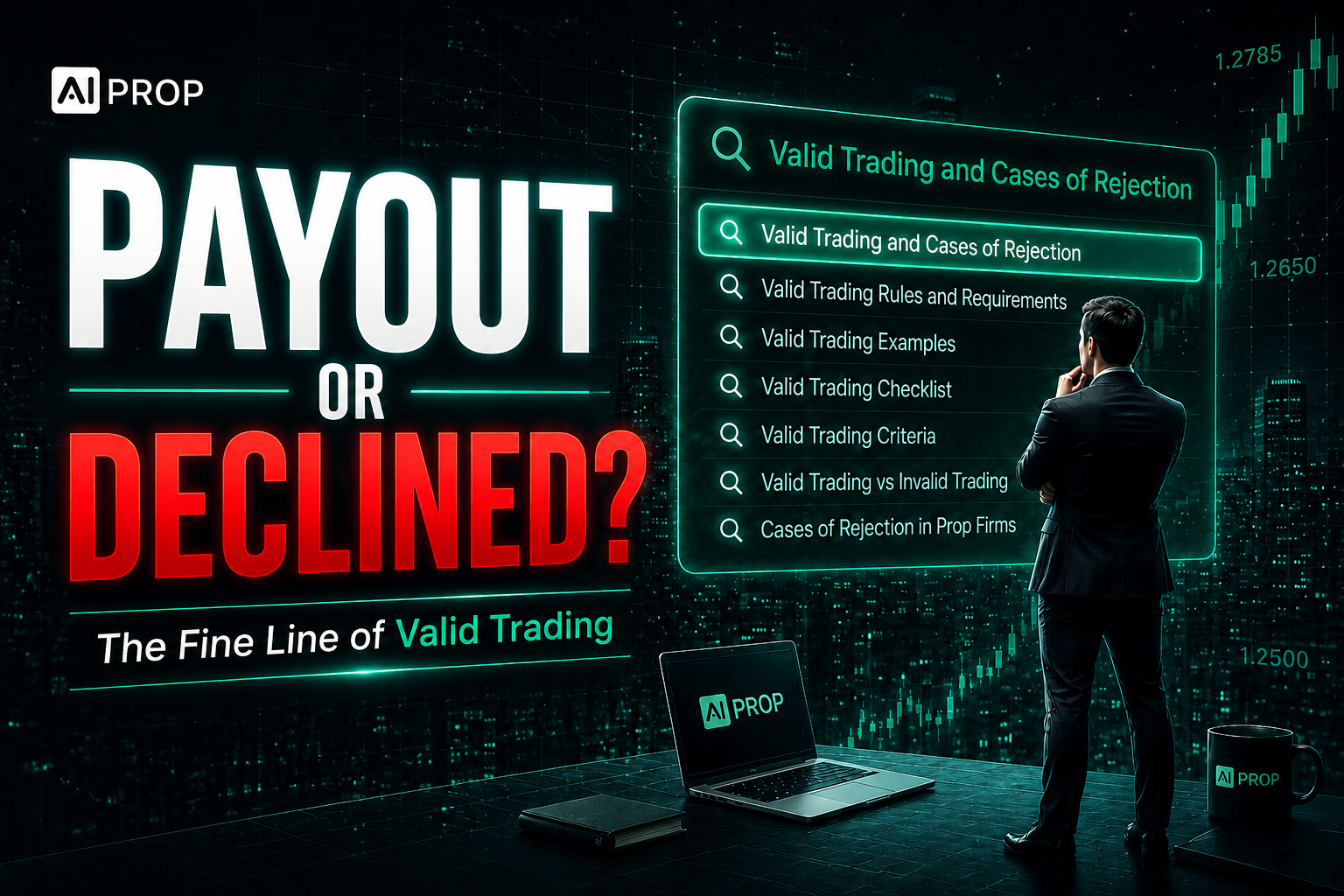
You did the hard work. You managed your risk, kept your emotions in check, and spent weeks staring at charts to finally hit that profit target. You click “Request Payout,” expecting a reward for your discipline.
Instead, you get an email: Payout Denied. Account Breached.
It feels like a gut punch, but it’s an incredibly common reality in the prop firm industry. Passing the evaluation is only half the battle; getting your hands on the capital requires navigating a minefield of compliance. If you want to ensure your hard-earned profits actually make it to your bank account, you need to understand exactly what constitutes valid trading—and the specific traps that trigger a rejection.
Why passing doesn’t equal getting paid?
In the prop firm world, getting a funded account is just the middle of the funnel. Data shows that of the small percentage of traders who manage to pass an evaluation, fewer than half ever reach their first payout.
Why? Because many firms use complex compliance rules as a secondary filter. When a firm’s business model relies heavily on evaluation fees rather than shared trading profits, they are financially incentivized to look at your trading history with a magnifying glass, searching for any technicality to void your balance.
To survive this system, you have to trade beyond reproach.
What is “Valid Trading”?
Valid trading isn’t just about making money; it’s about proving to the firm that you are managing risk in a way that is replicable and safe for live market conditions. Generally, an account is considered in good standing when it demonstrates:
-
Consistency: Your wins are distributed organically across multiple trades and days, rather than resulting from one massive, lucky gamble.
-
Clear Risk Management: Every trade utilizes stop-losses, proper lot sizing, and respects daily drawdown limits.
-
Human Intent: Your trading behavior reflects genuine market analysis rather than trying to exploit software lag or platform inefficiencies.
The Most Common Cases of Rejection (And How to Avoid Them)
Most payout denials don’t happen because a trader hit a hard drawdown limit; they happen because of “hidden” or poorly understood compliance clauses. Here are the primary culprits behind rejected payouts:
1. The Consistency Rule Breach
This is the silent killer of funded accounts. Many firms require that no single trading day account for more than 30% to 40% of your total profit target. If you make $10,000 total, but $4,500 of it came from a single lucky trade during a high-impact news event, your payout will be frozen or rejected.
How to fix it: Treat your funded account like a marathon, not a sprint. Aim for steady, incremental gains rather than swinging for the fences on one position.
2. Minimum Hold Time (MHT) Violations
Some firms explicitly forbid “scalping” or holding trades for less than a specific timeframe (often 1 to 2 minutes). If you close a trade in 45 seconds because the market moved rapidly in your direction, those profits can be retroactively voided. In worst-case scenarios, firms have been known to delete wins while keeping the losses incurred from short-lived trades.
How to fix it: Read the fine print regarding execution speed. If you are an ultra-short-term scalper, you must choose a firm that explicitly advertises “no minimum hold times.”
3. Copy Trading and IP Matches
If you use a popular commercial Expert Advisor (EA) or copy trades from a public signal service, you run a massive risk. If another trader on the same prop firm is using the exact same service, the firm’s automated risk systems will flag both accounts for “identical trading” and ban them. Furthermore, logging into your account from different countries or VPNs can trigger fraud alerts.
How to fix it: Ensure your strategy is uniquely yours. Avoid generic, off-the-shelf EAs, and stick to a consistent IP address when executing trades.
4. Toxicity and Arbitrage Exploitation
Firms look for “toxic flow”—trading behaviors that work on a demo server but cannot be replicated in a real live-market environment. This includes latency arbitrage (exploiting the delay between the firm’s feed and the real market) or news straddling (placing pending orders in both directions seconds before a major economic release).
How to fix it: If your strategy relies on tricking the broker’s platform rather than reading the actual market, it will eventually be rejected at the payout stage.
Hidden Rules You Should Watch For
Beyond the heavy-hitting compliance terms, there is an entire catalog of secondary restrictions that firms use to flag accounts at the payout phase. If you aren’t actively auditing your account metrics against these hidden parameters, you are leaving your balance vulnerable.
Maximum Lot Size Violations: Many traders assume they can use any lot size as long as they don’t break the drawdown limits. However, many firms enforce an absolute cap on standard lots per position or across all open trades. Exceeding this—even on a winning trade—is an automatic breach.
Hedging Across Accounts (Group Hedging): Opening a long position on one funded account and a short position on another (either yours or a friend’s) to guarantee a profit on one side is strictly forbidden. Prop firms treat this as risk-free manipulation of their demo environment.
Trading During Server Downtime or Maintenance: Executing trades right as the daily market rolls over, or during explicit backend platform maintenance windows, can cause pricing lag. Firms will routinely void any profits generated during these technical gray areas.
Account Sharing: Sharing your login credentials with a mentor, friend, or account management service will instantly trigger simultaneous IP logins from different geographical regions, causing an immediate fraud termination.
Third-Party Trade Copiers: While copying trades between your own personal accounts is generally permitted, using a third-party commercial software network that links hundreds of unrelated retail traders to the same master account will trigger institutional risk triggers.
Deliberately Exploiting Slippage: Attempting to exploit platform lag or data feed errors by filling orders at stale prices before the demo server syncs with real-world liquidity provider data is flagged as toxic arbitrage.
High-Frequency Order Spam: Flooding the platform’s execution bridge with dozens of rapid, micro-lot orders within seconds (often done by aggressive high-frequency EAs) can degrade server performance and is classified as system abuse.
Bonus Abuse: Manipulating seasonal promotional structures, free-retry parameters, or leverage-boosting add-ons to take unhedged, asymmetric bets is a direct path to getting your payout rejected and your initial fee forfeited.
The Aligned Alternative: Eliminating the Friction
The anger in trading communities rarely stems from traders failing fairly; it comes from traders who did everything right, only to see their profits erased by a retroactively applied clause.
This is exactly why the industry is shifting toward transparency. Firms like AI Prop are redesigning the model to remove these traps entirely.
-
Zero Friction Rules: AI Prop features a Friction Score of 0/6, meaning the most notorious compliance traps—including the consistency rule and minimum hold times—have been completely eliminated.
-
On-Chain Verifiability: Instead of your payout sitting in a centralized dashboard where it can be quietly reversed or adjusted by the firm, payouts are recorded on a public blockchain ledger.
-
Pass-First-Pay-Later: You don’t pay your evaluation fee upfront, aligning the firm’s financial success directly with your ability to pass and trade validly.
Frequently Asked Questions
Why do prop firms reject payouts?
Most payouts are rejected because of compliance clauses hidden in the terms of service, such as consistency rules, minimum hold times, or IP mismatches. Structurally, firms that rely heavily on evaluation fees benefit when payouts are minimized, leading to strict enforcement of these technicalities.
Can I copy trades from my own personal account?
Many firms allow you to copy trades from your own personal account to your prop account, provided you own both accounts. However, copying trades from a third-party trader or a shared public service is a frequent cause for account rejection.
What happens if I accidentally breach a rule?
It depends on the firm. Some transparent firms will simply deduct the invalid trade and allow you to keep trading. More restrictive firms will use a single technical breach to completely fail the account and forfeit your accrued profits. Always check the withdrawal terms before you start trading.
How can I prove my trading is valid?
Maintain a clean trading log, avoid high-frequency arbitrage algorithms, use consistent risk parameters, and avoid switching IP addresses or using unauthorized VPNs. Trading with a firm that uses public, on-chain payout tracking also ensures your valid payouts cannot be altered behind closed doors.