Blog
Blog  21-May-2026
.svg) 49,210
49,210 

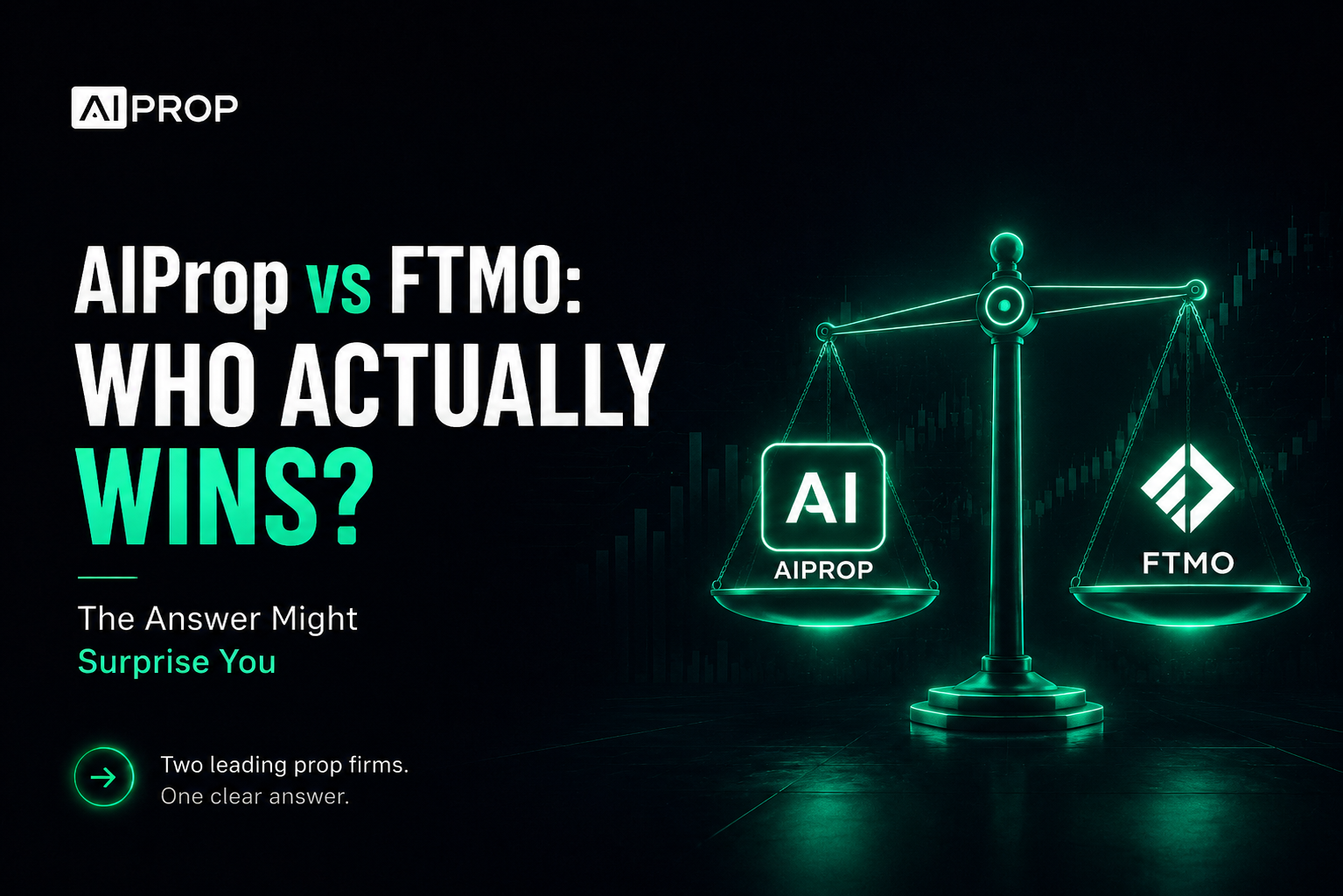
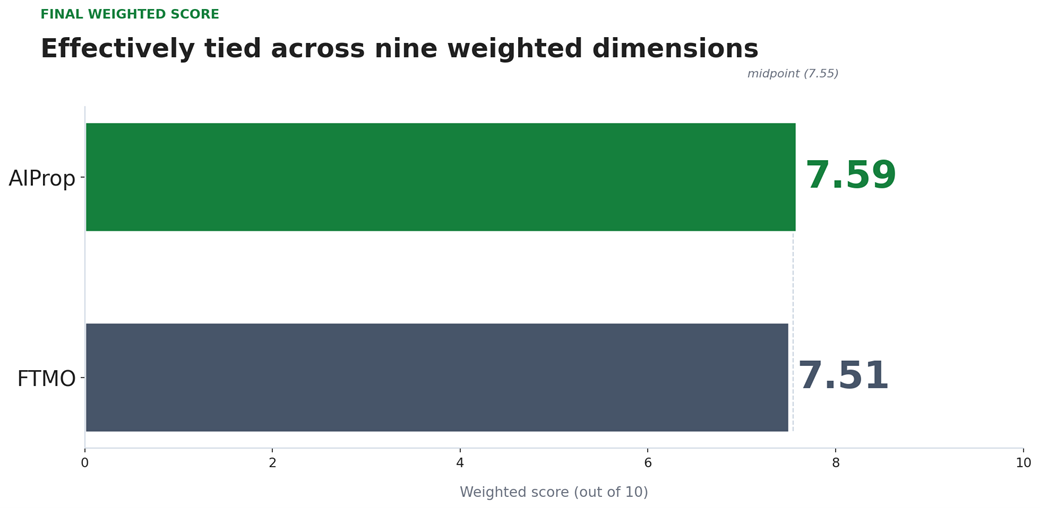
If you’ve been shopping between AIProp and FTMO, you’ve probably read your share of Reddit threads and YouTube reactions. Most fall into one of two camps: FTMO loyalists pointing at a decade of operating history, or AIProp enthusiasts hyping AI features and on-chain payouts.
We just finished a 29-page benchmark comparing the two firms across nine weighted dimensions. The result was a near-tie — but “tied” doesn’t mean the firms are interchangeable. They win on completely different things, and which one fits you depends entirely on what you’re optimizing for.
Why this comparison matters right now
Prop trading is splitting into two generations.
Era II firms — incumbents like FTMO — compete on trust-at-scale: years of operating history, cumulative payout volume, deep review bases.
Era III firms — design-first operators like AIProp — compete on product structure: AI-assisted execution, behavioral analytics, blockchain-verifiable payouts, and fee models that defer payment until traders pass.
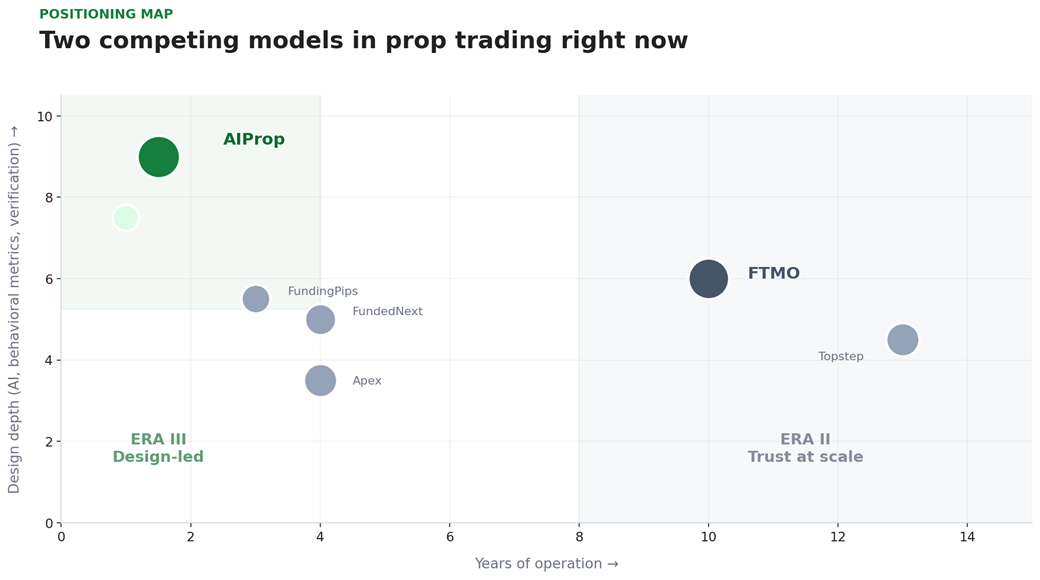
The category question for the next 12–24 months isn’t “which firm is better.” It’s “what will traders end up prioritizing?” If the answer is trust-at-scale, FTMO and its peers continue dominating. If it shifts toward structural design, firms like AIProp take share. Right now, neither model has decisively won.
Who wins where
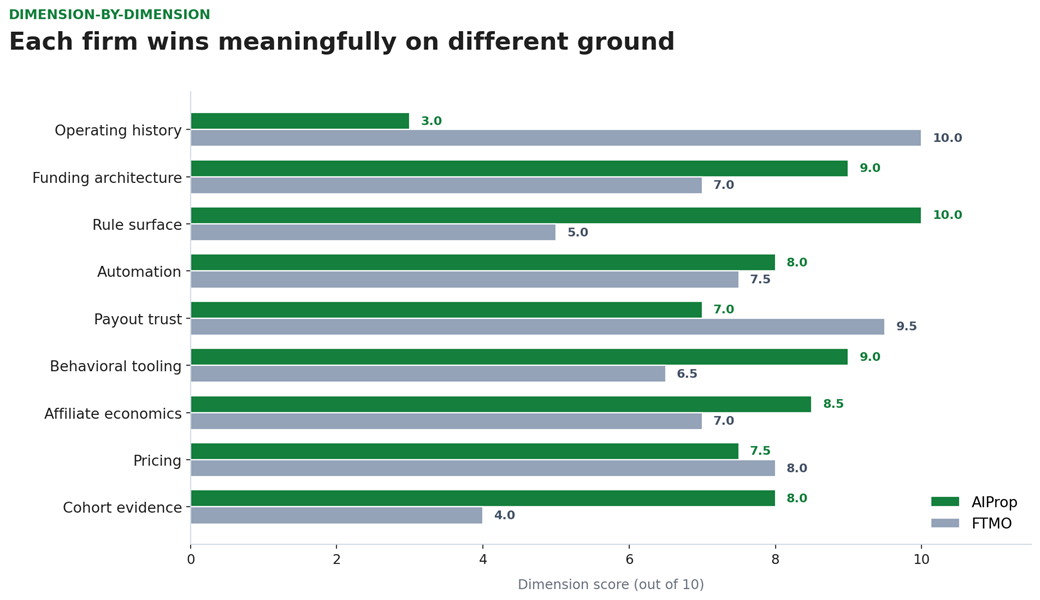
AIProp’s wins concentrate on what a firm controls through product decisions: rule design, automation policy, capital scaling, integrated behavioral tooling. FTMO’s wins concentrate on what only time and scale produce: a decade of operating history, $450M+ paid out, a large public review base.
Pricing and affiliate economics are roughly at parity — the two firms made different choices that produce similar trader-economic outcomes.
Four things that actually matter for traders
1. AIProp’s PFPL changes who pays for what
Most prop firms collect the full evaluation fee upfront. If you fail the challenge, the firm keeps the money. With industry-wide pass rates around 5–10%, that means 90–95% of evaluation revenue comes from traders who never pass. FTMO mitigates this with a 100% refund on the first payout — a good policy, but the upfront-fee structure is intact.
AIProp’s Pass-First-Pay-Later (PFPL) inverts the timing: you pay a small access fee ($19–$199) to start, and settle the bulk of the evaluation fee only after passing. A meaningful portion of AIProp’s revenue is tied to traders actually succeeding.
Worth noting: total commitment under PFPL isn’t lower than FTMO’s upfront model — the timing differs, not the price level. PFPL also exists at several other prop firms. In this specific head-to-head, FTMO doesn’t offer a PFPL equivalent.
2. The behavioral tooling has measurable effects
AIProp’s 1,000-trader cohort study tracked manual and AI-assisted traders across 24 months (April 2024 – March 2026). The differences in behavioral outcomes were large and statistically significant.
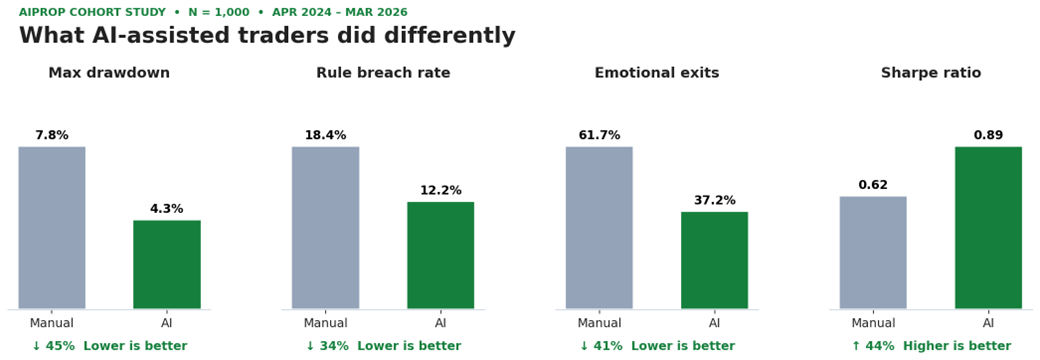
This isn’t a claim that AI makes you win more trades. It’s a claim that AI makes you violate fewer rules, exit fewer trades emotionally, and run smaller drawdowns — which is what kills most prop traders before strategy ever becomes the bottleneck.
Honest caveat: this is an observational study, not a randomized trial. Traders who chose AI assistance may have started with different baselines than manual traders. We can’t rule that out without a controlled experiment.
3. Operating history compounds with time. Design choices don’t.
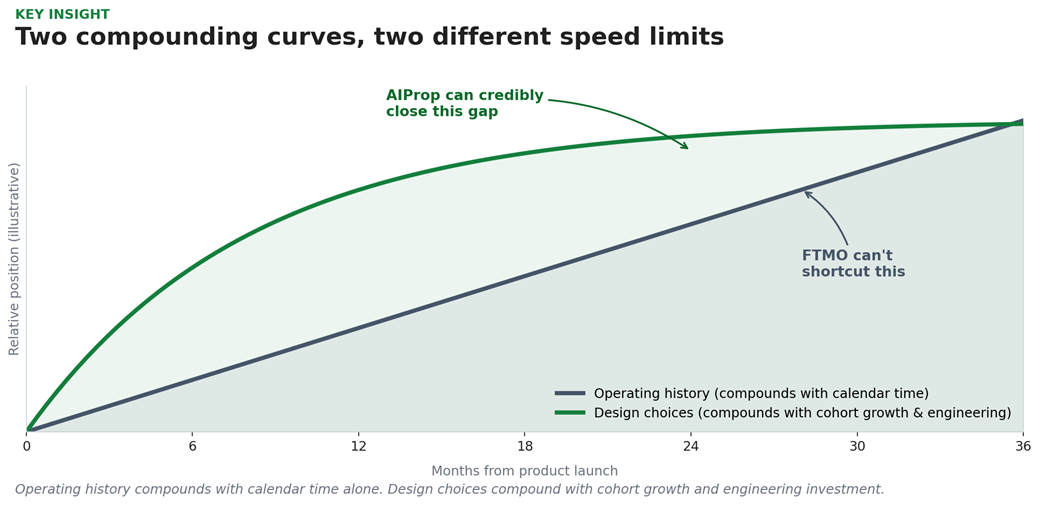
This is the most important insight from the research, and it cuts both ways.
AIProp loses on operating history today — and today, that’s a real weakness. But operating history only compounds with calendar time. A firm founded in 2024 cannot have 10 years of history by 2026, no matter how good its product is.
Design choices compound differently. AI tooling, behavioral metrics, payout verification infrastructure — all of these improve with cohort growth and engineering investment, not with calendar time. AIProp can credibly close the design gap on FTMO within 24 months. FTMO cannot close the design gap on AIProp without rebuilding its product.
The flip side: AIProp’s design advantages can be copied. Multi-tier affiliate structures, on-chain payout records, integrated behavioral metrics — none of these has a technical moat. FTMO’s operating history is the only moat in the comparison that can’t be replicated by a competitor through engineering effort.
4. Platform breadth matters and gets overlooked
AIProp runs on cTrader only. FTMO supports MT4, MT5, cTrader, and DXtrade.
If your strategy lives in an MT4 or MT5 EA, or your existing workflow runs on DXtrade, this is a critical filter. Migrating an EA across platforms isn’t always trivial. Don’t let the AI features distract from this constraint — if AIProp’s platform doesn’t match your stack, none of the other advantages compensate.
So which firm should you pick?
The answer isn’t “which is better” — it’s “what do you prioritize.”
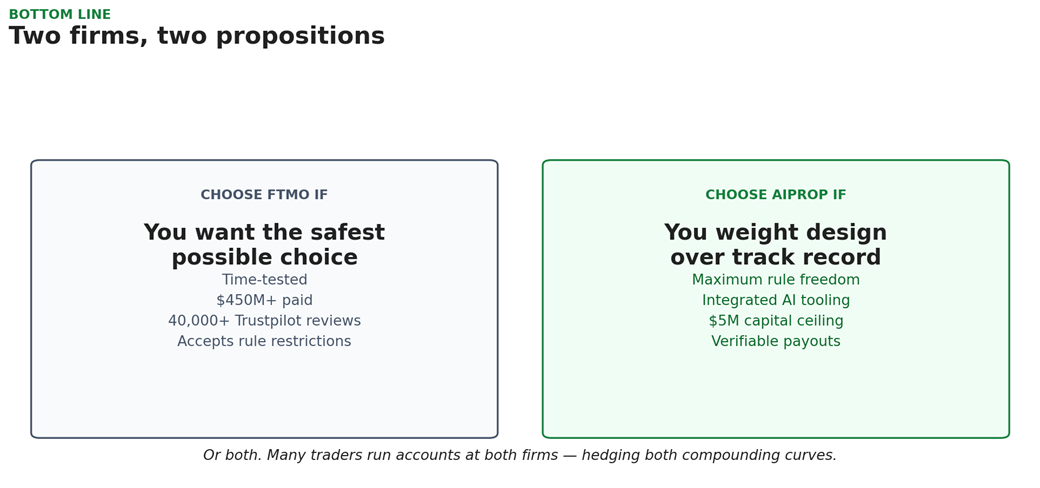
The next 12–24 months will tell us whether trader preferences shift toward structural design (good for Era III firms) or stay anchored on incumbency (good for FTMO). Nobody has the answer yet.
But here’s a useful frame: you don’t actually have to pick one and abandon the other. Plenty of traders run accounts at both firms, hedging both compounding curves. That might be the most rational play of all.
This post summarizes the working paper “AIProp vs FTMO: A Head-to-Head Structural Benchmark of Two Prop Trading Models” (BM-2026-04, AIProp Research Hub, April 2026). The full 29-page paper includes sub-score breakdowns, sensitivity analysis, and complete source references. Findings are reported as associations from observational data, not as causal claims. This is not investment advice.