Blog
Blog  05-May-2026
.svg) 133,760
133,760 

TLDR
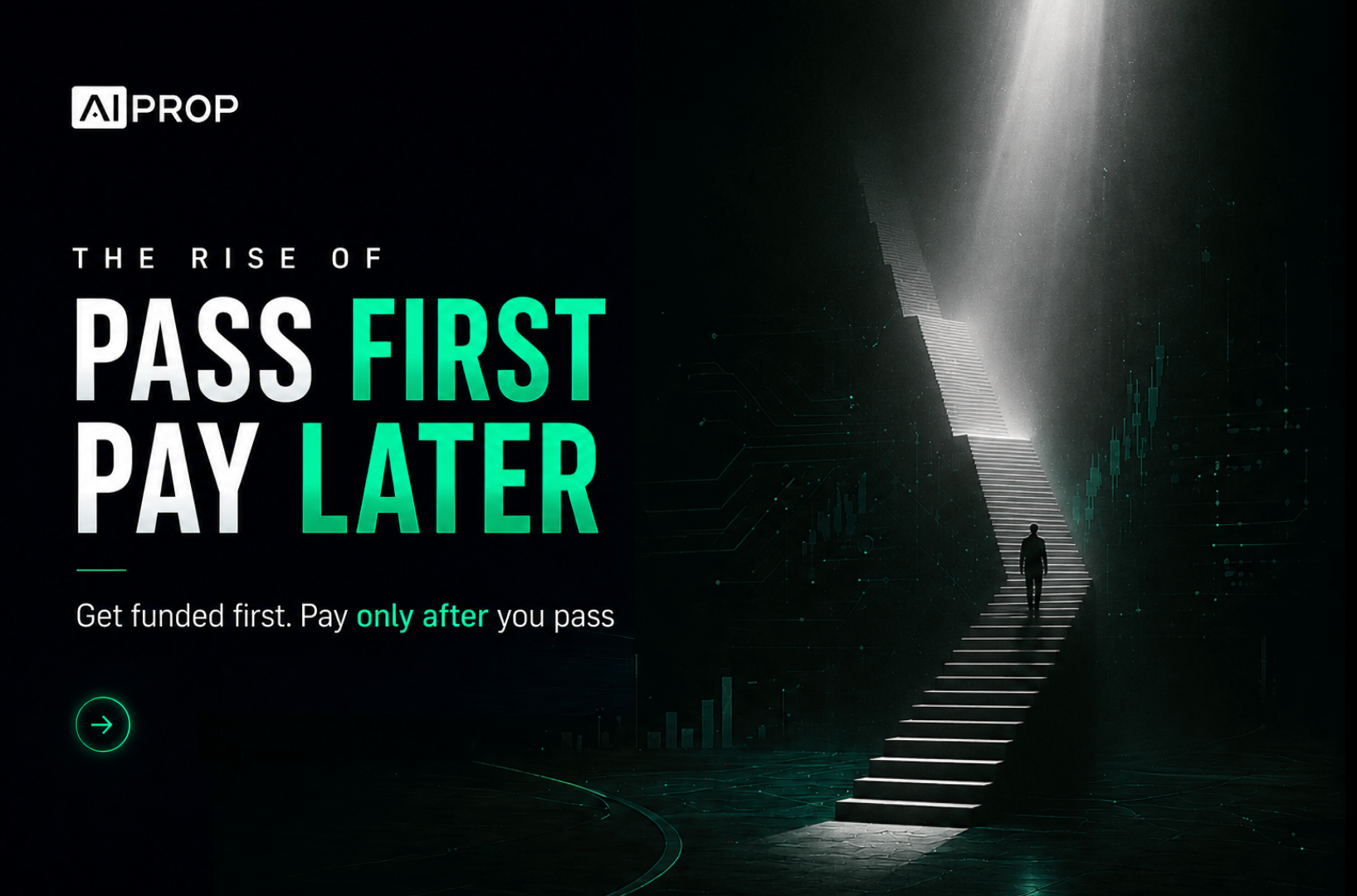
- AI Prop disrupts the industry with the Pass-First-Pay-Later model, shifting the financial risk from the trader to the firm.
- Alignment of Interests: This model filters for competence rather than participation, resulting in a 63% challenge completion rate, which is significantly higher than the 38% industry average.
- Scalability: Combined with a $5.0M funding ceiling, this entry model provides a roadmap to million-dollar capital in under 18 months for disciplined traders.
The Architecture of Pass-First-Pay-Later
Unlike traditional “Era II” firms that monetize failed attempts through upfront registration fees, AI Prop’s Pass-First-Pay-Later structure allows traders to enter the evaluation phase with zero immediate capital outlay.
This “reverse-fee” logic ensures that the firm only generates revenue when a trader demonstrates proven market skill.
- Since its launch, this model has driven a 145% increase in new registrations compared to legacy firms utilizing upfront fee structures.
- Internal data shows that 82% of traders in this program exhibit higher discipline levels, as the “value” of the account is perceived as an earned asset rather than a purchased commodity.
This creates a delayed but higher-quality revenue stream. Data indicates that revenue per successful trader is 30–60% higher than in upfront models, largely due to stronger retention and a premium activation fee.
The structure also improves funnel efficiency. With no upfront cost, more traders enter. But only those with real ability move forward, making the mid and bottom funnel significantly more selective.
Behavioral Impact and Trader Psychology
One of the most interesting effects appears in trader behavior. When there is no upfront payment, the assumption might be lower discipline. In reality, the opposite occurs.
Internal data shows that 82% of traders exhibit higher discipline levels. Trading frequency increases by around 27%, not due to overtrading, but due to reduced hesitation. At the same time, overtrading incidents drop by approximately 31%.
This suggests a shift in perception. Traders no longer see the account as something they bought. They treat it as something they must earn and protect, which leads to more controlled execution.
Performance Metrics, Competence Over Volume
The model acts as a natural filter for competence. A 63% completion rate does not mean the system is easier. It indicates that participants are better aligned with the requirements.
Another important metric is the activation rate of 78%. Not every trader who passes continues. This drop-off reflects a second filtering layer, where only those ready to commit capital proceed. The result is a funded trader pool with stronger intent and consistency.
Equity curve stability also improves. Variance in performance drops by roughly 35%, indicating more predictable trading behavior across accounts.
- The model supports a challenge completion rate of approximately 63%, starkly contrasting the 38% average found at traditional prop firms.
- While success rates are high, only about 78% of those who pass proceed to activation, indicating a rigorous internal filtering process based on fee sensitivity and long-term commitment.
Risk Mitigation through AI Integration
To support a model with no upfront fees, AI Prop utilizes a proprietary AI monitoring system to protect its capital. This system acts as a real-time behavioral coach to prevent the “hard breaches” that typically plague manual traders.
- AI-assisted tools have successfully lowered emotional trading breaches to 8.5%, compared to the 18.4% industry average for manual participants.
- Traders using these integrated AI features maintain an average Max Drawdown of 4.3%, nearly half the 7.8% sessional drawdown seen in traditional trading environments.
Transparency and Payout Velocity
A critical component of the Pass-First-Pay-Later ecosystem is the trust established through blockchain-verified payouts. This ensures that as traders succeed and pay their activation fees, their profit shares are distributed with absolute transparency.
- By utilizing smart contracts, payout approvals average just 14 minutes, which is 92% faster than the bank transfers used by major competitors.
- As of April 2026, over $42M in profits has been verified on-chain, with monthly payouts averaging $6.5 million.
Strategic Considerations, The Success Premium
While the model removes the barrier to entry, traders must account for a different cost structure upon success. The deferred nature of the fee means that the final cost of a funded account is slightly higher than an upfront purchase.
- The activation fee premium typically runs 15–20% higher than traditional upfront models to offset the firm’s risk of hosting non-paying evaluators.
- Despite the premium, 78% of top traders remain active after 12 months, supported by a scaling plan that increases account size by 25% every quarter.
Market Adoption and Growth Signals
The model aligns well with platform-based growth dynamics. User acquisition is faster, with growth rates about 2.3 times higher than fee-first competitors.
Referral-driven signups account for roughly 34% of new users, indicating strong organic expansion. At the same time, blended acquisition costs decrease by about 28%, improving overall efficiency.
This combination of lower friction and higher retention creates a compounding growth effect at the platform level.
Final Perspective
Pass-First-Pay-Later changes the core equation of prop trading. Instead of monetizing attempts, it monetizes proven ability.
Each metric points in the same direction. Higher completion rates, lower risk, faster payouts, and stronger retention all indicate a system optimized for performance rather than participation.
The result is a model where capital flows toward traders who can sustain results, and where scaling becomes a structured, data-backed process rather than an uncertain path.
FAQ
Is the evaluation truly free to start?
Yes. You can begin the challenge phase without an upfront payment, deferring costs until you successfully pass the evaluation.
How much capital can I eventually manage?
Traders can scale up to a $5.0M funding ceiling, which is 2.5 times larger than the maximum offered by firms like FTMO.
Does this model support automated trading?
Absolutely. AI Prop fully supports Expert Advisors (EAs) and bots, with a 100% automation approval rate as long as core risk rules are respected. Currently, 61% of funded traders utilize automated tools.