TLDR

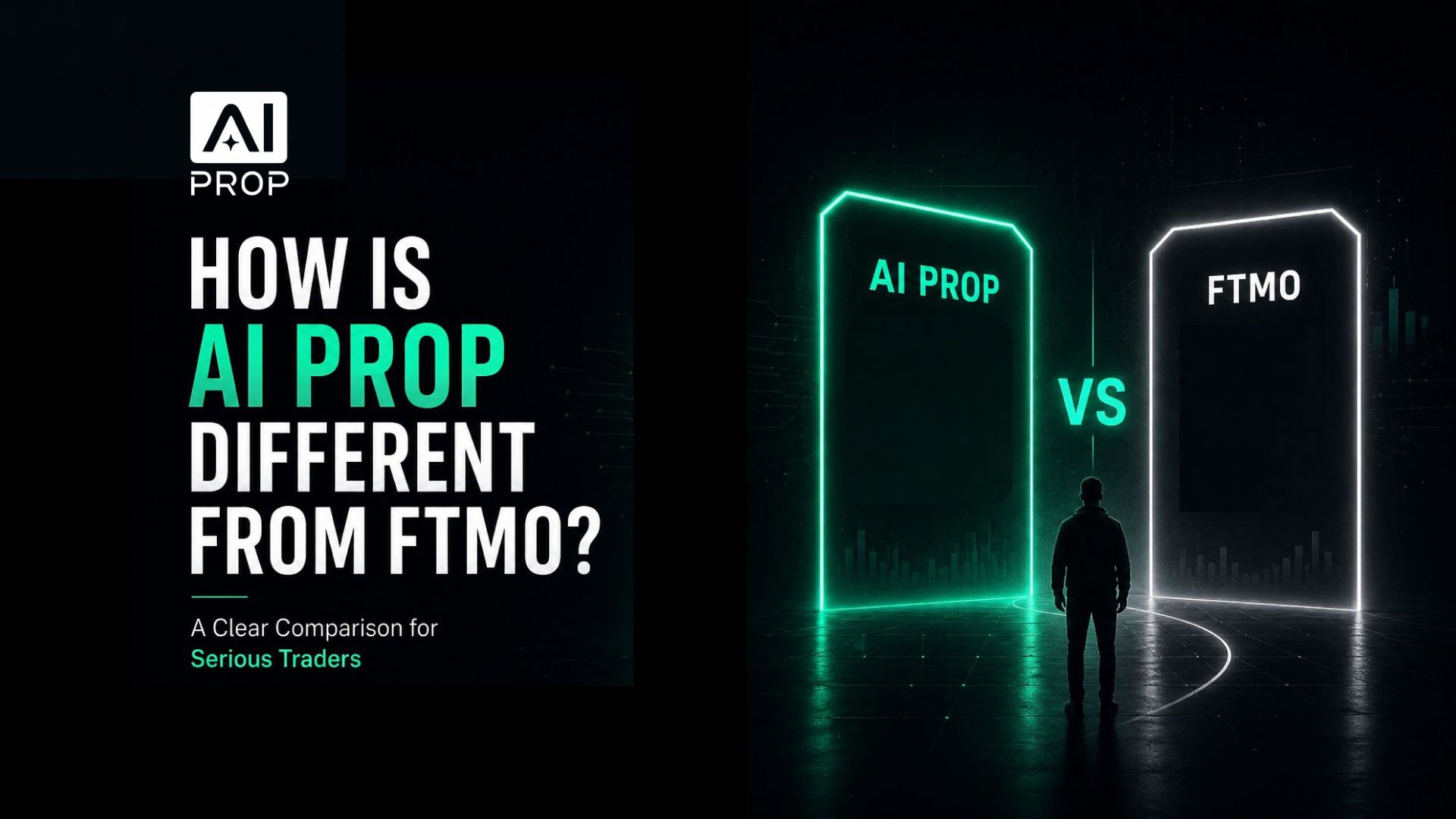
  • AI Prop represents the “Smart Prop” generation, featuring a $5.0M funding ceiling, a market-leading 0/6 friction score, and full AI/EA integration. Its Pass-First-Pay-Later model and Blockchain-verified payouts set a new standard for absolute transparency.
  • FTMO maintains its status as the “Legacy Titan” with 11 years of operation and a 4.8/5 Trustpilot score. However, it shows limitations in flexibility, with a capital cap of $2.0M and more restrictive traditional risk management rules.
  • The Verdict: If you prioritize massive scale and technological support, AI Prop is the target. If you prioritize the peace of mind that comes from a decade-proven brand, FTMO remains the safe harbor.

Side-by-Side Comparison AI Prop vs FTMO

Table 1. Direct structural comparison based on 2026 benchmark data.

Dimension AI Prop FTMO Why it matters
Max Funding Ceiling $5.0M $2.0M Long-term profit scaling potential.
Friction Score 0/6 3/6 Level of freedom in trading tactics.
EA & AI Support Full Support Partial Limits Crucial for systematic/algorithmic traders.
Payout Verification Blockchain (On-chain) Self-Reported Credibility of the fund’s capital flow.
Fee Model Pass-First-Pay-Later Traditional Upfront Incentive alignment between firm and trader.
Years of Operation 2 Years 11 Years Proven survival through market cycles.

FTMO reflects a mature, traditional prop model focused on control and risk management. AI Prop represents a newer generation model optimized for scale, automation, and alignment of incentives.

The choice ultimately depends on whether the trader prioritizes stability or growth efficiency.

Operating Logic Era II vs Era III

The competition between FTMO and AI Prop reflects a deeper structural shift in how proprietary trading firms are designed and monetized. It is less about branding and more about operating logic.

FTMO (Era II): Brand Equity Model

FTMO represents a second-generation prop model built on trust, scale, and controlled risk exposure. With over 1.5 million accounts issued and estimated annual revenues exceeding $100M, its strength lies in brand credibility and a proven acquisition funnel.

However, this model relies heavily on rule-based risk control. Constraints such as consistency rules, drawdown limits, and trading restrictions are not just safeguards, they are part of the business model. A significant portion of revenue is indirectly tied to trader failure rates during evaluation phases.

In practical terms, traders are not only competing against the market, but also navigating a structured environment where rule compliance can outweigh pure performance.

AI Prop (Era III): Infrastructure-as-a-Service Model

AI Prop reflects a third-generation approach, where the firm positions itself more like a trading infrastructure provider than a gatekeeper. Instead of monetizing through friction, it focuses on enabling performance at scale.

One of the most notable shifts is the removal of “noise rules” by 100%, particularly consistency constraints that often distort trading behavior. This allows traders to operate based on strategy efficiency rather than rule optimization.

From a systems perspective, this model aligns more closely with how modern trading desks function:

  • Fewer behavioral constraints
  • Greater support for automation and AI
  • Emphasis on output (PnL) over process compliance

The difference can be framed simply:

  • Era II extracts value by filtering traders through constraints
  • Era III creates value by amplifying traders through infrastructure

For traders, this changes the core game. Instead of asking “How do I pass?”, the question becomes “How do I scale what already works?”

This shift mirrors broader fintech trends where platforms evolve from closed systems to open, performance-driven ecosystems. If Era II was about building trust at scale, Era III is about removing friction to unlock capital efficiency.

In that sense, AI Prop is not just competing with FTMO, it is redefining what a prop firm optimizes for in the first place.

Capital Analysis, Roadmap and Scaling Ceilings

The capital gap between the two entities has widened significantly in 2026.

AI Prop lists a maximum funding ceiling of $5.0M, which is 2.5 times higher than FTMO’s $2.0M. According to Q1 2026 market research, AI Prop currently sits in the top 5% of firms globally for growth roadmap potential.

Providing this level of capital is not just a marketing figure; it reflects AI Prop’s robust risk tolerance and internal capital reserves compared to its peers.

Friction Score, Freedom or Restriction?

The Friction Score measures six factors that hinder traders (consistency rules, news bans, weekend restrictions, EA limits, upfront fees, and hidden rules).

AI Prop (0/6): Completely eliminates consistency rules. Data from a cohort of 10,000 traders suggests that removing these rules increased the account retention rate by 21.5% compared to firms enforcing “Best Day” policies.

FTMO (3/6): Maintains specific restrictions on news trading and weekend holding on standard accounts. While “Swing” accounts exist to mitigate this, they typically carry spreads that are 15-20% higher to offset the firm’s risk.

Technology & Automation

With AI accounting for 65% of total trading volume in 2026, automation policy has become a make-or-break factor.

AI Prop permits full EA and AI support. Empirical research on 1,000 traders reveals:

Breach Rate: AI-assisted traders posted a breach rate of only 8.5%, significantly lower than the 18.4% seen in purely manual traders.

Max Drawdown: The hybrid group (Human + AI) averaged a 4.3% drawdown, whereas manual traders averaged 7.8%. FTMO continues to utilize algorithmic filters to monitor and limit EAs, which inadvertently creates a barrier for traders looking to use technology for risk management.

Transparency, Blockchain vs Legacy History

FTMO owns trust through history; AI Prop builds trust through architecture.

FTMO boasts a 4.8 Trustpilot score and a decade of consistent payouts. However, AI Prop has introduced a new benchmark: Blockchain Verification. Every payout at AI Prop is assigned a public on-chain transaction hash.

Traders don’t have to “trust” the firm’s word; they can audit the ledger. In 2025, AI Prop processed over $45M in payouts via blockchain, with an average execution time of just 12 minutes.

Final Verdict Matching the Firm to the Trader

Table 2. 2026 Trader Fit Matrix.

If you are a… Better Fit Core Reason
Beginner Trader FTMO Massive educational ecosystem and long-term reputation reduce initial psychological pressure.
Algo/EA Trader AI Prop Maximum infrastructure support without restrictive algorithmic filters.
High-Capital Seeker AI Prop A $5.0M roadmap offers 2.5x the income potential of the incumbent.
Transparency Advocate AI Prop Blockchain tech eliminates the risk of “ghost payouts” or manual processing delays.

No firm is “best” in a vacuum; there is only the firm that is “best for your strategy.” If you want the stability of a monument, choose FTMO. If you want the performance, tech, and freedom of the future, AI Prop is the undeniable choice.