Blog
Blog  03-May-2026
.svg) 141,265
141,265 

TLDR
Risk Logic: Prop firms do not merely manage capital, they manage trader behavior. In 2026, over 82% of leading prop firms use real-time behavioral surveillance to detect emotional decision-making, overexposure, and rule-breaking before significant losses occur.
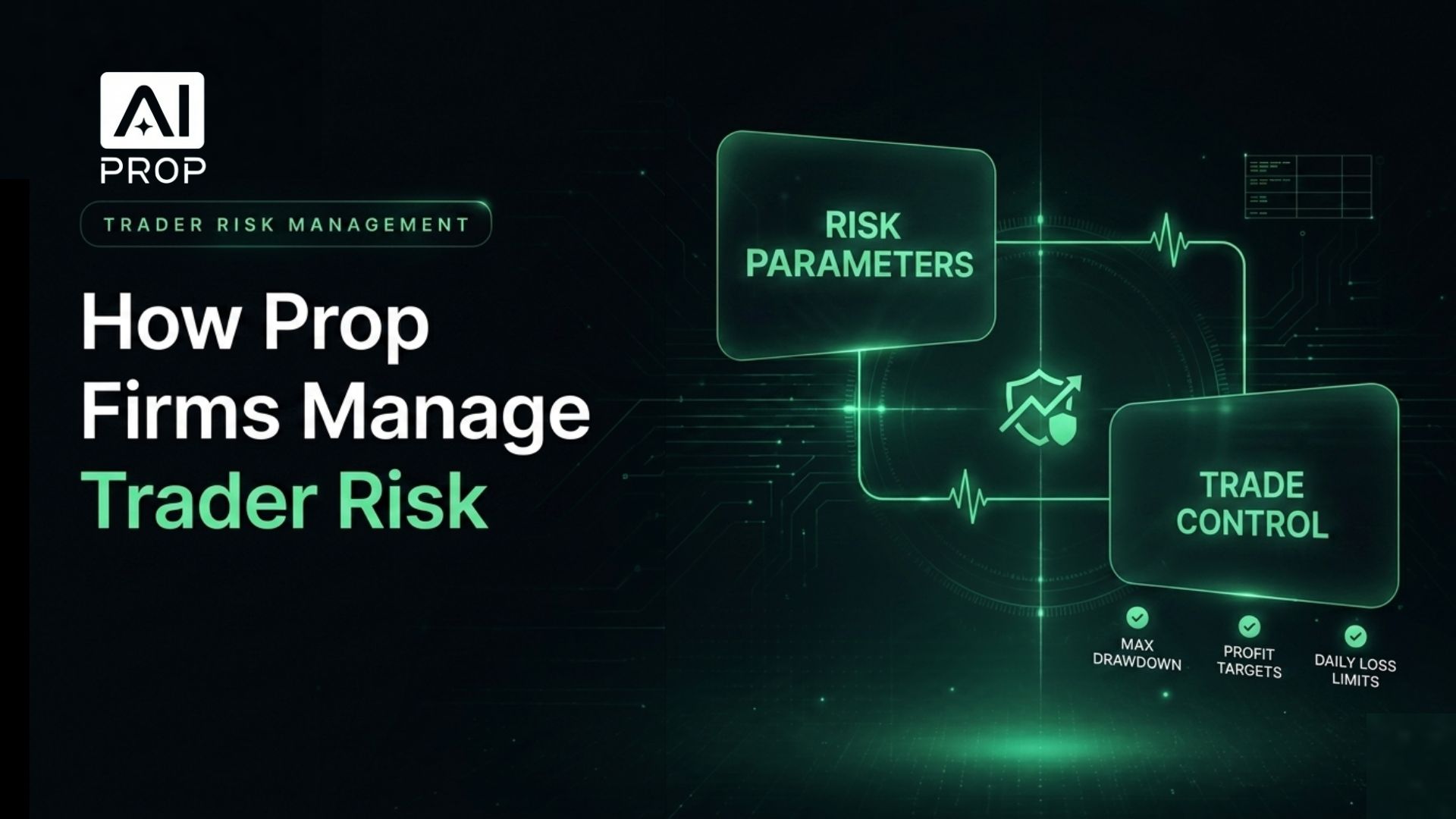
Structural Barriers: Rules such as Maximum Drawdown, Daily Loss Limits, and Consistency Requirements function as mechanical safeguards, protecting firm liquidity and ensuring long-term sustainability.
The Modern Shift: The industry’s top firms are evolving from punitive, rule-based enforcement toward predictive, AI-driven risk management. AI systems can now identify potential breaches up to 15-30 minutes before they happen.
The Bottom Line: Effective prop firm risk management is a delicate balance, protecting institutional capital while giving skilled traders enough freedom to generate sustainable returns.
Core Risk Management Frameworks
Table 1. The Most Common Prop Firm Risk Controls in 2026
| Dimension | Mechanism | Why It Matters |
|---|---|---|
| Static Drawdown | Fixed relative to starting balance | Reduces psychological pressure and preserves original capital. |
| Trailing Drawdown | Moves upward with account equity highs | Eliminates short-term lucky traders and demands strict discipline. |
| Daily Loss Limit | Trading is halted after daily loss threshold | Prevents revenge trading; reduces single-day blowup risk by over 70%. |
| Consistency Rule | Caps percentage of profits from one day or one trade | Filters gambling behavior and rewards repeatable skill. |
| Leverage Caps | Asset-specific leverage restrictions | Controls margin volatility during high-impact events and news releases. |
Why Risk Management Matters More Than Profit
Most traders obsess over profit targets of 10% or 20%. Prop firms, however, focus almost exclusively on one metric:
Risk of Ruin
A profitable trader who cannot control risk is still an unacceptable liability. Industry data shows:
- Only 5-10% of challenge participants pass evaluation.
- Fewer than 2% maintain profitability for 12 consecutive months.
- Nearly 78% of account failures are caused by risk violations, not poor market analysis.
Modern prop firms are transitioning from the rigid Era II model, where violations immediately terminate accounts, to the data-centric Era III model, where behavioral analytics continuously monitor trader quality.
Instead of simply asking, “Did you break the rules?” They now ask, “How likely are you to break them next?”
The Three Pillars of Modern Prop Risk Management
1. Real-Time Surveillance Algorithms
Manual monitoring is obsolete. Leading firms now deploy AI engines such as RiskMonitor AI, processing thousands of account events per second. Key Detection Systems:
- Over-Leveraging Alerts: Detects sudden position size increases, especially before major economic releases.
- Grid/Martingale Recognition: Flags high-risk recovery systems that can rapidly destroy liquidity.
- Behavioral Volatility Tracking: Measures deviation from a trader’s historical risk profile.
Top firms report a 43% reduction in catastrophic account losses after implementing AI surveillance.
2. Behavioral Management Through Consistency Rules
Consistency rules are not designed to frustrate traders. A trader who generates profits steadily across multiple sessions is far more valuable than one who relies on a single outsized win.
For example: If 90% of total profits come from a single trade, the strategy lacks statistical reliability, the trader resembles a gambler more than a risk manager.
Internal industry data shows:
- Traders who generate profits across at least 5 separate trading days are 3.4x more likely to receive multiple payouts.
- Accounts with a single-day profit concentration above 50% have a 67% higher failure rate within the next 30 days.
- Nearly 74% of long-term funded traders maintain no single trading day above 35% of total monthly profits.
Firms analyzing payout data consistently find that:
- Smooth equity curves reduce risk-of-ruin by approximately 58%.
- Consistent traders produce 2.7x higher lifetime value.
- Accounts passing consistency filters experience 43% fewer hard breaches.
3. Hard Breach vs. Soft Breach
Hard Breach
A Hard Breach occurs when a trader violates a non-negotiable risk parameter, most commonly the Maximum Overall Drawdown.
- Account is terminated instantly.
- All open positions are liquidated automatically.
- Reinstatement is typically not permitted.
- Evaluation fees are usually forfeited.
Approximately 72-78% of failed evaluation accounts are terminated due to hard drawdown violations. Over 85% of hard breaches occur during periods of emotional escalation, such as revenge trading or over-leveraging.
Nearly 60% of hard breaches happen within the first 15 trading days of a challenge. For prop firms, hard breaches remain the final line of defense against catastrophic capital loss.
Soft Breach
Increasingly popular among modern firms. Instead of immediate termination:
- Violating trades may be closed automatically.
- Trading may be suspended for the remainder of the session.
- Traders receive AI-generated coaching before resuming.
By 2026, approximately 41% of top-tier prop firms have implemented some form of soft-breach protocol. Among AI-native prop firms, adoption exceeds 68%. Firms using soft-breach systems report a 35-42% reduction in repeat rule violations.
- Trader retention improves by roughly 28-31%.
- Second-attempt pass rates increase by 22%.
- Average trader lifetime value (LTV) rises by approximately 37%.
Soft Breach models shift the firm’s role from pure enforcer to performance partner.
Matching Risk Models to Trader Profiles
Table 2. Choosing the Right Prop Firm Based on Your Trading Style
| Trader Profile | Best Risk Model | Why |
|---|---|---|
| Swing Trader | No News Restrictions | Essential for holding positions overnight and through macro events. |
| Scalper | Tight Daily Loss + High Leverage | High-frequency trading requires both flexibility and daily protection. |
| Algo / EA Trader | AI-Supported Firms | Better API infrastructure and more sophisticated automated risk routing. |
| Conservative Trader | Static Drawdown | Lower psychological pressure and more predictable risk parameters. |
Limitations of Current Risk Systems
Approximately 6-9% of trader appeals in 2025 involved false-positive behavioral flags. The smartest traders do not trade to the firm’s limits. They trade well inside them.
- If your firm allows a 5% daily drawdown, cap yourself at 3%.
- If the consistency threshold is 40%, aim for 25-30%.
- Never risk more than 0.5-1.0% per trade.
Professional traders understand a simple truth: The firm’s risk rules are the minimum standard, not the optimal one. Prop firms do not want you to lose. They want you to trade in a way that can be modeled, measured, and scaled.
The traders who align themselves with the firm’s risk architecture, rather than fighting against it, will be the ones collecting the largest payouts in 2026. In today’s environment, trading skill alone is not enough. Risk compatibility is the true edge.
Frequently Asked Questions
Why do prop firms impose drawdown limits?
To ensure the firm never loses more than its allocated risk budget with liquidity providers. This preserves capital efficiency and protects the business model.
What is the difference between manual and AI risk management?
Manual systems react after violations occur.
AI systems predict violations before they happen by analyzing: Order frequency, Position sizing velocity, Behavioral deviations and Emotional trading patterns. This predictive capability can reduce preventable breaches by up to 35%.