Blog
Blog  11-Jun-2026
.svg) 48,070
48,070 

A trader hits most of their target in one clean trade. The rest of the funded period is quiet, a few small wins, nothing dramatic. The number on the account clears the threshold. They request the payout, and the payout doesn’t come. No daily loss limit was breached. No drawdown, no missed minimum trading day. The account is still live and still in profit. But the withdrawal sits frozen, because a single day made up too large a share of the total. One good trade, and the money you earned is suddenly stuck behind a rule most people never read.
That rule has a name, and it traps profitable traders more often than any other hidden clause in this industry. It’s called the consistency rule, and it’s worth understanding in full, the same way you’d want a clear picture of what a prop firm challenge involves, before you ever hand a firm a fee.
What is the consistency rule?
The consistency rule caps your single best trading day so it can’t exceed a set share of your total funded-period profit, usually somewhere in the 30.0-50.0% range. Some firms apply it to your best day, some to your best week, but the idea is the same: no single chunk of profit can be “too big” a slice of the whole. Make most of your money in one strong session and you can clear your target on paper yet still fail the consistency test.
Thresholds vary, and the wording differs wildly from firm to firm. The strictest versions sit around 30.0%. The 50.0% versions are more forgiving. The number you’ll bump into most often is 35.0%. So if a firm runs a 35.0% rule and your best day is worth more than 35.0% of your total profit, the payout is blocked, even when you’ve followed every other rule on the page. This is the kind of after-the-fact clause that sits in the same family as the broader hidden-rule problem most buyers never check for: rules that decide whether a passed account actually gets paid.
Why your best day works against you
The math is simple, and once you see it you can’t unsee it. Your Consistency Score is your best single day divided by total profit, expressed as a percentage. If your best day is $1,500 and your total is $3,000, that day is 50.0% of your profit. Under a 35.0% rule, you’re ineligible to withdraw despite doing nothing wrong.
Here’s the part that stings. The rule doesn’t just block a payout, it quietly raises the number you actually have to hit. Picture a challenge with a $10,000 target and a 30.0% best-day cap. You have a great session and bank $5,000 in one day. For that $5,000 day to be 30.0% or less of your total, your total now has to reach roughly $16,667, not $10,000. You’ve essentially raised your effective target by about 66.7%, and you did it by trading too well on one day.
Figure 1 lays this out: the published target you signed up for versus the real total you need once a strong day enters the picture.
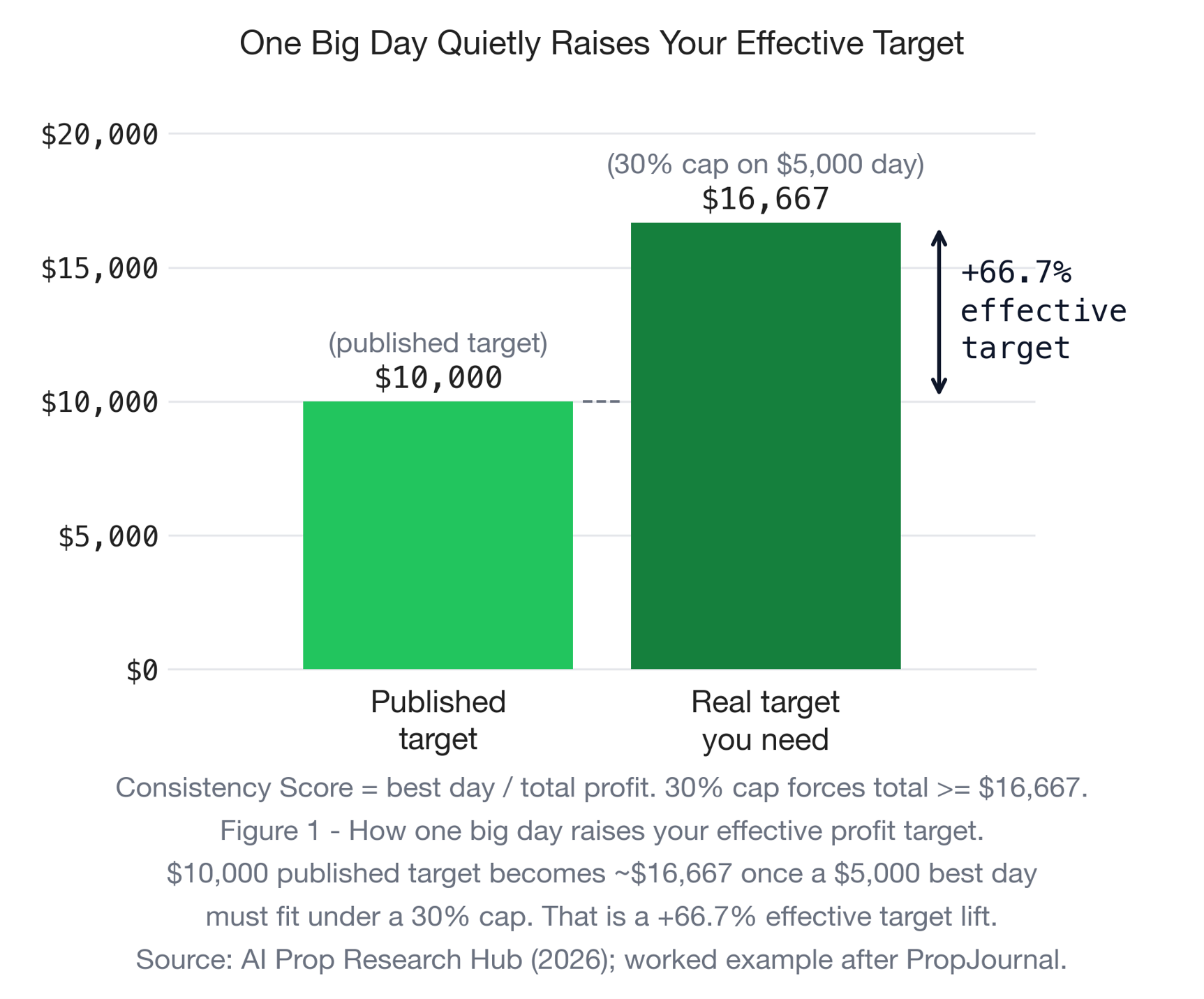
Figure 1: How one big day raises your effective profit target. A $10,000 published target becomes ~$16,667 once a $5,000 day must fit under a 30.0% cap, a 66.7% lift.
That’s the trap in one chart. You don’t fail for losing. You get penalised for winning, and the penalty is dressed up as a target you can technically still reach.
The trap is a freeze, not a fail
A consistency breach freezes your payout. It does not fail your account. That distinction matters more than it first sounds. Hitting your daily loss limit fails the account outright; violating consistency just delays the payout while the account stays live. On the surface that sounds gentler, almost generous. In practice it’s the more dangerous outcome, because it hands you a problem you have to keep trading your way out of.
To “fix” a breach, you have to dilute the big day. The only way to shrink one day’s share of the total is to grow the total, which means more trades. Hit your target and then realise your day-three spike is 42.0% of your profit, and now you need to keep trading to bring that percentage down, risking the entire account in the process. You earned the money already. To unlock it, you have to put it back at risk. That is the precise moment disciplined traders blow up: not chasing a target, but grinding to dilute a payout they’ve technically already won. Figure 2 shows why a freeze can be more dangerous than a clean fail.
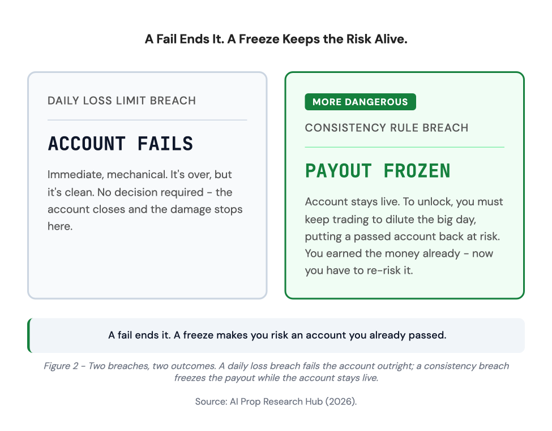
Figure 2: Two breaches, two outcomes. A daily loss breach fails the account outright and it’s over; a consistency breach freezes the payout while the account stays live, forcing you to keep trading to dilute the big day and putting a passed account back at risk.
This is why the rule is so contested. One prop firm founder went on record calling the consistency rule a payout trap rather than a genuine risk-management tool. In one industry survey of around 500 active prop traders, 53.0% named consistency rules among the features they most want to avoid, second only to trailing drawdown. The pushback is real and it has teeth: one firm introduced its own 50.0% version and rolled it back barely two weeks later after an overwhelmingly negative response, with its own CEO conceding the rule limited specific trading styles from succeeding. A growing list of firms now run no consistency rule at all, and one major firm loosened its threshold from 30.0% to 50.0% in early 2026 as part of a broader move to relax rules. The direction of travel is away from the rule, not toward it, which tells you how the people closest to it really feel.
To be fair to the other side, firms don’t invent this rule purely to withhold money. The stated intention is to fund repeatable performance and filter out traders who rely on one outsized trade to hit the target, which traces back to the one-step model economics of how a firm prices the risk it takes on. That’s a reasonable goal. The problem is the tool: a blunt percentage cap punishes a clean, well-timed trade exactly as harshly as a reckless gamble, and it does the punishing after you’ve already passed. It’s worth understanding how prop firms manage risk before deciding which controls are fair, because the genuinely mechanical ones, like drawdown, are knowable in advance in a way a best-day cap is not.
AI Prop has no consistency rule
AI Prop has no consistency rule, at any stage. Your profit shape is irrelevant: you either hit the published number or you don’t, and one great day counts exactly the same as ten steady ones. There’s no best-day cap to dilute, no Consistency Score to manage, and no scenario where winning too well on a single session freezes the money you earned. AI Prop exclusive research describes a Friction Score of 0/6, meaning the six most common friction rules, the consistency rule among them, have all been removed.
That’s paired with where the payout actually lives. AI Prop publishes payouts on-chain, so the record sits on a public ledger anyone can verify rather than a ledger the firm controls. The same exclusive research associates removing rules like this one with higher account retention, an observational pattern across the cohort rather than a guarantee, but a directionally clear one: when traders aren’t forced to keep risking a passed account to unlock it, fewer accounts get blown up trying. Profit shape, in other words, stops being a thing you have to engineer. You just trade. This is what clear-rule prop firms are built around, and it’s the whole point of the model.
How to protect yourself
If your firm has a consistency rule, you can trade around it, but you have to plan for it from day one rather than discover it at payout, the same way you’d plan how to pass the one-step evaluation before you place a single trade. Three habits do most of the work, and Figure 3 shows the difference they make.
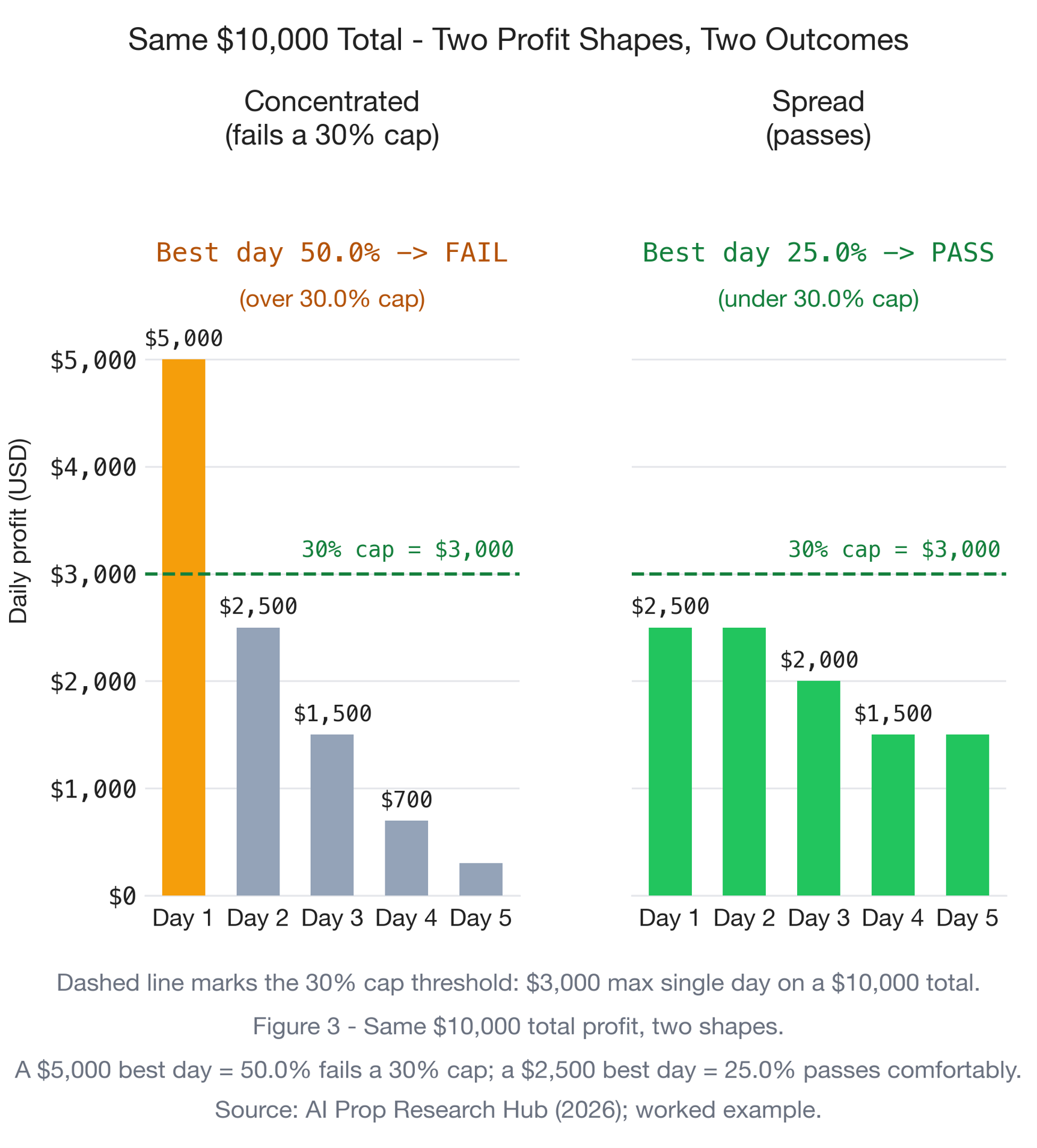
Figure 3: Same $10,000, two profit shapes. Concentrating it in one $5,000 day makes that day 50.0% of your total and fails a 30.0% cap; spreading it so no day tops $2,500 keeps your best day at 25.0% and passes comfortably.
Cap your daily profit from the start. A clean rule of thumb is to cap each day’s profit at around 20.0% of your overall target. Spread across enough days, that keeps any single session well under even a strict 30.0% threshold, so no one day can dominate your total. Front-loading a huge first day feels great and quietly creates the exact problem you’re trying to avoid.
Size down when a day is running hot. If a single session is sprinting ahead and approaching your cap, reduce position size for the rest of that day. You’re not trying to stop winning, you’re trying to stop one day from swallowing your profit distribution. A few smaller trades after a hot open protect the payout the big open created.
Read the payout terms before you buy, not after. The threshold, whether it’s a daily or weekly cap, and whether it resets after each approved payout, all change how you should trade. Most rules reset after a payout, so only profits since your last withdrawal count toward the next calculation. None of that is on the sales page. It’s in the terms, and the difference between a 30.0% and a 50.0% rule is the difference between two completely different trading plans.
If that sounds like a lot of management for something that should be simple, that’s the honest takeaway. The cleanest way to never manage a consistency rule is to trade somewhere that doesn’t have one. If payout reliability is your priority, it’s worth knowing what makes the safest prop firm for payouts different, because a firm’s rule surface tells you most of what you need to know before you commit a fee.
Frequently asked questions
What is the consistency rule at a prop firm?
The consistency rule caps your single best trading day (or sometimes your best week) so it can’t exceed a set share of your total funded-period profit, typically in the 30.0-50.0% range. The idea is to stop any one session from making up too large a slice of your profit. If your best day is too big a percentage of the total, your withdrawal is blocked even though you cleared the profit target, because the firm wants to see profit spread across multiple days rather than concentrated in one trade. Thresholds and wording vary widely from firm to firm.
How is the consistency rule calculated?
Your Consistency Score is your best single day’s profit divided by your total profit, multiplied by 100. If your best day made $1,500 and your total profit is $3,000, that day is 50.0% of the total. Compare that figure to the firm’s threshold: under a 35.0% rule, a 50.0% best day fails. The hidden cost is that the cap effectively raises your target. A $5,000 best day on a 30.0% rule means you need roughly $16,667 total, not the $10,000 you signed up for, a 66.7% lift in your real target.
Does the consistency rule fail my account or freeze the payout?
It freezes the payout. It does not fail the account. Breaching a daily loss limit fails the account outright, but violating consistency just delays the withdrawal while the account stays live. That sounds milder, but it’s arguably worse: to unlock the money you have to keep trading until the big day’s share shrinks, which means putting an account you’ve already passed back at risk. Many traders blow up not chasing a target, but grinding to dilute a payout they technically already earned.
What is a typical consistency rule threshold?
Thresholds usually sit between 30.0% and 50.0% of total profit. The 30.0% versions are the strictest, 50.0% the most forgiving, and 35.0% is the threshold you’ll encounter most often. The number matters enormously: a 30.0% rule forces profit across far more days than a 50.0% rule, so the same trading style can pass at one firm and fail at another purely on the threshold, which is exactly why it pays to compare prop firms on their evaluation model, not just their marketing. Always check the exact figure in the payout terms, not the marketing page, before you choose a firm or plan your trades.
How do I pass the consistency rule?
Plan for it from day one. Cap each day’s profit at around 20.0% of your overall target so no single session can dominate the total, and reduce your position size if one day starts running hot and approaching the cap. If you’ve already had a big day, you can dilute it by adding more profit on other days, but be careful: over-trading purely to dilute a single day is how passed accounts get blown up. Read the threshold, the daily-versus-weekly basis, and the reset rules before you start, because they change how you should size every trade.
Do all prop firms have a consistency rule?
No. A growing list of firms run no consistency rule at all, and the industry is broadly trending toward removing or softening it. One firm rolled back its own version barely two weeks after launching it following heavy trader backlash, and another major firm loosened its threshold from 30.0% to 50.0% in early 2026. In one survey of around 500 traders, 53.0% listed consistency rules among the features they most want to avoid. So whether a firm has the rule, and how strict it is, is a genuine point of difference worth checking, alongside payout history, when you’re weighing up the most reliable prop firm in 2026 before you buy.
Does AI Prop have a consistency rule?
No. AI Prop has no consistency rule at any stage, so your profit shape is irrelevant: you hit the published number or you don’t, and one big day counts the same as many small ones. AI Prop exclusive research describes a Friction Score of 0/6, meaning the consistency rule and five other common friction rules have all been removed. Payouts are published on-chain, so the record is independently verifiable rather than something the firm controls. With no best-day cap to dilute, there’s no scenario where trading too well on a single session freezes the money you earned.
Before you risk another lot under a rule you didn’t fully read, open your firm’s payout terms and search for “consistency,” “best day,” or “profit distribution.” If you find a cap, you’ve found the clause that can freeze a clean payout, and now you know exactly how to trade around it. Then see how AI Prop runs zero consistency rules and publishes every payout on-chain at aiprop.com before you commit a fee anywhere.