Blog
Blog  15-Jun-2026
.svg) 51,965
51,965 

Table of Content
What happened when a “profit” turned into a clawback
A trader logged in to a $3,200 balance and logged out to $751.62. No bad trade caused it. No drawdown breach. Overnight, a prop firm had introduced a one-minute minimum hold time, applied it backwards across trades that were already closed and settled, and stripped out every fast-closed profit on the books. Trades that had been valid the day before were suddenly invalid, and the money they earned went with them.
The fallout was fast. Reviews collapsed, the firm’s public review rating slid from 4.1 to 3.2, and within weeks the firm announced it was winding down entirely. But the trader’s $2,400-and-change never came back. That is the part worth sitting with: the rule that did the damage was not in the rulebook when those trades were placed. It arrived after the fact and reached into the past (Figure 1).
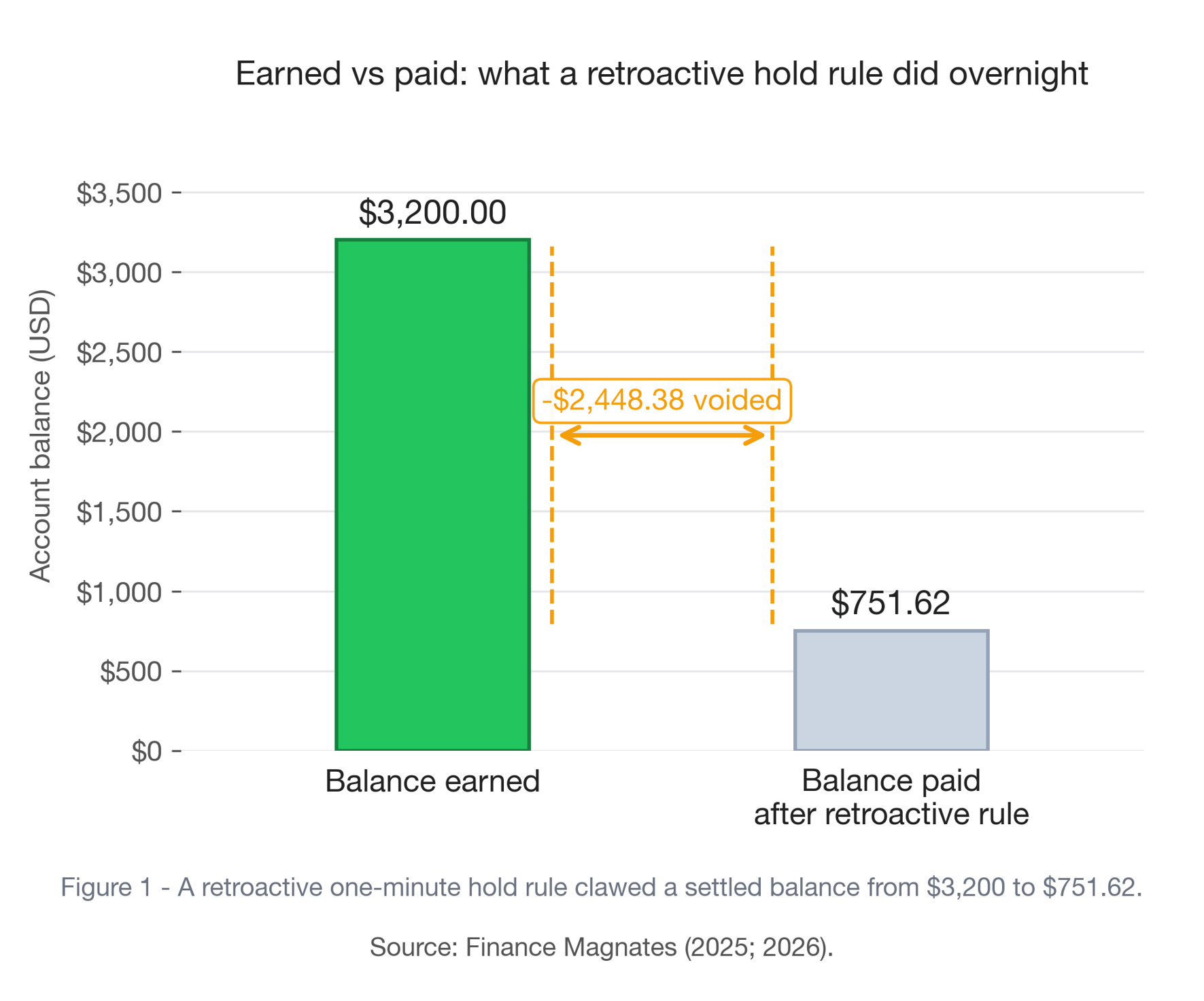
Figure 1. A settled $3,200 balance fell to $751.62 after a retroactive one-minute hold rule voided every fast-closed profit, a $2,448.38 clawback.
This is the second hidden rule we have unpacked in this series, and it belongs to the same family as the hidden-rule problem we documented when a different trader was denied a $42,936 payout despite breaking nothing. The mechanism here is different, but the lesson rhymes: the rule that costs you money is usually the one you never read.
What is a prop firm minimum hold time (and the scalping rule behind it)?
A minimum hold time is a rule that says a trade must stay open for at least a set number of seconds before it “counts.” Close faster than that floor, and the firm can flag the trade as scalping, latency abuse, or high-frequency activity, then void it. The floor is usually short, somewhere between 30 seconds and two minutes, which is exactly why it slips past so many traders. It belongs to the same category of account-limiting rules as drawdown thresholds, which is why anyone who wants to understand drawdown before prop trading should add hold-time rules to that same reading list before funding.
The logic the firm runs is mechanical. An algorithm watches how long each position is open. Anything under the threshold gets tagged. At some firms a single fast trade is fine as long as fast trades stay a minority of your activity; at others, profit from any sub-floor trade is simply deleted at payout. Either way, the strategy that triggers it is the same: closing positions quickly to capture small, repeatable moves. That is scalping, and the rule that polices it is the anti-scalping rule.
The important nuance, and the one that trips up the most people, is that “scalping” is not one thing. There is manual scalping, where a human opens and closes trades over 30 seconds to a few minutes. And there is tick scalping, latency arbitrage, and high-frequency trading, where an algorithm fires trades in milliseconds to exploit quote delays or spread gaps. Firms that “ban scalping” almost always mean the second group. The trouble starts when a blunt hold-time floor catches the first group too.
Why firms add hold-time and anti-scalping rules
Firms add these rules to filter out execution that is not really trading. The honest version of the case is reasonable: tick scalping and latency arbitrage exploit a pricing feed rather than reading a market, and high-frequency bots can fire dozens of trades a minute, faster than any human could realistically execute. One official rulebook defines high-frequency trading as exactly that, millisecond-to-second algorithmic execution, and prohibits latency trading outright. A firm covering real capital, or pricing risk on a simulated feed, has a legitimate interest in not paying out an edge that comes from a data delay rather than skill.
If the rule stopped there, few traders would object. The problem is that the same detection net that catches a latency bot also catches a discretionary trader who happens to scalp the open, or who closes a winner the instant it hits target. And because the floor is enforced by an algorithm reading trade duration, intent does not enter into it. A 25-second manual scalp and a 25-second latency exploit look identical to the timer. That is where a sensible guardrail turns into a trap, and it is why the next part matters more than anything.
The asymmetry that should scare you: losses count, profits don’t
Here is the detail that turns a hold-time rule from annoying into dangerous: at some firms, the rule only deletes your wins. Under one published funded-account rule, profit from any trade held less than two minutes (120 seconds) is invalid and removed at payout, while losses from those same sub-two-minute trades stay entirely your responsibility. Your account is not breached. The losing trades still count against you. The winning ones just quietly do not count for you.
Sit with the math. If you place ten fast trades and six win, four lose, a normal scorecard nets you ahead. Under this asymmetry, the four losses come off your balance and the six wins evaporate. You traded well and finished behind, not because the market moved against you but because the rule only swings one way (see Figure 2).
There are subtler versions of the same idea. One firm’s rulebook defines a “Quick-Strike” rule: any position closed within 30 seconds of opening is in scope, and if 30 percent or more of your profit comes from such trades, that counts as a violation. So even a profitable, disciplined scalper can cross a hidden line, not by losing, but by being too good, too fast, too often. None of this is exotic. It is written into terms that most traders skim past on the way to the funding number.
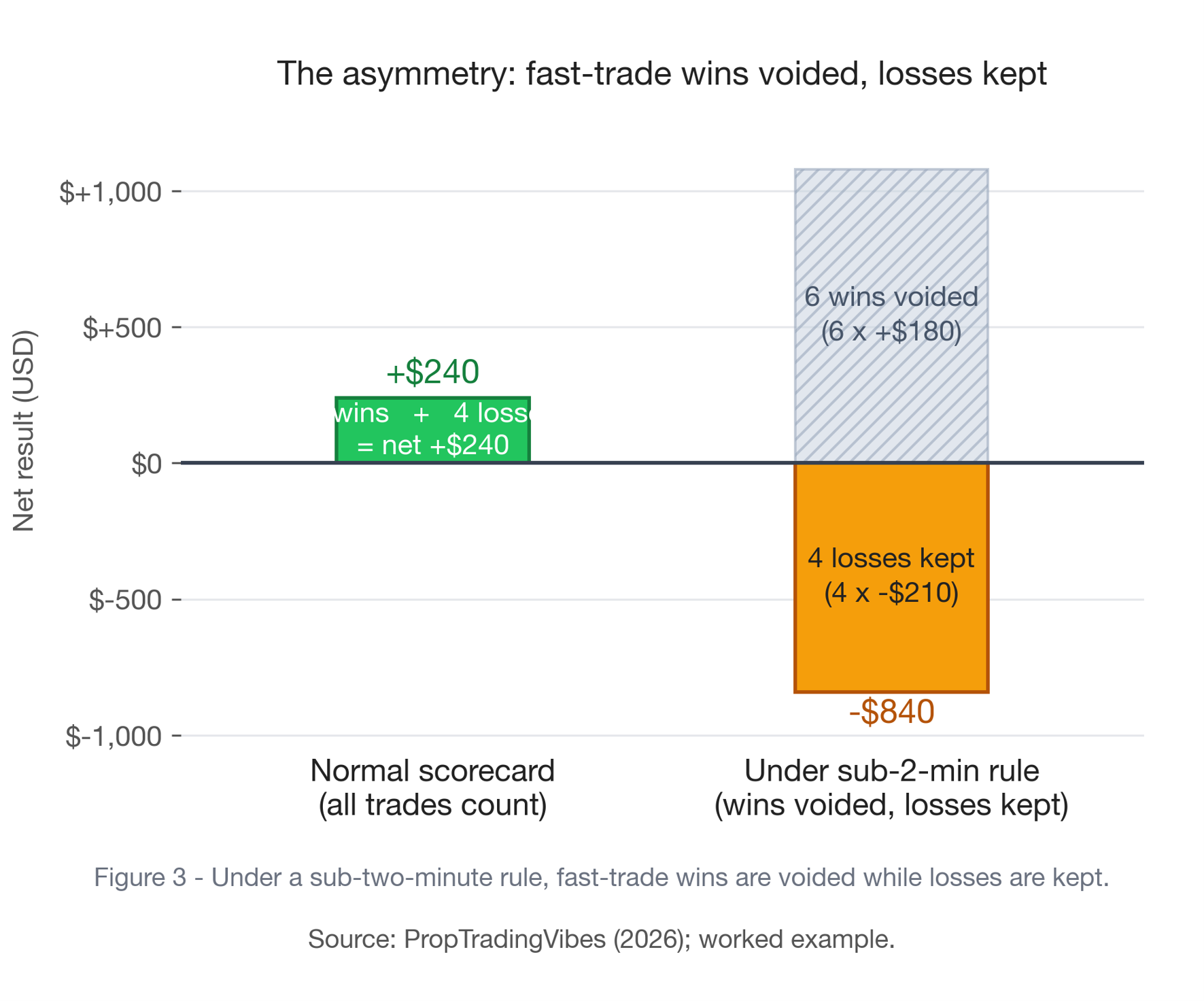
Figure 2. Under a sub-two-minute rule, a winning fast-trade record can still finish behind because profits are voided while losses are kept.
Which firms actually restrict scalping (and which don’t)
Most firms accept scalping; a minority restrict it, and a smaller minority do so in ways that can cost you profit you already earned. As of June 2026, around 22 futures prop firms openly accept scalping, and standard tick scalping (aiming for 1 to 3 ticks of price movement) is permitted at virtually every firm. The most commonly restricted variant is microscalping, the sub-second, single-tick style that looks the most like an algorithm gaming the feed. So banning “tick scalping” is genuinely not the same as banning all scalping, and aggregators that list a firm as “scalping allowed” are usually talking about the manual kind.
The floors themselves vary, and that is the practical landscape to internalise (Figure 3):
- No minimum hold time: close in two seconds or two hours, both count.
- Tick scalping banned (sub-second): manual scalping is fine; only algorithmic single-tick exits are blocked.
- A roughly 60-second floor: trades must stay open at least a minute to count.
- “50 percent of trades over one minute”: fast trades are allowed only as a minority of your activity.
- Two-minute profit void: sub-two-minute wins are deleted while losses are kept.
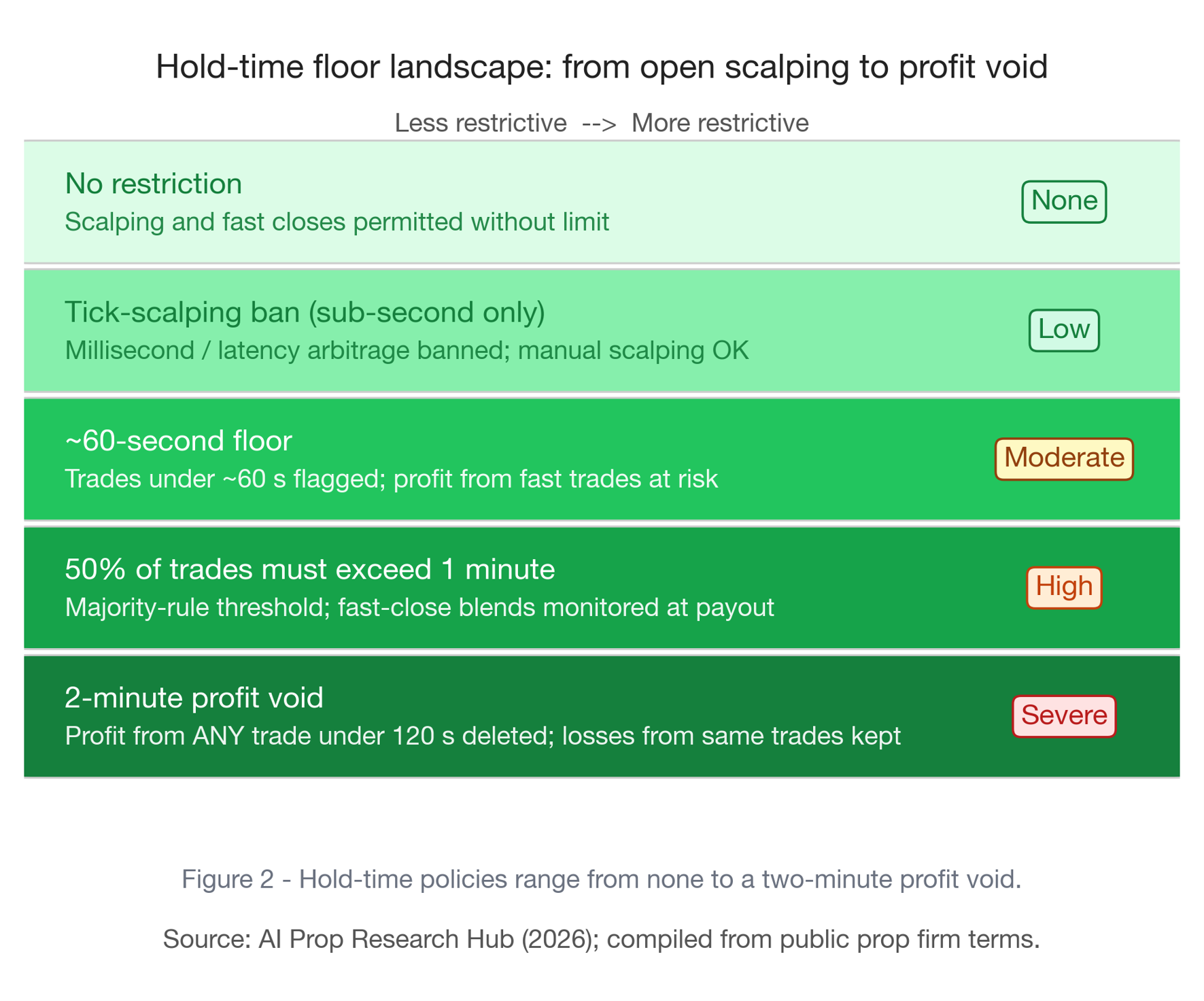
Figure 3. The hold-time floor landscape, from no restriction to a two-minute profit void.
The single number on the floor matters less than one thing the table cannot show: whether the firm can change that floor and apply it backwards. A two-minute rule you knew about going in is a constraint you can trade around. A one-minute rule introduced overnight and run against trades you already closed is something else entirely. The retroactive-change risk, not the floor itself, is the real danger, and it is the reason the cold open to this piece ended in a wind-down. This is the same reason traders increasingly weigh how prop firms manage risk, which is the safest prop firm for payouts, and which is the most reliable prop firm 2026 before they ever fund an account.
How to check before it costs you
Read the payout and strategy terms before you pay the evaluation fee, not after you pass. The rule that voids your profit lives in the fine print, and five minutes of reading beats a surprise clawback. The firms that don’t require this level of detective work are the clear-rule prop firms, but until you know which is which, here is the checklist that actually surfaces the risk:
- Search the strategy and payout terms for these exact words: “minimum hold time,” “minimum trade duration,” “tick scalping,” “HFT,” “latency,” and “Quick-Strike.” If any appear, read the surrounding clause in full, not the heading.
- Find out whether the rule is symmetric. Ask directly: if a sub-floor trade wins, is the profit voided? If it loses, is the loss kept? If losses count but profits do not, treat that as a red flag, because that is the asymmetry that quietly works against you.
- Check the order-count caps too. Some firms flag hyperactivity at a threshold like 200 trades or 2,000 server messages a day, which a busy scalper can hit without trying. Trading at intervals under five seconds is also increasingly read as high-frequency activity regardless of how you label your strategy.
- Look at the firm’s history of changing rules. Has it altered terms mid-account before, and did the change apply backwards? A firm that has retroactively invalidated settled trades once will do it again.
If it doesn’t work, meaning the terms are vague, the support reply is evasive, or you cannot get a straight answer on the profit-void question, that is your answer. Vagueness in a rulebook is not an oversight; it is room for the firm to decide later. The same diligence applies whether you are checking a prop firm challenge guide, reading a prop firm comparison guide, or learning how to pass the one-step evaluation without tripping a rule you never saw.
AI Prop has no minimum hold time and no scalping restriction
AI Prop has no minimum hold time. Close a trade in two seconds or two hours, and it counts exactly the same. There is no tick-scalping ban, no high-frequency restriction, and no latency clause waiting at payout. The homepage states it plainly: “Scalping, swing, EAs, no restrictions. Your strategy, your edge”.
That is one of six common friction rules AI Prop has removed, for a Friction Score of 0 out of 6, with the minimum hold time among them. And because payouts run on-chain, the profit you earn is mechanical: hit the number, get paid, no matter how fast your trades closed. There is no after-the-fact review surface where a settled win can be voided, which is precisely the failure mode that took $2,400 off one trader’s balance overnight. Fast trading is a strategy here, not a liability.
Frequently asked questions
What is a prop firm minimum hold time?
A minimum hold time is a rule requiring a trade to stay open for a set minimum, usually between 30 seconds and two minutes, before it counts toward your results. Close faster than the floor and the firm can flag the trade as scalping or high-frequency activity and void it. Some firms apply the floor only as a “majority of trades” threshold; others delete profit from any sub-floor trade at payout. The rule is enforced by an algorithm reading trade duration, so it does not distinguish between a manual scalp and an automated exploit. Always confirm the exact floor and whether it is symmetric before funding an account.
Is scalping allowed at prop firms?
At most firms, yes. Around 22 futures prop firms openly accept scalping as of June 2026, and standard tick scalping is permitted at virtually every firm. The confusion comes from firms that “ban scalping” while actually meaning sub-second algorithmic exploits, not manual fast trading. The safest move is to read the strategy terms rather than trust a one-word “allowed” or “banned” label, because the same firm can permit manual scalping and prohibit microscalping in the same document.
What is the difference between tick scalping and scalping?
Scalping is a broad style: opening and closing trades quickly to capture small, repeatable moves, often over 30 seconds to a few minutes by hand. Tick scalping is a narrow subset where an algorithm opens and closes within seconds, or milliseconds, to capture spread or quote-latency gaps. Most firm bans target tick scalping, latency arbitrage, and high-frequency trading, the machine-speed variants, not the manual kind. So a firm can honestly say it prohibits tick scalping while still welcoming your discretionary scalp.
Can a prop firm void my profit after the fact?
At some firms, yes, and it is the single biggest risk in this whole topic. One documented case involved a firm introducing a one-minute hold rule overnight and applying it backwards, clawing one trader’s balance from $3,200 to $751.62 and invalidating trades that were already closed. Separately, some firms void profit from sub-floor trades at payout as standard policy while keeping the losses. The defence is the same in both cases: read whether the firm can change terms mid-account, and whether profit-voiding is in the rules before you fund.
What is a typical minimum hold time floor?
Floors cluster between 30 seconds and two minutes. Common forms include a 60-second minimum, a “50 percent of trades must last over one minute” threshold, a two-minute profit-void window, and a 30-second “Quick-Strike” trigger where a violation kicks in if 30 percent or more of profit comes from sub-30-second trades. Many firms have no minimum hold time at all. The number itself matters less than two things: whether profit-voiding is symmetric with losses, and whether the firm can change the floor retroactively.
How do I check a firm’s hold-time rule before I buy?
Open the strategy and payout terms and search for “minimum hold time,” “minimum trade duration,” “tick scalping,” “HFT,” “latency,” and “Quick-Strike”. Read the full clause around any hit. Then confirm three things: whether sub-floor wins are voided while losses are kept, whether there is an order-count cap you might hit, and whether the firm has changed rules retroactively before. If the terms are vague or support will not answer the profit-void question directly, treat the silence as the answer and walk.
Does AI Prop have a minimum hold time?
No. AI Prop has no minimum hold time, no tick-scalping ban, and no high-frequency or latency restriction. A trade closed in two seconds counts the same as one held for two hours. It is one of six common friction rules the firm has removed, for a Friction Score of 0 out of 6. Payouts run on-chain, so profit is mechanical, hit the number and get paid, with no after-the-fact review that could void a settled win. Scalping, swing trading, and EAs are all permitted.
Start trading where fast is just fast
If you trade fast and you are tired of reading the fine print for a rule that might delete your wins, AI Prop has no minimum hold time, no scalping restriction, and on-chain payouts that cannot be clawed back after the fact. See how it works at aiprop.com.